How Allergy Voyage Saves a Dozen Hours a Week Monitoring 100+ Menus with Visualping
By Kayla Zhu
Updated September 8, 2026
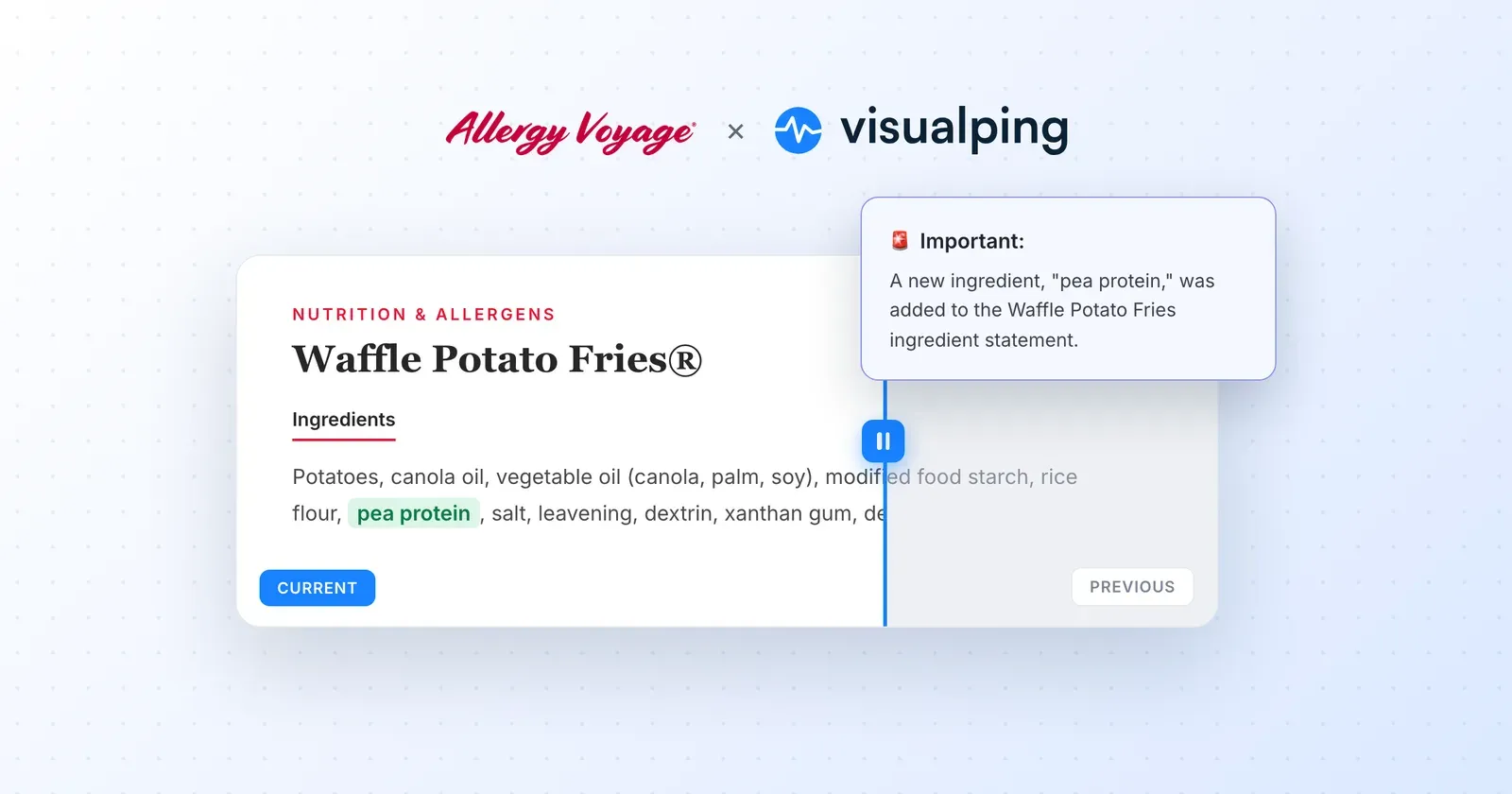
The food allergy safety platform retired its manual spreadsheet tracker and now catches single-line ingredient changes across more than 100 national retail menus automatically.


| Company | Allergy Voyage |
| Industry | Food allergy safety / food service technology |
| Stage | Early-stage startup, founded at Arizona State University |
| Use case | Ingredient and allergen change monitoring across national retail menus |
Allergy Voyage hosts restaurant menus for people with food allergies. Diners filter any menu on the platform by their specific dietary needs and see exactly which allergens and ingredients are in every dish. That promise only holds if every ingredient line is current.
Those menus can change any day, without an announcement or changelog. A brand rewrites one ingredient line, a recall pulls a product, or a seasonal launch like pumpkin spice redraws dozens of menus overnight across every location Allergy Voyage covers. Somewhere on those campuses, a student with a severe food allergy is about to pull up a menu and trust the data behind it.
For months, that trust rested on Allergy Voyage interns working through an Excel spreadsheet, checking national menu pages one at a time.
About Allergy Voyage
Tristan Tierce and his co-founder Jonathan Janosky have both lived with severe dietary restrictions their whole lives. As university students, they started Allergy Voyage to solve their own problem: easier communication between diners with food allergies and the food service providers who want to serve them safely.
Diners browse the platform free. On the other side, restaurants and campus dining programs get an interactive menu management platform for tracking ingredients, flagging dishes for potential allergens, and keeping their menus accurate. Allergy Voyage now works with colleges nationally and is expanding into restaurants.
For their users, an unnoticed ingredient change is a health risk, and menu accuracy is the product.
The problem with checking menus by hand
Allergy Voyage's collegiate clients carry national retail brands like Starbucks and Chick-fil-A, whose menus update against national databases. Most days nothing changes. Then, a seasonal launch lands and any number of new items and ingredient lists can drop at once.
To keep up with these changes, the team built an internal tool they called the organization menu timeline tracker.
In practice, it was an Excel spreadsheet listing every retail menu they covered, when it was last updated, when the next update was expected, and when someone needed to check it again. Interns worked through the list by hand, on internal reminders, week after week.
"It was brutal for sure," Tierce says.
"It was just being aware that these updates were happening and adapting to them as soon as we could. That was the manual part of it."
Tristan Tierce, CEO and co-founder, Allergy Voyage
Updating the Allergy Voyage platform once a change was found was the easy part. The hard part was knowing a change had happened at all. Every gap between checks was a window where a menu could drift out of date, and for people with severe allergies, stale allergen data is a safety risk.
How an intern's research project replaced the spreadsheet
The team knew the tracker was a stopgap. Building their own change detection system felt like a project they didn't have the bandwidth for, so they gave an intern, Katie Irons, a research task alongside her tracker duties.
She was already watching for FDA and brand allergen recalls, another stream of scattered updates that had to be caught fast. Her project was simple: find a better way to do both.
Her research led to Visualping. The team set an internal experiment, a fixed number of menus over a fixed period, to test whether automated monitoring could keep them as current as manual checking did. A Visualping team member walked them through setup and plan options, and the trial grew into the wider system they run today.
"What started from, hey, can we keep up to date with these recalls, became a much wider use case for our company."
Tristan Tierce, CEO and co-founder, Allergy Voyage
How Allergy Voyage monitors 100+ menus today
The Allergy Voyage team now monitors north of 100 menu pages with Visualping. On each page they set what they call flagpoles, monitors aimed at high-priority signals, including indicator dishes that reveal wider menu changes, nutrition and allergen documentation, and ingredient statements.
When a page changes, Visualping's webhook alerts post the change into the team's Microsoft Teams channels. The team then went a step further and built an internal review dashboard fed by those webhooks.
Every detected change lands there with a summary of what Visualping caught, the changed content highlighted, and an accept-or-reject decision for updating Allergy Voyage's own menu data.
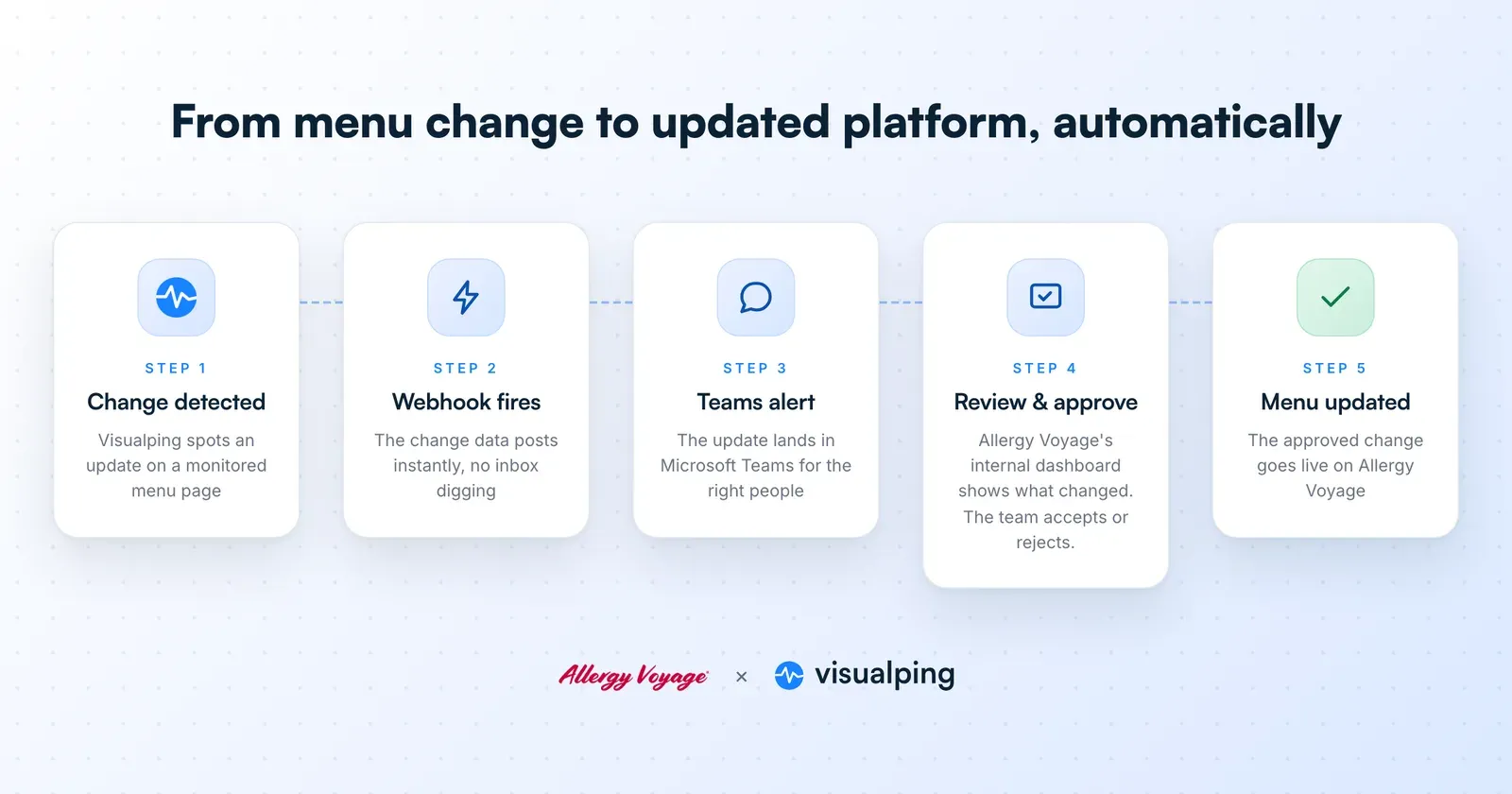
The dashboard also gives them a feedback loop. Interns analyzed several weeks of aggregated alerts to see which flagpoles were hitting and which needed tuning, so the monitoring setup keeps getting sharper.
Tierce describes what it looks like now: the team opens the dashboard to 100+ Visualping notifications, sizes the work at four hours, and schedules every menu update in one pass.
What used to be an open-ended checking rotation is now a queue the team can see, size, and schedule.
The results
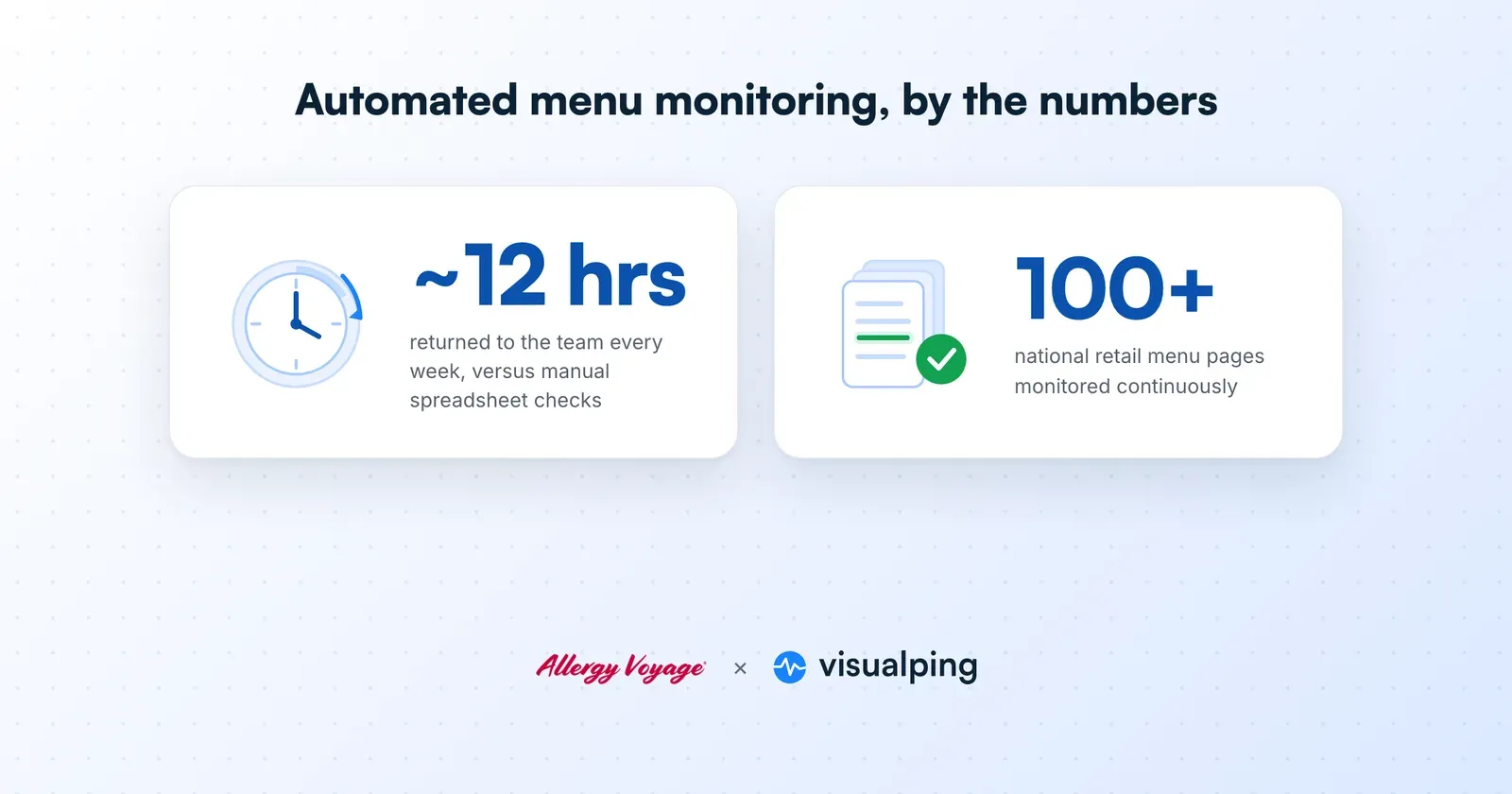
More than 100 menu pages now sit under continuous monitoring, the open-ended checking rotation that filled interns' weeks is a scheduled review queue, and Tierce puts the time returned to his team at about a dozen hours every week.
"It has at least saved us probably a dozen hours a week. Legitimately, it has been a big time saver."
Tristan Tierce, CEO and co-founder, Allergy Voyage
That figure accounts for the setup cost. The team spent real hours wiring webhooks into Teams and building its review dashboard, and Tierce counts the investment as repaid: "The effort that we've put into it, we've seen come out of it in terms of time saved."
Speed and coverage changed too. The team caught menu changes before Visualping; Tierce is clear about that. The difference is that they now catch them "so quickly and at so much scale" that the size of the monitoring list stopped being the constraint.
One catch shows the stakes. Chick-fil-A added pea protein to its waffle fries earlier this year. In a long ingredient list, the addition took up less than one line. Most diners would never notice. For a small community of people with a pea protein allergy, it is exactly the information Allergy Voyage exists to surface.
"My team would have put in the effort to catch it, but Visualping makes it so much easier that we don't have to go through every single item. We know, hey, this is something that has changed since the last time we checked it, here's where it's located."
Tristan Tierce, CEO and co-founder, Allergy Voyage
Here's an example of a live catch from the same kind of monitor. Overnight on September 1, Domino's added "Detroit Style Crust" to its allergen chart, and Visualping's AI summary flagged the new entry and the allergen markers that came with it.
The payoff is confidence at scale.
"If someone were to knock on our door and say, hey, we need you to take a look at 50 new retail menus, that would not make me as concerned as it would have before Visualping," Tierce says.
What's next for Allergy Voyage
Allergy Voyage wants to work with anyone who puts food on plates: universities, cruise lines, hotels, and restaurants. As more retail locations come onto the platform, the team plans to keep Visualping on menu monitoring duty, and may circle back to its original recall-tracking idea as a second use case.
His advice for anyone still checking pages by hand at scale echoes what kept his own team on board.
"I really would harp on how communicative the sales and support team has been up to this point. And that is why we've really continued to work with [Visualping]."
Tristan Tierce, CEO and co-founder, Allergy Voyage
Want to monitor web changes that impact your business?
Sign up with Visualping to get alerted of important updates from anywhere online.
Kayla Zhu
Kayla is the Public Relations Specialist at Visualping and manager of Visualping's Journalist Program. She manages Visualping's media relations, content marketing, and social media.
More articles by Kayla Zhu