The Best Compliance Monitoring Software in 2026
Updated April 9, 2026

The Best Compliance Monitoring Software in 2026
Regulatory obligations keep multiplying. Across a sample of Visualping's 2M+ users, nearly 11,000 chose "Laws & Regulations" as their primary reason for monitoring websites during onboarding, making it one of the top use cases on the platform. Regulations change constantly, and managing compliance manually (shared drives, spreadsheet trackers, calendar reminders) breaks down fast.
Compliance monitoring software automates the surveillance, evidence collection, and reporting that keeps your organization aligned with regulatory standards, industry frameworks, and internal policies. Some platforms track internal controls and audit evidence. Others watch external regulatory changes across government websites. Most organizations need both.
This guide compares nine tools across those use cases, from full GRC platforms to website change detection, so you can match the right software to your compliance workflow.
What to Look for in Compliance Monitoring Software
Pin down your evaluation criteria before comparing specific tools. The right platform depends on your industry, team size, framework count, and whether you need internal control monitoring, external regulatory tracking, or both.
Framework coverage. How many frameworks does the tool support out of the box? If you're juggling SOC 2 alongside HIPAA, GDPR, and ISO 27001, you need pre-built mappings. Manual framework configuration adds months to deployment.
Automation depth. The line between a compliance tracking tool and a compliance monitoring tool is automation. Look for continuous control testing, automated evidence collection, and real-time alerting the moment something falls out of compliance.
Integration coverage. Your compliance software needs to plug into the systems it monitors: cloud infrastructure (AWS, GCP, Azure), identity providers (Okta, Azure AD), HR systems, code repos, and ticketing tools. Fewer manual data entry points means less audit prep overhead.
Reporting and audit readiness. When auditors arrive, can the platform generate the evidence packages they need? Look for pre-built report templates, audit trail exports, and continuous monitoring dashboards that prove compliance posture at any point in time.
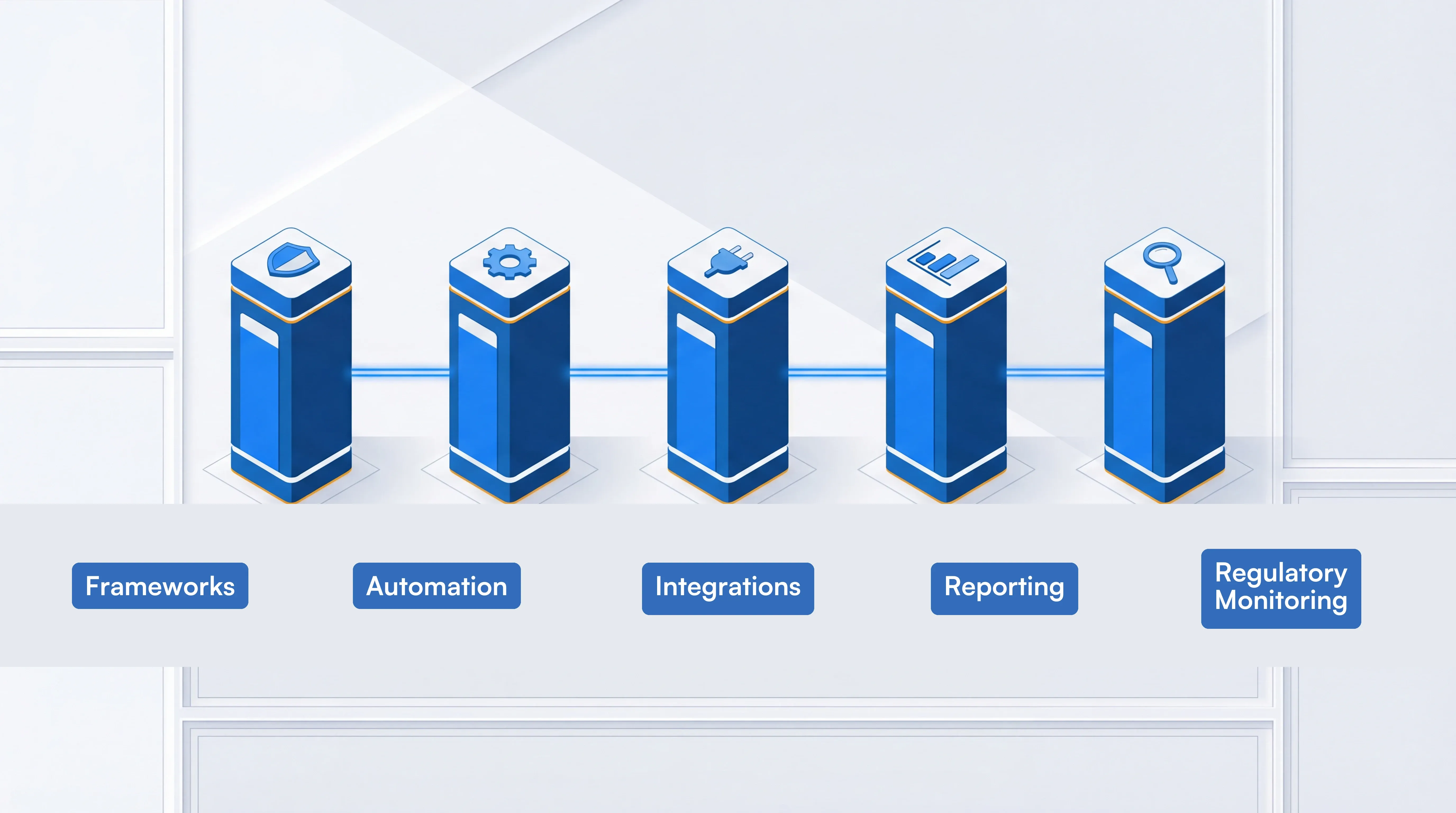
External regulatory monitoring. Internal controls are only half the picture. Regulations change on government websites, in Federal Register notices, and through industry body announcements. Tools that track regulatory changes across multiple websites close the gap between what your controls do and what regulators currently require.
Editor's note: Visualping is our product. For managing internal compliance programs across frameworks like SOC 2, ISO 27001, and HIPAA with automated evidence collection and audit preparation, Hyperproof and Vanta are purpose-built for that. For mid-market compliance automation with continuous control monitoring, Drata is the stronger choice. Visualping monitors external web pages for regulatory text changes; it does not manage compliance workflows, map controls to frameworks, or produce audit-ready reports. Review the limitations noted for each tool, including ours.
9 Best Compliance Monitoring Software Tools for 2026
1. Visualping: Best for Monitoring External Regulatory Changes
Visualping is a website change monitoring tool that watches any web page and alerts you the moment something updates. For compliance teams, that means automated monitoring of regulatory websites, government portals, and industry body announcements, no more manually checking dozens of pages every week.
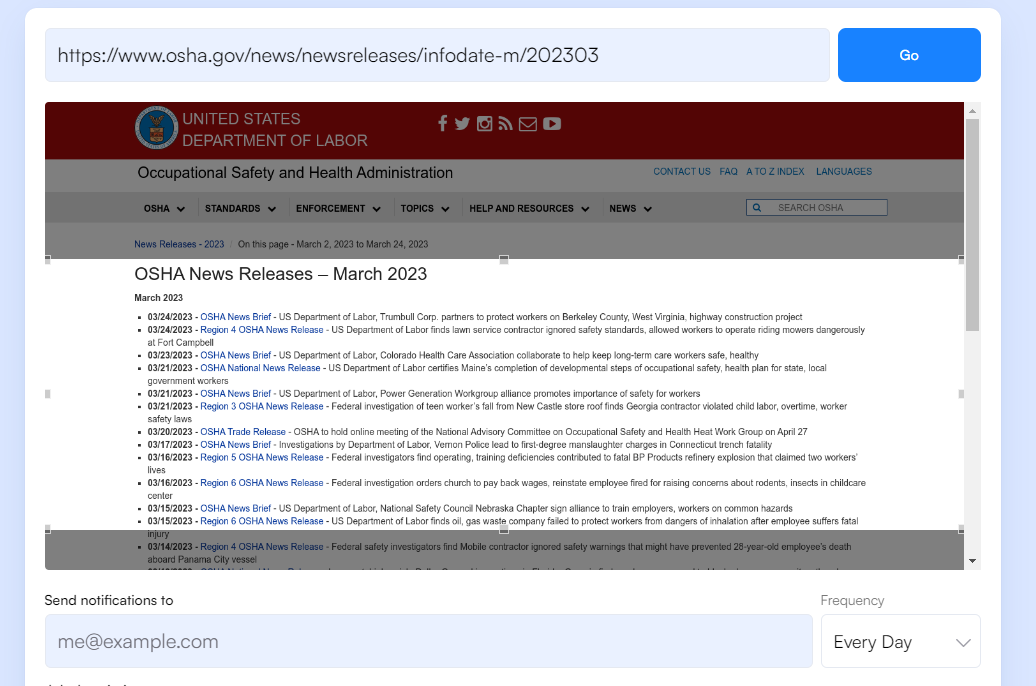
How it works for compliance: Select any web page, or just one section of it. Visualping checks the page on your schedule (every 5 minutes to once a week) and sends an alert when the content changes. Each alert includes an AI-generated summary that explains what changed in plain English, flagged as IMPORTANT or routine, plus a timestamped visual diff you can save as evidence.
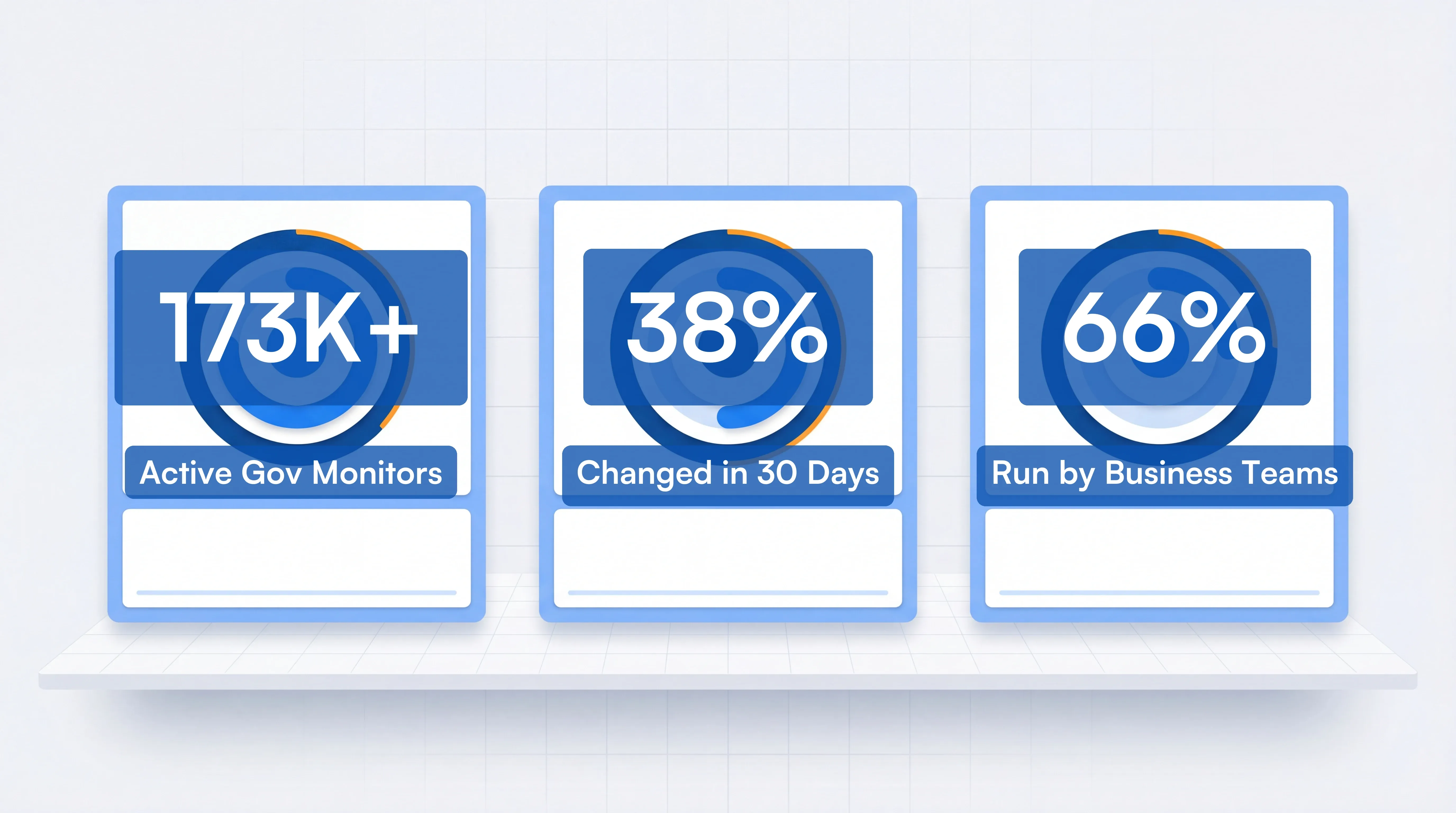
The data behind it: Over 173,000 active monitors on our platform track government and regulatory URLs (.gov, sec.gov, fda.gov, osha.gov, europa.eu, and similar domains). Nearly 38% of those pages detected a change in the last 30 days alone. Two-thirds of compliance monitors are run by business teams, not individuals. Regulatory monitoring is an organizational function, not a side project.
Key compliance use cases:
- Tracking regulatory changes across OSHA, FDA, SEC, FCA, and other government portals
- Monitoring terms of service changes from vendors and partners for contract compliance
- Watching industry body websites (FINRA, ISO, PCI SSC) for framework updates
- Monitoring SEC filings and EDGAR updates for financial compliance
Pricing: Free plan (5 pages, 150 checks/month). Paid plans from $10/month for individuals to $100/month for business teams. Enterprise and Solutions pricing available for larger deployments.
Best for: Compliance teams that need to monitor external regulatory sources alongside their internal GRC platform.
Limitations: Visualping monitors external web content, not internal controls or evidence collection. It pairs well with a GRC platform (like those below) that handles the internal compliance workflow.
2. Hyperproof: Best for Multi-Framework Compliance Programs
Hyperproof is a compliance operations platform built for organizations juggling multiple frameworks at once. Its Hypersync technology automates evidence collection from connected systems, stripping out the manual grind of gathering audit artifacts.
Key features:
- Pre-built control mappings for SOC 2, ISO 27001, HIPAA, PCI DSS, CMMC, NIST 800-171, FedRAMP, and 100+ additional frameworks
- Continuous monitoring with automated evidence collection
- Cross-framework control mapping that eliminates redundant testing across overlapping standards
- Risk register with configurable assessment workflows
Pricing: Custom pricing, typically starting in the $15,000-$30,000/year range for mid-market organizations.
Best for: Organizations managing 3+ compliance frameworks that need to eliminate redundant control testing.
Limitations: The platform requires upfront configuration effort. Organizations with a single framework may find it overbuilt for their needs.
3. Vanta: Best Integration Network for Cloud-Native Companies
Vanta has built the broadest integration library in the compliance monitoring software space, with 300+ native connections to cloud infrastructure, identity providers, HR systems, and developer tools. Its trust center feature lets organizations publicly share their compliance posture with customers.
Key features:
- 300+ integrations for automated evidence collection
- Continuous control monitoring with real-time gap detection
- Trust center for publicly sharing security posture
- AI-powered gap analysis and remediation guidance
- SOC 2, ISO 27001, HIPAA, PCI DSS, GDPR, SOX ITGC, and NIST AI RMF support
Pricing: Starting around $10,000/year for small teams, scaling with company size and framework count.
Best for: SaaS companies and tech startups pursuing SOC 2 or ISO 27001 where speed to compliance matters.
Limitations: CMMC and defense-specific framework coverage is more limited than some competitors. Premium features like the AI compliance copilot require add-on pricing.
4. Drata: Best Automation for Mid-Market Organizations
Drata competes directly with Vanta and differentiates through its customizable workflow engine and strong compliance-as-code capabilities. Its risk management module is more mature than most competitors at the same price point.
Key features:
- 200+ integrations with continuous automated monitoring
- Customizable compliance workflows and control frameworks
- Compliance-as-code capabilities for engineering-heavy teams
- 20+ framework support including SOC 2, ISO 27001, HIPAA, CMMC, NIST 800-53
Pricing: Starting around $12,000/year. Generally priced below Vanta for comparable coverage.
Best for: Mid-market companies with multiple framework requirements and engineering teams that want compliance automation in their existing workflows.
Limitations: Fewer integrations than Vanta (200+ vs 300+). Newer platform with a smaller auditor network.
5. Optro (formerly AuditBoard): Best for Enterprise Audit and SOX Compliance
Optro, formerly known as AuditBoard, rebranded in March 2026 to reflect its expanded scope beyond audit into full GRC. More than 50% of the Fortune 500 use the platform. Optro was named a Leader in the 2025 Gartner Magic Quadrant for GRC Tools.
Key features:
- Connected risk platform spanning internal audit, SOX compliance, risk management, and ESG
- AI-powered GRC capabilities with agentic risk management
- Cross-functional collaboration tools that connect first, second, and third lines of defense
- Recent acquisition of FairNow adds AI governance capabilities
Pricing: Enterprise pricing (contact for quote). Positioned for large organizations with complex audit and compliance structures.
Best for: Large enterprises in heavily regulated industries (banking, insurance, pharmaceuticals) that need SOX compliance, internal audit, and risk management on a single platform.
Limitations: Enterprise-focused pricing puts it out of reach for small and mid-market teams. Implementation timelines can extend several months for complex deployments.
6. LogicGate Risk Cloud: Best No-Code GRC Platform
LogicGate Risk Cloud provides a no-code GRC platform where compliance teams can build custom workflows, risk registers, and assessment processes without developer support.
Key features:
- No-code workflow builder for custom compliance processes
- Configurable risk registers and assessment frameworks
- Integrations with Gmail, Jira, ServiceNow, Slack, and other workplace tools
- Support across software development, financial services, telecommunications, banking, insurance, healthcare, and energy sectors
Pricing: Custom pricing based on modules and user count.
Best for: GRC teams that want flexibility to build compliance workflows tailored to their specific processes without relying on professional services.
Limitations: The flexibility of a no-code platform means more upfront configuration work compared to pre-built solutions.
7. MedTrainer: Best for Healthcare Compliance
MedTrainer is purpose-built for healthcare compliance, combining credentialing, training, and compliance management in a single platform designed for medical practices and healthcare systems.
Key features:
- Incident reporting and investigation workflows
- Policy and document management with version control
- Equipment management and safety plan templates
- Dedicated HIPAA and OSHA compliance templates
- Credentialing management for healthcare staff
- Contract management for vendor compliance
Pricing: Custom pricing based on organization size and module selection.
Best for: Healthcare organizations that need compliance training and management in one platform, particularly those managing HIPAA, OSHA, and credentialing obligations.
Limitations: Healthcare-specific. Organizations in other regulated industries will need a general-purpose GRC platform.
8. StandardFusion (now part of Wolters Kluwer TeamMate): Best for IT Security Compliance
StandardFusion is a GRC platform focused on IT security compliance, acquired by Wolters Kluwer in January 2026 and now integrated into the TeamMate audit and assurance platform. The combined platform creates a unified system for audit, risk, and compliance.
Key features:
- Risk management with qualitative and quantitative risk assessment
- Audit management with evidence collection and tracking
- Compliance management for documenting and tracking regulatory protocols
- Vendor management with third-party risk questionnaires and assessments
- Policy management with approval workflows and version control
- Library of 150+ pre-built compliance framework mappings
Pricing: Custom pricing through Wolters Kluwer. Contact for current availability as the integration with TeamMate evolves.
Best for: IT security and compliance teams already in the Wolters Kluwer platform, or organizations that want audit and GRC capabilities on a single platform.
Limitations: The Wolters Kluwer acquisition means the product roadmap is evolving. Organizations evaluating StandardFusion should confirm current feature availability and integration timeline with TeamMate.
9. Sprinto: Best for Startups on a Budget
Sprinto targets small and mid-sized businesses with a more affordable entry point than Vanta or Drata, while maintaining strong continuous monitoring capabilities and fast time-to-compliance.
Key features:
- Continuous control monitoring with real-time compliance status
- Automated evidence collection with deep cloud integrations
- Pre-built compliance programs for SOC 2, ISO 27001, HIPAA, GDPR, and PCI DSS
- Built-in security training and policy management
Pricing: More affordable than Vanta or Drata, with pricing scaled for smaller organizations.
Best for: Startups and SMBs pursuing their first compliance certification who need speed and simplicity at a reasonable price.
Limitations: Less suited for large enterprises with complex, multi-jurisdictional compliance requirements.
Compliance Monitoring Software: Comparison Table
| Tool | Primary Use Case | Best For | Framework Coverage | Starting Price |
|---|---|---|---|---|
| Visualping | External regulatory monitoring | Tracking government and industry website changes | Any (monitors the source) | Free, from $10/mo billed annually |
| Hyperproof | Multi-framework compliance | 3+ overlapping frameworks | 100+ frameworks | ~$15K/year |
| Vanta | Cloud compliance automation | SaaS/tech companies | SOC 2, ISO, HIPAA, GDPR, 10+ | ~$10K/year |
| Drata | Compliance-as-code | Engineering-heavy mid-market | SOC 2, ISO, HIPAA, CMMC, 20+ | ~$12K/year |
| Optro | Enterprise audit and SOX | Fortune 500, regulated enterprise | SOX, SOC, risk, ESG, AI governance | Enterprise (contact) |
| LogicGate | Custom GRC workflows | Teams wanting no-code flexibility | Configurable | Custom |
| MedTrainer | Healthcare compliance | Medical practices, health systems | HIPAA, OSHA, credentialing | Custom |
| StandardFusion | IT security GRC | Security teams, Wolters Kluwer users | 150+ frameworks | Custom |
| Sprinto | Fast first certification | Startups, SMBs | SOC 2, ISO, HIPAA, GDPR, PCI | Budget-friendly |
How to Choose the Right Compliance Monitoring Software
Start with what you actually need to monitor.
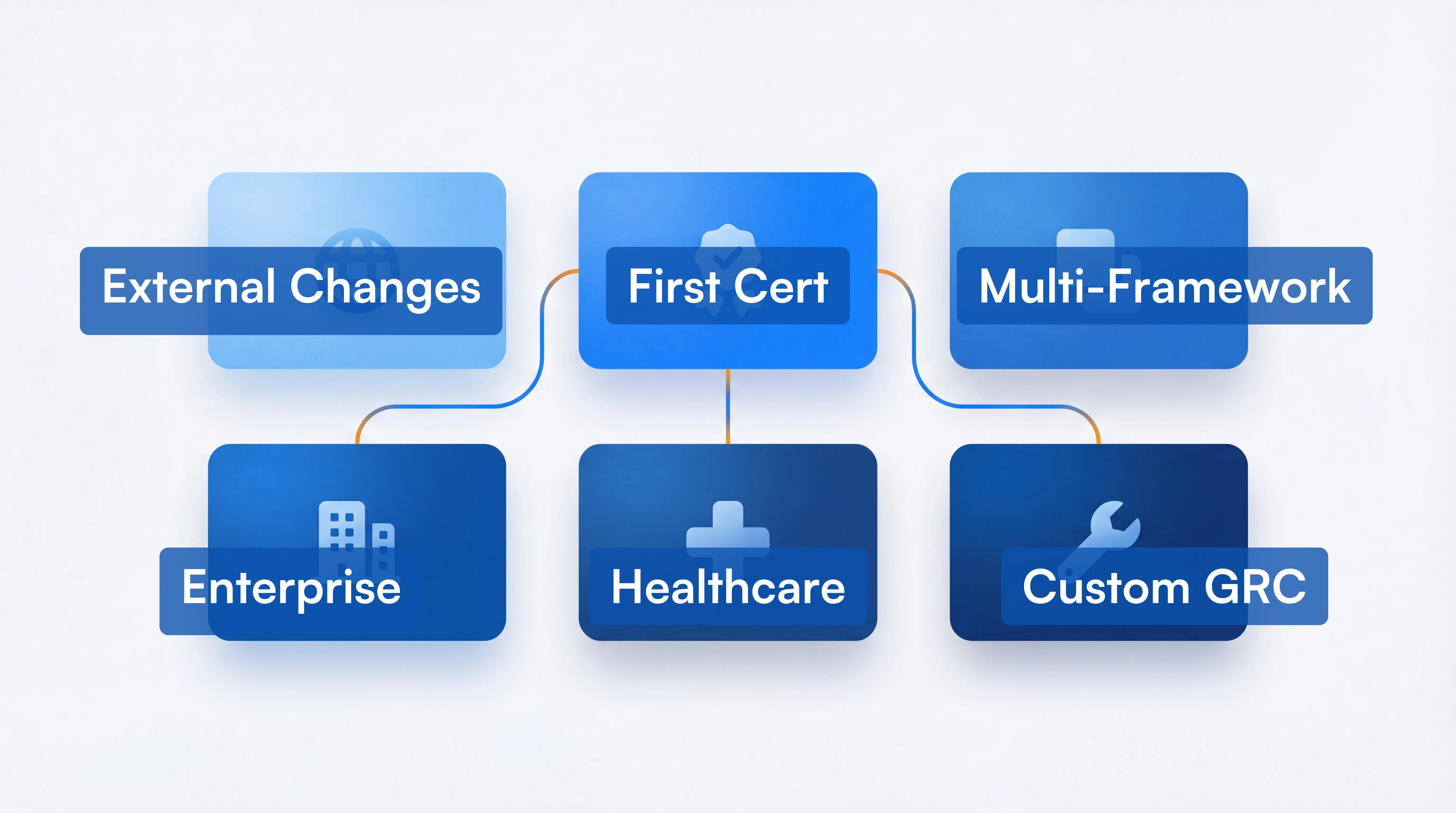
If you need to monitor external regulatory changes: Start with Visualping. Government websites, regulatory portals, and industry body pages change without warning. Among the 173,000+ government URL monitors on our platform, 37% check every 5 to 60 minutes and 61% check hourly to daily. When nearly 4 in 10 regulatory pages change every month, manual checking doesn't scale. Pair Visualping with a GRC platform for internal controls.
If you need to automate internal controls for a first certification: Vanta, Drata, or Sprinto will get you to SOC 2 or ISO 27001 fastest. Choose based on your budget, integration requirements, and team size.
If you manage 3+ compliance frameworks: Hyperproof's cross-framework control mapping eliminates redundant testing. The upfront configuration investment pays off when you stop duplicating evidence collection across overlapping standards.
If you are a large enterprise with SOX obligations: Optro's connected risk platform handles the complexity of Fortune 500 audit and compliance programs.
If you need healthcare-specific compliance: MedTrainer combines credentialing, training, and compliance management in a single healthcare-focused platform.
If you want maximum flexibility: LogicGate's no-code platform lets you build compliance workflows that match your exact processes. More work upfront, but more control over the result.
For most organizations, the answer is a combination: an internal compliance platform paired with external regulatory monitoring that tracks the sources those regulations come from.
Frequently Asked Questions
What is compliance monitoring software?
Compliance monitoring software automates the tracking, evidence collection, and reporting required to maintain adherence to regulatory standards, industry frameworks, and internal policies. It replaces manual processes like spreadsheet trackers and periodic audits with continuous compliance monitoring and real-time alerting. For a deeper explanation, see our complete guide to compliance monitoring.
How much does compliance monitoring software cost?
Costs range widely. Website monitoring tools like Visualping start with a free plan and scale from $10/month billed annually. Cloud compliance platforms like Vanta and Drata typically start at $10,000-$15,000/year. Enterprise GRC platforms like Optro and MetricStream can run $50,000-$500,000/year depending on scope and deployment size.
Can one tool handle all compliance monitoring needs?
Most organizations use at least two compliance monitoring software tools: one for internal controls and evidence collection (like Hyperproof, Vanta, or Drata) and one for external regulatory monitoring (like Visualping). Internal platforms automate audit preparation, while external monitoring tools track the regulatory changes your compliance program needs to respond to.
What is the difference between compliance monitoring and compliance management?
Compliance monitoring is the continuous surveillance of controls, regulations, and obligations. Compliance management is the broader discipline of designing, implementing, and maintaining a compliance program. Monitoring is one component of management, focused specifically on detection and alerting rather than program design, training, or remediation.
How do I monitor regulatory changes across multiple jurisdictions?
Multi-jurisdictional monitoring requires watching regulatory websites across every jurisdiction where you operate. Enterprise regulatory intelligence platforms (CUBE, Ascent) specialize in this but can cost $30,000-$500,000/year. A more accessible approach is setting up website monitors on each regulatory agency's page and receiving change alerts by email or webhook. For financial compliance, this means monitoring bodies like the SEC, FCA, FINRA, and relevant central banks.
What compliance frameworks does monitoring software typically support?
The most commonly supported frameworks include SOC 2, ISO 27001, HIPAA, PCI DSS, GDPR, SOX, CMMC, NIST 800-53, NIST CSF, FedRAMP, and CCPA. Enterprise platforms support 100+ frameworks. The number of pre-built framework mappings determines how much manual configuration your team needs to do during implementation.
Keep Your Compliance Monitoring Current
This space moves fast. Since this article was first published in 2023, AuditBoard rebranded to Optro, StandardFusion was acquired by Wolters Kluwer, and Sprinto, Drata, and Vanta have each matured into serious contenders.
Whatever you choose for internal compliance, regulatory change management starts with knowing when the rules change. Visualping monitors the web pages where those changes appear first.
Want to monitor web changes that impact your business?
Sign up with Visualping to get alerted of important updates from anywhere online.
Eric Do Couto
Eric Do Couto is the Head of Marketing at Visualping. He leads content strategy, growth operations, and brand positioning for website change detection.
More articles by Eric Do Couto