G2 Review Monitoring Automation: Track Competitor Sentiment
Updated February 24, 2026
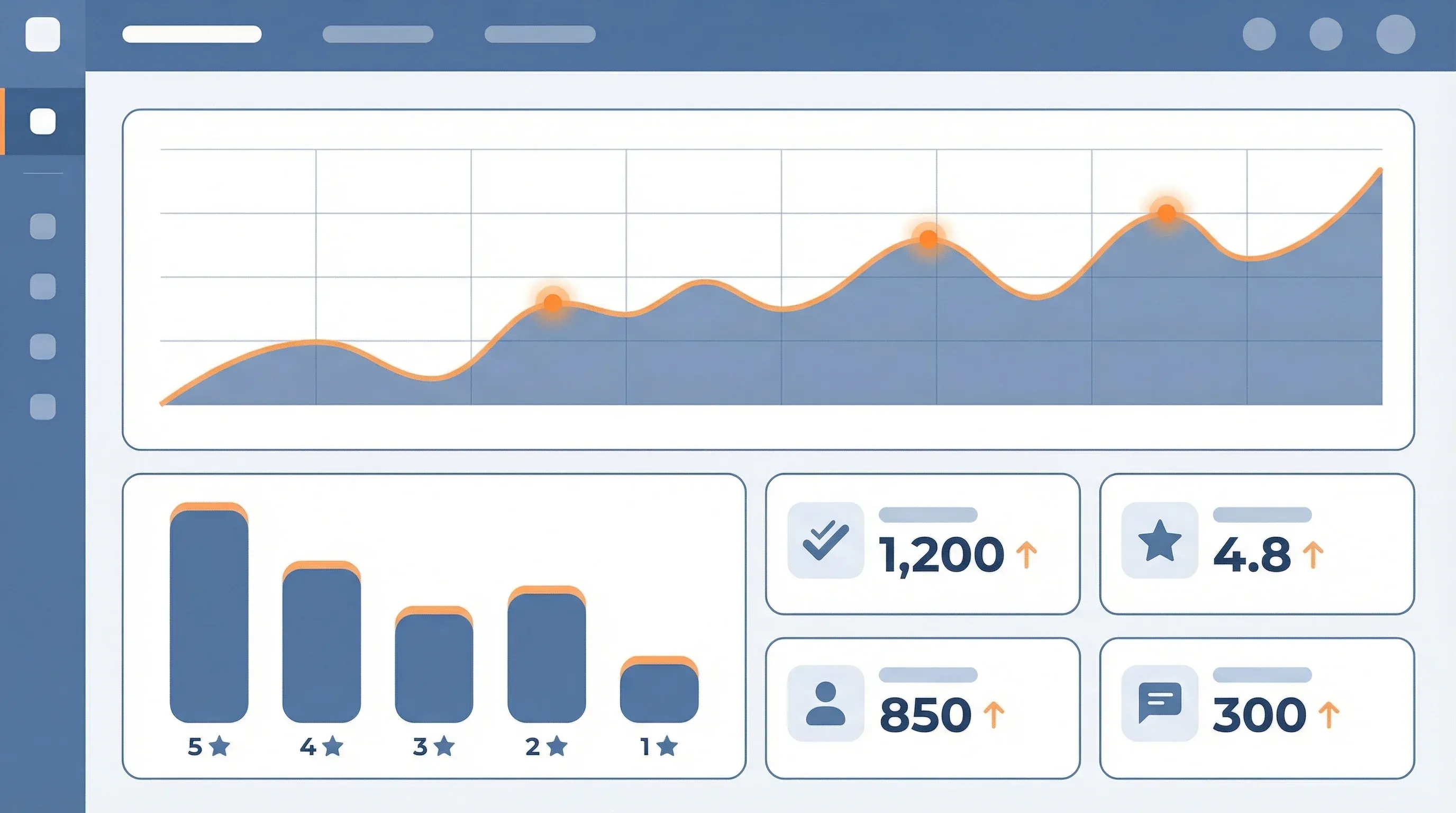
Automation at a glance
What it does: Monitors competitor review pages on G2 and Capterra for new reviews, performs AI-powered sentiment analysis and theme extraction, and generates monthly competitive intelligence digests.
Tools: Visualping (trigger) + Zapier (orchestration) + Visualping AI (analysis) + Airtable (storage) + Slack/Email (delivery)
Workflow: New reviews detected -> Reviews scraped and stored -> Monthly AI sentiment analysis -> Competitive digest generated -> Leadership report distributed -> Action tasks created
Setup time: ~20 minutes | Ongoing effort: 10 min per monthly digest
Part of the Automation Workflows Series — 12 ready-to-use workflows for Sales, Marketing, Partnerships, Engineering, and Legal teams.
Buyers read reviews before they talk to you. They check G2, Capterra, and Gartner to validate claims about competitors. They note common themes: "fast implementation," "poor support," "expensive," "integrates with everything."
But you're not doing the same. Your understanding of what is competitive intelligence is months-old analyst reports and educated guesses. Meanwhile, real customers are leaving real reviews that reveal what's actually sticky about competitors and what's falling apart.
Review site data is the loudest voice in the buyer's journey. It's also the easiest to ignore because monitoring it manually is tedious: logging into G2, scrolling through reviews, writing down themes, noting sentiment. You do this once a quarter if you're diligent. By month 4, you don't know what changed.
This post covers how to set up G2 review monitoring automation to catch sentiment shifts, identify emerging strengths and weaknesses, and understand what's actually driving buyer perception of your competitive set.
Why review data beats market intelligence
Here's the hierarchy of competitive intelligence:
Weakest: What competitors say about themselves (messaging, marketing) Stronger: What analysts say about competitors (Gartner, Forrester reports) Strongest: What customers say about competitors (reviews, case studies, testimonials)
Reviews are the strongest signal because they're unfiltered and motivated by real usage. According to G2's 2024 Buyer Behavior Report, 92% of B2B buyers are more likely to purchase after reading a trusted review, and 68% consult review sites before engaging with a vendor's sales team.
When a G2 review says "implementation took 4 months," that's a customer's lived experience. When 3 reviews mention it, it's a pattern. When 12 reviews mention it, it's a positioning angle your sales team should own ("we implement in 2 weeks").
But here's what happens: You know competitors have reviews. You occasionally pop over to G2, sort by "most critical," and skim a few. You catch the egregious stuff but miss the patterns. You don't know if they're improving (reviews getting better) or declining (reviews getting worse). You don't know what new complaints are emerging.
G2 review monitoring automation changes this. Instead of occasional spot-checking, you get monthly digests that show:
- Sentiment trend (are reviews improving or declining?)
- Emerging themes (what new complaints are customers raising?)
- Strengths that are holding (what do customers consistently praise?)
- Weaknesses that are appearing (what new problems are surfacing?)
This intelligence feeds directly into messaging, sales playbooks, and product strategy.
The automated review monitoring workflow
The workflow has four stages: monitoring, extraction, analysis, and reporting. It follows a similar pattern to other competitor tracking workflows.
Stage 1: Visualping monitors review pages
You set up monitoring on:
- G2 page for each competitor (profile page, not individual reviews)
- Capterra page if your market uses it
- Optional: Gartner page if they're included
- Optional: Industry-specific review sites (Trustpilot for B2B SaaS, for example)
Visualping checks daily or every 2 days. New reviews trigger the workflow. This is the same competitive monitoring approach used for tracking pricing pages and product messaging.
Stage 2: Reviews are scraped and stored
When Visualping detects changes (new reviews posted), a tool like Zapier's webhook captures the review data and stores it in a database (Airtable, Google Sheets, or Notion). You now have a historical log of every review, when it was posted, star rating, and review text.
Stage 3: AI analyzes sentiment and themes
This is where the intelligence emerges. An AI step processes all reviews posted in a time period (monthly is standard) and generates:
- Sentiment distribution: Percentage of 5-star, 4-star, 3-star, 2-star, 1-star reviews
- Sentiment trend: Is average rating improving or declining?
- Key themes: What are the top 3-5 things customers praise? Top 3-5 criticisms?
- Emerging issues: What new complaints are appearing that didn't exist 3 months ago?
- Strengths holding: What do all reviews mention positively?
- Weaknesses persistent: What complaints have existed for 6+ months?
Stage 4: Monthly digest goes to leadership
Once per month, your marketing or product leadership gets a report:
- Competitive review summary (each competitor's sentiment trend)
- Theme comparison (how does their strength compare to ours?)
- Emerging opportunities (new weaknesses in competitor's product)
- Emerging threats (new strengths in competitor's reviews)
- Messaging recommendations
Technical setup
Here's the exact workflow in Zapier:
Step 1: Visualping trigger
- URLs monitored:
g2.com/products/[competitor-name]/reviews(G2 reviews page)capterra.com/software/[competitor-name]/reviews(Capterra)
- Check frequency: Every 2 days (daily creates too much noise from pagination changes)
- Change detection: "New elements added" (catches new reviews)
Step 2: Filter out pagination changes
Add filter: Only continue if change includes text matching review content (e.g., "star", "review", date patterns). This prevents false positives from "Load more reviews" buttons or pagination updates.
Step 3: Store review data
- Parse the detected changes to extract: review text, star rating, date posted, reviewer name/company
- Store in Airtable table with columns: Competitor | Review Date | Rating | Text | Theme | Sentiment
- This creates your review archive
Step 4: Monthly analysis (using Schedule by Zapier)
- Trigger: First day of month
- Action: Send all reviews from past 30 days to AI analysis
- AI prompt:
Analyze these reviews for [competitor] from [month] to [month]:

REVIEWS:
[concatenated review texts with ratings]

Generate:
1. Average rating (0-5)
2. Rating distribution (% 5-star, 4-star, 3-star, 2-star, 1-star)
3. Sentiment trend (improving, stable, declining)
4. Top 3 praised features/aspects
5. Top 3 criticized features/aspects
6. Any NEW criticisms not mentioned in previous months?
7. Any strengths that IMPROVED since last month?

Format as JSON for easy parsing.
Step 5: Create monthly digest
- Generate formatted report with competitor analysis side-by-side
- Add comparison table: Competitor A vs Competitor B vs Us (sentiment, themes)
- Include summary section: "Emerging opportunities" and "Emerging threats"
Step 6: Distribute report
- Email to CMO, CMM, product leadership
- Option: Post summary to Slack #competitive-intel channel
- Option: Add to monthly business review (MBR) deck
Step 7: Create Asana/Monday tasks
For each "emerging opportunity" (new competitor weakness):
- Title: "[Competitor] New Weakness: [Theme]"
- Description: Review excerpts, recommendation on how to use this in positioning
- Assigned to: PMM team
- Due: End of month for decision on messaging response
Go deeper: Online reputation monitoring strategies | Top online reputation monitoring tools
Scenario: how this changes your competitive visibility
The situation: You compete in sales enablement. Your top competitors are HubSpot, Salesloft, and Outreach.
Old approach: Every quarter, someone asks "what are people saying about Outreach on G2?" You visit the page, see the rating is 4.4 stars, read 5 reviews, make a note that "implementation is slow," move on.
New approach:
Month 1 (January): Workflow starts. Review monitoring activated.
February 1st: First monthly digest arrives. It shows:
- Outreach G2 rating: 4.4 stars (9 new reviews this month)
- Rating distribution: 56% 5-star, 22% 4-star, 11% 3-star, 11% 2-star
- Key strengths: "Advanced features," "Good integration," "Strong support"
- Key weaknesses: "Complex interface," "Slow implementation," "Expensive"
- NEW this month: 3 reviews mentioning "difficulty onboarding new users" (not mentioned previously)
- Trend: Stable month-to-month
March 1st: Second month digest:
- Outreach G2 rating: 4.35 stars (8 new reviews)
- Rating distribution: 50% 5-star, 25% 4-star, 13% 3-star, 12% 2-star
- EMERGING: "Onboarding difficulty" now mentioned in 7 of 17 reviews posted this month
- EMERGING: 2 reviews mentioning "poor mobile experience" (new complaint)
- HOLDING STRENGTH: "Integration" still praised in 85% of positive reviews
- HOLDING WEAKNESS: "Implementation time" still criticized in 60% of negative reviews
Your response:
- Asana task created: "Messaging opportunity: Position implementation ease vs. Outreach"
- PMM team proposes battlecard: "Fast deployment guarantee" (vs. their known slow implementation)
- Sales team gets briefing on emerging onboarding issue (selling point: better UX = easier onboarding)
Month 6 (June): After 5 months of monitoring, you have trending data:
- Outreach rating declined from 4.4 to 4.2
- Onboarding difficulty complaints growing (now in 60% of reviews)
- New complaint emerging: "Pricing became more expensive" (noticed in reviews from May onward)
- Strength "advanced features" still holding strong
- Strength "support" declined (fewer mentions)
This data directly informs your strategy:
- They have execution problems (onboarding, support declining)
- Their price increase is visible to customers (new complaint emerging) — a signal you can cross-reference with competitor pricing monitoring alerts
- Their feature strength is hard to compete with
- Your positioning should emphasize: ease of use, fast onboarding, responsive support, simpler pricing
Without monitoring, you'd discover this through lost deals ("customer said Outreach was too slow to implement") or from asking your sales team ("what are customers saying?"). With G2 review monitoring automation, you're seeing it systematically, months before it becomes obvious. Pairing this with competitor messaging tracking gives you both what customers say and what competitors claim.
Related reading
Tracking competitor sentiment over time
The real power emerges when you track sentiment trends across months.
Set up a simple trend tracker:
| Competitor | Month | Avg Rating | 5-star % | Top Strength | Top Weakness | Emerging Issue |
|---|---|---|---|---|---|---|
| Outreach | Jan | 4.40 | 56% | Integration | Implementation speed | - |
| Outreach | Feb | 4.35 | 50% | Integration | Implementation speed | Onboarding difficulty |
| Outreach | Mar | 4.32 | 48% | Integration | Implementation speed | Onboarding + Pricing |
| Outreach | Apr | 4.28 | 47% | Features | Implementation speed | Pricing + Support |
| Outreach | May | 4.22 | 44% | Features | Pricing + speed | Pricing + Support |
After 6 months, a pattern is clear: Their rating is declining. Their weakness isn't static (implementation speed), it's compounding (pricing increase making it harder). New vulnerabilities (onboarding, support) are emerging. Their strengths (features, integration) are holding but becoming table stakes.
Gartner's 2024 report on voice-of-customer analytics confirms that companies using systematic review analysis outperform competitors on customer retention by 23% and win rate by 15%. This is strategic intelligence. It tells you:
- Their positioning around "advanced features" is working but not defensible
- Their execution (implementation, onboarding, support) is a liability
- Price/value perception is deteriorating
- Next 6 months, focus on ease of use, fast time to value, and predictable pricing
Go deeper: Online reputation management best practices | Track competitor feature releases automatically
Common pitfalls and solutions
Pitfall 1: Too much review noise.
Your Airtable is filled with reviews, but analyzing them is manual work. The monthly digest takes 4 hours to compile. Solution: Use AI to automate the analysis step completely. Write a detailed prompt that handles theme extraction, sentiment classification, and comparison. Don't try to manually read 100+ reviews. Let AI do it, then spot-check the analysis.
Pitfall 2: Data quality issues.
Reviews are scraped inconsistently. Sometimes you capture the rating, sometimes you don't. The AI analysis is based on incomplete data. Solution: Build a validation step that checks: review text present, rating present, date present. Only store complete reviews. Incomplete records get flagged for manual review.
Pitfall 3: Monitoring too many competitors.
You're tracking 8 competitors across 3 review sites. That's a lot of data. The monthly analysis is overwhelming. Solution: Monitor your top 3-4 competitors closely. Monitor tier-2 competitors (4-6) monthly only. Skip tier-3. Focus on the companies your sales team actually competes against.
Pitfall 4: Reports don't drive action.
You get a beautiful monthly digest with sentiment trends, but nobody knows what to do with it. It sits in a shared drive. Solution: Make the digest explicitly useful. For each "emerging threat" or "emerging opportunity," include a specific action item. Assign ownership. Make it part of monthly PMM planning. If nobody acts on it, eliminate it from the report.
Pitfall 5: Sentiment analysis is inaccurate.
The AI says a review is positive when it's clearly negative. Or it flags a complaint that isn't really a complaint. Solution: Periodically spot-check AI analysis against actual reviews. After month 2, refine the AI prompt based on misclassifications. Capterra's own research shows that B2B review volume grew 34% in 2024, making automated analysis increasingly necessary as manual review becomes impractical.
Integration with product and sales strategy
Review data should feed into three areas of your competitive intelligence strategy:
1. Sales messaging and battlecards:
- When competitor weakness emerges (onboarding difficulty), PMM creates or updates battlecard
- Sales team gets talking points about your strength in that area
- Competitive plays are grounded in customer feedback, not guesses
2. Product strategy:
- When multiple competitors are weak in an area (e.g., all criticized for slow support), that's a white-space opportunity
- Product leadership considers building/improving in that area
- Feature roadmap is informed by where competitors are failing
3. Marketing positioning:
- When competitor strength is stable (e.g., "advanced features" always praised), you don't attack it
- You position around a different axis where they're weaker
- Content strategy emphasizes where customers say competitors struggle
Frequently asked questions
Which review sites should I monitor for competitor intelligence?
Start with G2, the largest B2B software review site. Add Capterra if your market has strong representation there. For enterprise software, Gartner Peer Insights is worth monitoring. For B2B services, Trustpilot may be relevant. Most B2B companies get 80% of their review intelligence from G2 alone, so start there and expand based on where your buyers actually look.
How often should Visualping check review pages?
Every 2-3 days works best. Daily monitoring creates too much noise from pagination changes and minor page updates. Weekly is too infrequent to catch emerging sentiment shifts. The monthly digest is where analysis happens, but the underlying data collection needs to be frequent enough to capture reviews as they appear.
How many reviews per month do I need for meaningful analysis?
Five or more reviews per month per competitor gives you enough data to spot trends. Fewer than 5 means the sample size is too small for reliable sentiment analysis, so treat monthly results as directional rather than definitive. For competitors with fewer reviews, extend the analysis window to quarterly instead of monthly.
Can I monitor my own reviews with this same system?
Yes. Set up a parallel workflow monitoring your own G2 and Capterra pages. The AI analysis works the same way. This gives you a side-by-side comparison: how your sentiment is trending vs. competitors. It also helps you catch negative reviews early so your customer success team can respond.
How do I turn review insights into sales battlecards?
When the monthly digest reveals a persistent competitor weakness (mentioned in 40%+ of negative reviews for 3+ months), create a battlecard entry with: (1) the weakness in the customer's words (direct quotes from reviews), (2) your strength in that area with specific proof points, (3) a discovery question that surfaces the pain ("How has onboarding gone with your current vendor?"). Review-backed battlecards are more credible than competitor claims because they cite real customer experiences.
What's the difference between G2 review monitoring and just using G2's built-in competitor comparison?
G2's built-in comparisons show you a snapshot of the current state. Automated G2 review monitoring automation gives you the trend over time. You can see whether a competitor's reviews are improving or declining, which new complaints are emerging, and which strengths are eroding. The trend is more valuable than the snapshot because it tells you where things are heading, not just where they are today.
Wrapping up
Review sites are where buyer perception gets formed. Most companies ignore them, relying on speculation and occasional anecdotes. G2 review monitoring automation turns this valuable data into systematic competitive intelligence.
Start by monitoring your top 3 competitors on G2. Run the monthly digest for 2 months. You'll see patterns you didn't know existed. Then expand to Capterra and secondary competitors.
Ready to automate competitor review tracking? Use this Zapier template to set up G2 review monitoring automation in 20 minutes. Get your first monthly competitive digest in 30 days.
Want to monitor other competitive signals? Start a free Visualping trial and watch for pricing changes, content moves, and product updates across your competitive landscape.
Related automation workflows
- Competitor Content Monitoring: Automate Your Gap Analysis — Detect new competitor blog posts and analyze positioning gaps
- Competitor Messaging Tracking: Detect Positioning Shifts — Monitor competitor homepages for messaging changes
- Competitor Feature Tracking Automation — Monitor changelog pages for new feature releases
- See all 12 workflows →
Looking for more ways to use review data in your competitive strategy? Check out our guide on building a competitive intelligence strategy.
Want to monitor web changes that impact your business?
Sign up with Visualping to get alerted of important updates from anywhere online.
Eric Do Couto
Eric Do Couto is the Head of Marketing at Visualping. He leads content strategy, growth operations, and brand positioning for website change detection.
More articles by Eric Do Couto