How LJB Inc. Halved the Time It Spends Scanning 500 Client Websites with Visualping
By Kayla Zhu
Updated October 9, 2026
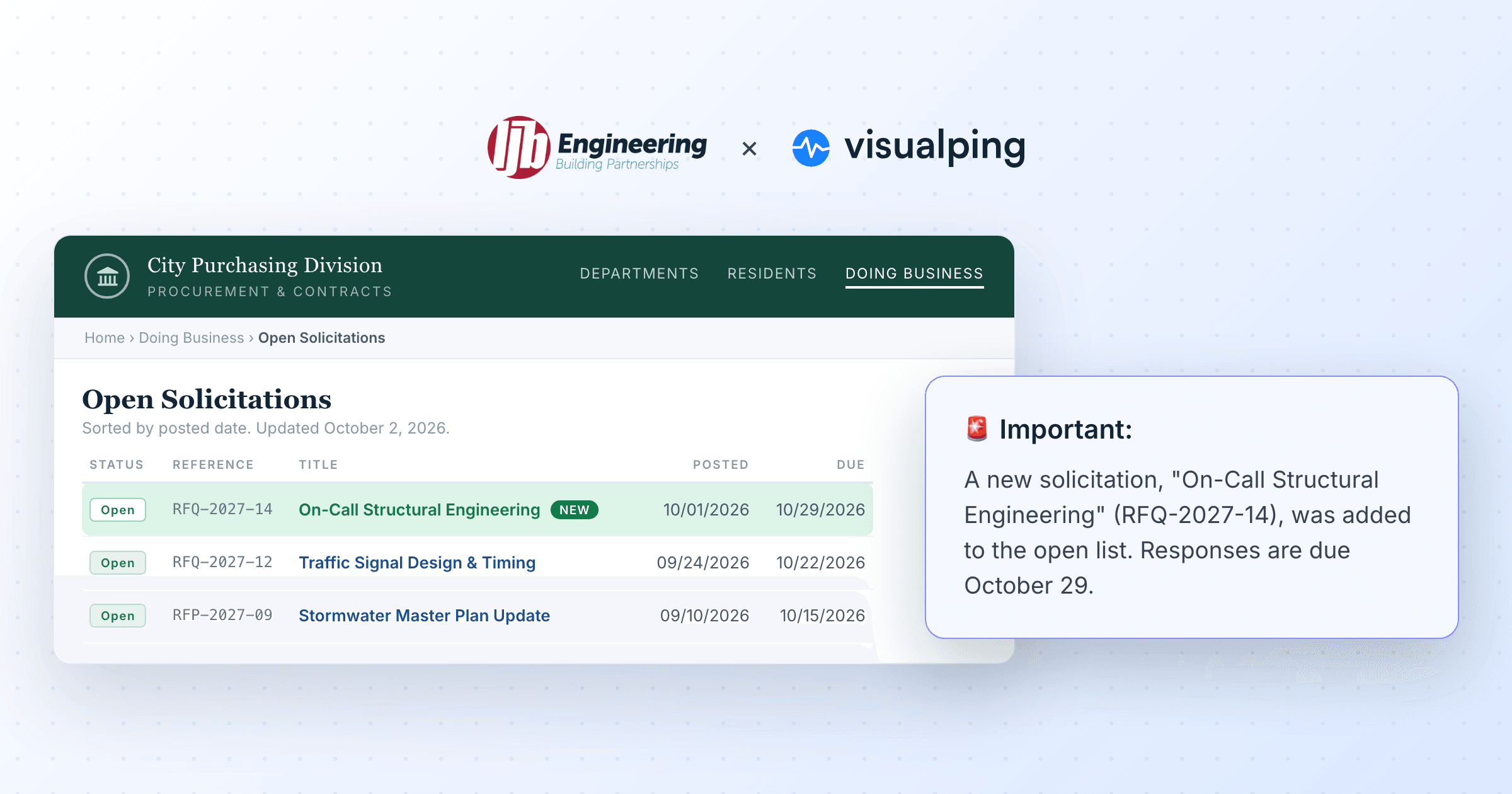
The 60-year-old engineering firm improved efficiency and data transfer on critical business intel by eliminating the manual process of checking websites, and now automatically runs two full scans of 500+ pages every week with Visualping.


| Company | LJB Inc. |
| Industry | Civil and structural engineering, geospatial, safety and underground services |
| Size | Founded 1966, 325+ employees, 20 offices across North America, ENR Top 500 Design Firms (#287 in 2026) |
| Use case | Monitoring client and prospect news pages, RFQ postings, and personnel changes |
Cities and public agencies post their requirements on their own schedules, in their own corners of the web. Some run on a one-year cycle, some on five. Miss the window on one of them and a firm can lose out on targeted opportunities.
For LJB Inc., keeping track of those windows across hundreds of client and prospect websites used to mean opening every page by hand.
About LJB Inc.
Founded in 1966, LJB Inc. is a North American engineering firm working across civil and structural engineering, transportation, underground services, water resources, geospatial survey, and fall protection safety. Its projects range from the buildings people work in to subway tunnels and traffic signals.
Brian Little is a Client Experience Manager at the firm, a role that encompasses sales operations and acts as the glue between operations and sales leadership. LJB has long won work on the strength of its engineers' reputations, and over the last five years the firm has invested in more go-to-market functions to support them.
What has not changed is how the work gets won.
"LJB's focus is to build deep partnerships and deliver quality work."
Brian Little, Client Experience Manager, LJB
The problem with checking 500 sites by hand
Prospect and client information sits in scattered places: city news pages, aggregate data websites, and the various boards where public agencies post opportunities. LJB tracked roughly 500 to 600 of them in a spreadsheet, and someone worked down the list opening each one.
LJB watches those pages for two things. The first is the opportunity itself: requests for proposals and ongoing contracts, the postings that invite engineering firms to express interest and capability and are the lifeblood of LJB's work for public agencies.
The second is movement in the relationships behind that work: a city manager retiring, a policy change, a funding announcement, or an event worth showing up to. LJB wins work on relationships its engineers have held for years, and it's beneficial to keep up on changes within the client organization.
Little's word for all of it is clues.
"We're just trying to gather as many clues as we can to equip our staff to go and have personal conversations with prospects and clients."
Brian Little, Client Experience Manager, LJB
Before using Visualping, a single thorough pass took Little's team 8 to 12 hours, which capped them at about one scan a week. It had to fit around the rest of their work, so a scan often meant stopping partway and picking the list back up later. And with busy weeks, pressing deadlines, and personnel changes, a thorough weekly review sometimes didn't happen.
The cost of that ceiling was not only time. RFQs and on-call agreements are how engineering firms win work, and the deadlines are often short.
"If you miss it, you may have to wait a year or more to get another chance."
Brian Little, Client Experience Manager, LJB
How LJB chose a monitoring tool
Little started by looking at what could be automated. The team tried building its own solution, using a paid web scraping application hosted on the vendor's server.
He also knew about the opportunity-search products built for government bidding, which hunt for postings rather than watch pages. He went digging for how other people in similar roles solved it, reading Reddit boards and any source he could find. He describes the search as manual.
"We're going to want to protect the IPs & Domain of our enterprise," as Little put it. Visualping runs its checks from its own infrastructure, so the client's domain stays out of it. Clearing that question changed what Little thought the project could become.
"Once we figured out that our IPs could be protected, we can check many websites respectfully, correctly, and with good web scraping practices. It essentially became limitless on what we could do with automations."
Brian Little, Client Experience Manager, LJB
From there the commercial side was straightforward. Little needed room to bring colleagues onto the same plan and hand work off between them, and he needed all of it in one place.
"The price was good for what we were looking for. It's great to have the ability to add a couple more people under our same plan to also carry out the task. Keeping all of the data in one database, rather than a spreadsheet living on a server somewhere that's hard to find and may not be the latest version."
Brian Little, Client Experience Manager, LJB
How LJB monitors client and prospect sites today
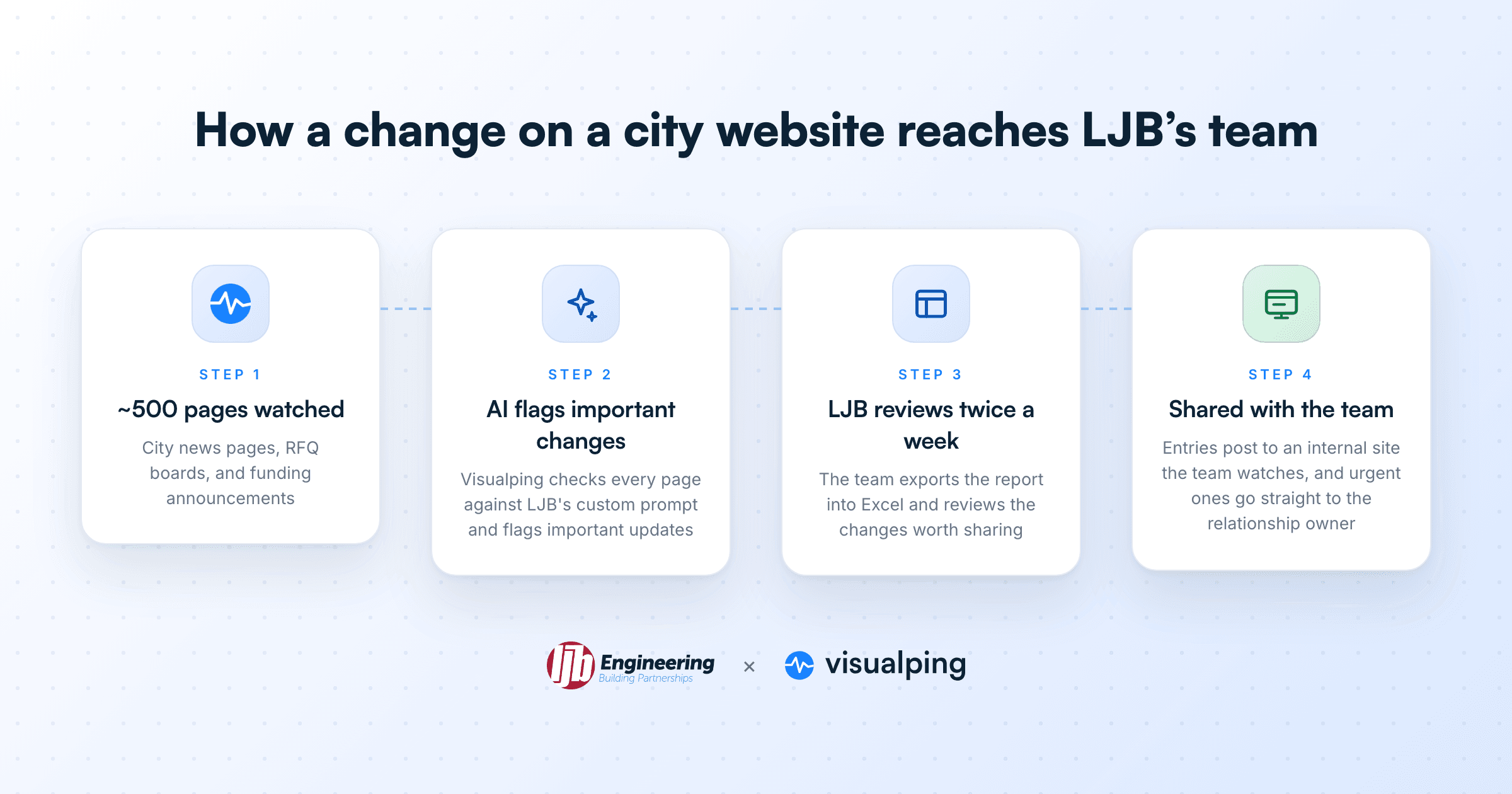
The team now monitors around 500 pages with Visualping, and each one is tied back to the business development executives and engineers who own that relationship.
Little's team also created a custom AI prompt loaded with what LJB's practices and clients care about, and Visualping judges every detected change against it, marking the ones that clear their criteria as important.
Those are what the team opens first. The categories they act on are personnel changes, new opportunities, and events where they can interact with clients.
Little sharpens the prompt when he sees a chance to, changing one variable at a time.
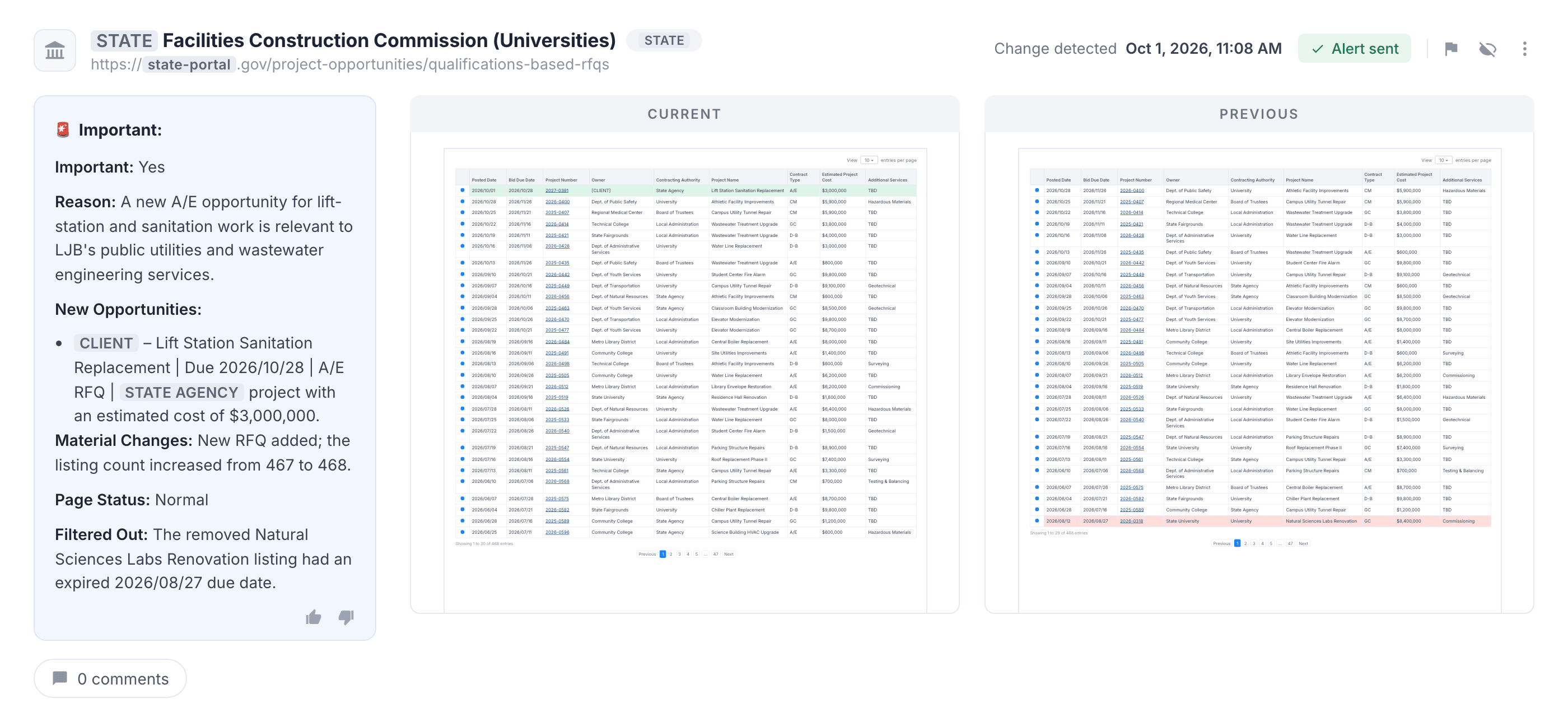
An anonymized mockup of an alert with a custom AI prompt that flagged a posting of a relevant project within LJB's wheelhouse of services. Little's team reviews alerts like these from their twice-a-week Visualping Reports.
Twice a week Little runs Visualping's Reports, exports the results to Excel and reviews the changes worth passing along to the team.
The updates worth acting on get entered into an in-house app that publishes them to an internal site, where the team can watch entries appear through the week or wait to be notified that a new round has been posted.
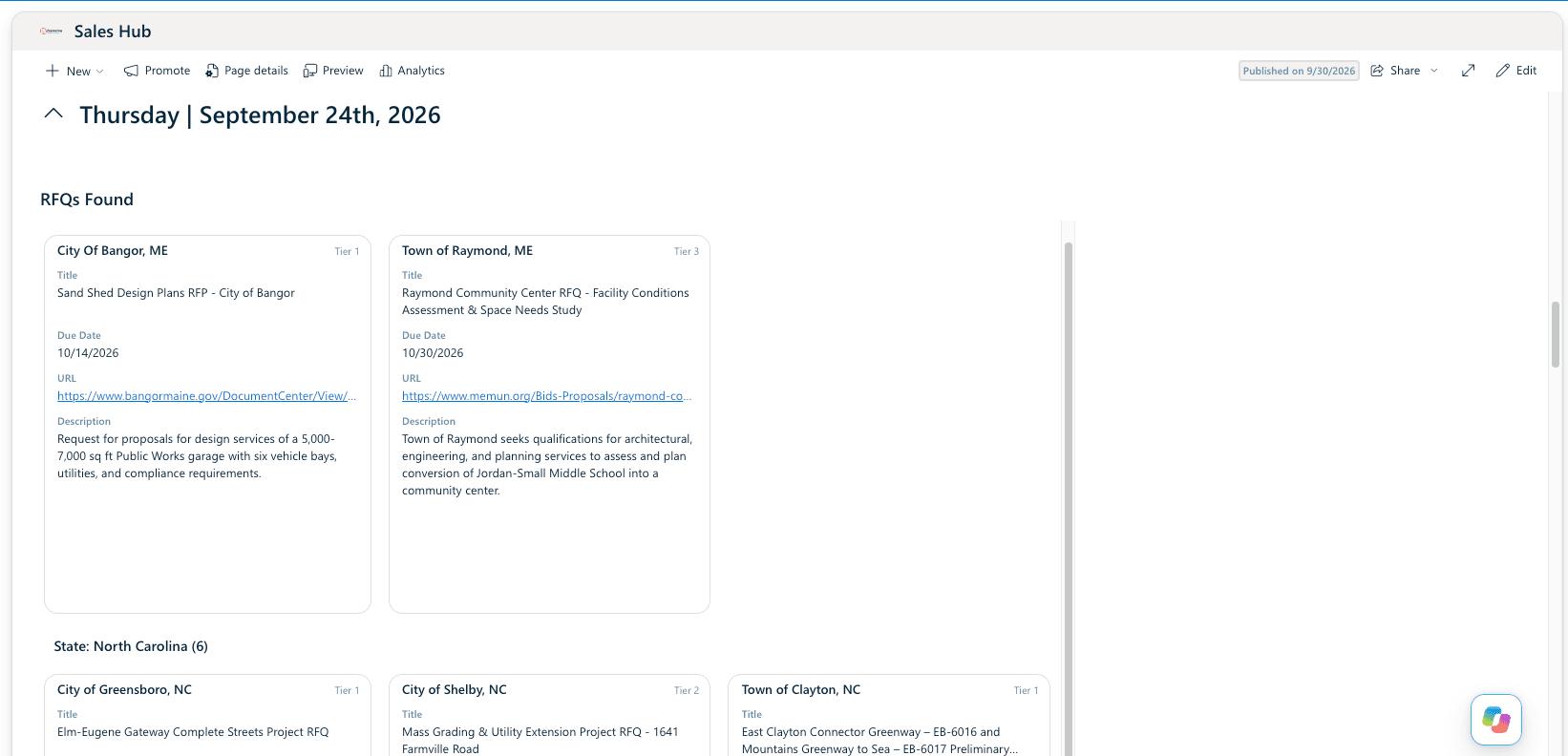
An example of an internal weekly report that Little's team generates based on Visualping's detected changes.
The setup got simpler over time. When LJB started, the team used webhooks and its own Power Automate flows to track which checks had run successfully and which had not, and fed Visualping detailed feedback about false positives along the way.
"Three to six months later, after we worked back and forth with the team, [Visualping] came out with Reports and we didn't need our own systems internally to maintain."
Brian Little, Client Experience Manager, LJB
Little describes the monitoring side as "straight out of the box."
The results
The change shows up in two numbers, and in what those numbers let the team do.
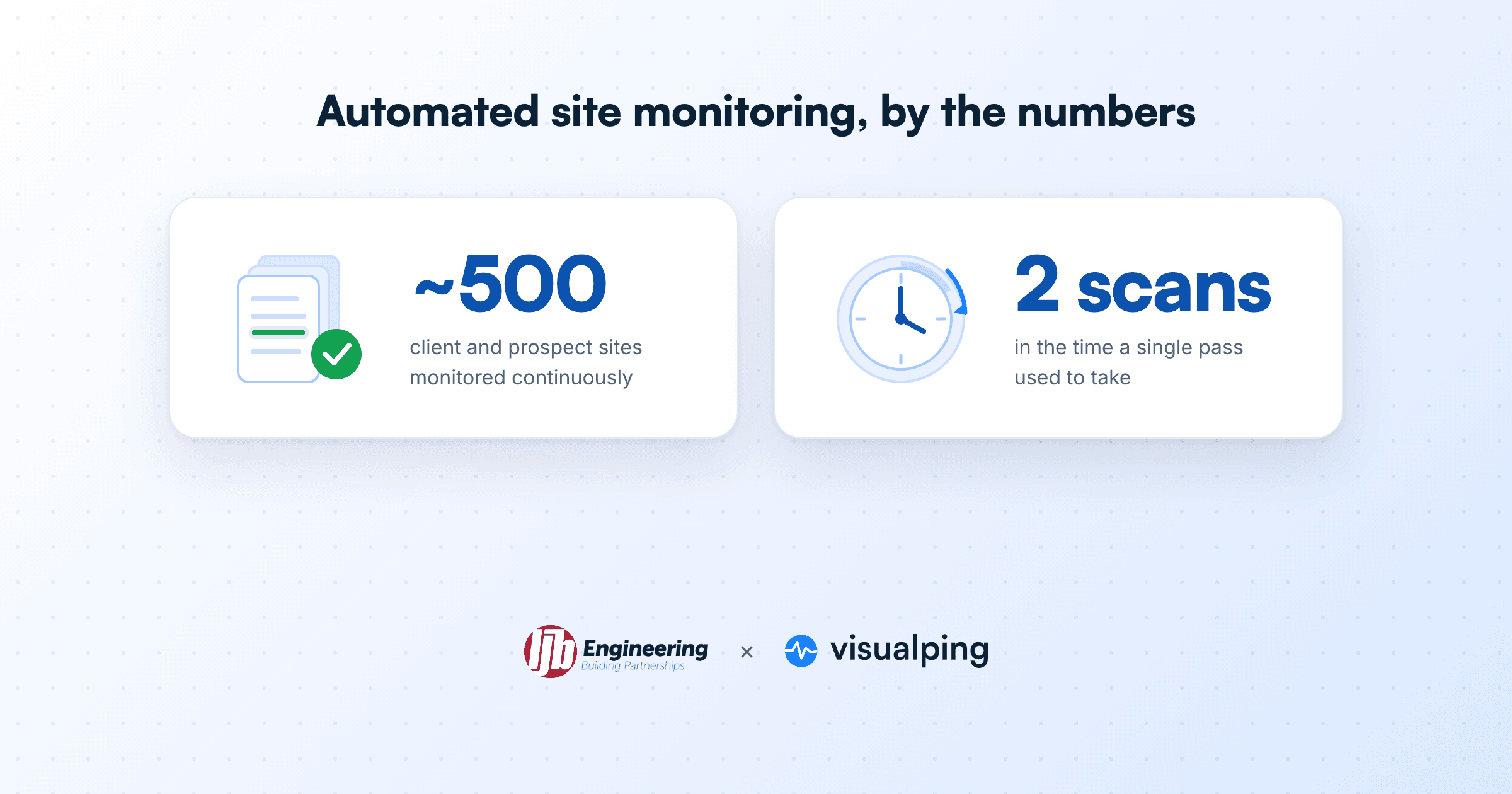
"It used to take us 8 to 12 hours for one scan. And now we can do 2 scans in about 8 hours. Meaning fewer things get missed, and we can also increase the capacity for what can be checked under that same timeframe."
Brian Little, Client Experience Manager, LJB
Two scans a week instead of one, in less time than a single pass used to take.
"It's cut down half the time to complete the scans of all the websites. Just showing us the ones that changed has been huge."
Brian Little, Client Experience Manager, LJB
The clearest proof came a couple of months ago. A city in Texas posted a solicitation LJB nearly missed while the team member who owned that relationship was buried in project work. Little sent the alert straight to them and put it in the report that goes to the whole team. That alert allowed LJB to submit on time, giving the firm the opportunity and the team confidence that the system is working.
Sometimes the catch is a detail on something they are already working on. In one recent round of scans, Visualping flagged that a deadline had been extended on a project LJB was pursuing.
"That gave our proposal team an extra day or so for any finishing touches, which can be helpful when they are slammed."
Brian Little, Client Experience Manager, LJB
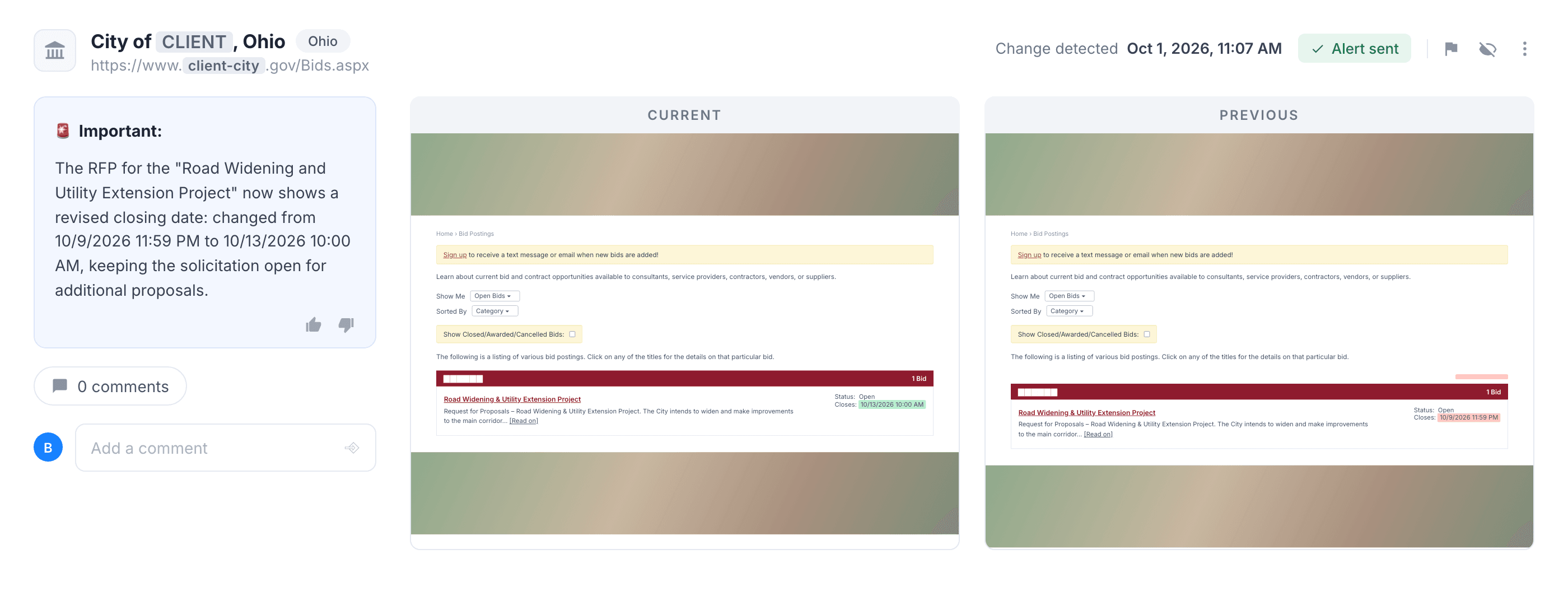
An anonymized example of the alert that caught an extended deadline for a project LJB was pursuing, as Little mentioned.
The everyday version is smaller and just as useful. A city manager announces a retirement, or a vacancy goes up, and someone at LJB who knows that office has a reason to reach out.
"It just makes things a lot more organic, personable, and it shows that we do our homework."
Brian Little, Client Experience Manager, LJB
What Little tells peers
For anyone whose job is keeping tabs on a lot of relationships in a lot of places, his sentiment on Visualping is clear.
"I'd say it's definitely worth the investment."
Brian Little, Client Experience Manager, LJB
He adds that it fits alongside what a team already runs.
"There's enough out of the box that's there for the folks that want to integrate it into their current systems, and a lot of other capabilities. [Visualping] plugs and plays pretty well."
Brian Little, Client Experience Manager, LJB
Still working down a list of client and prospect sites one by one? Set up your first Visualping monitor free and see only the pages that changed.
Want to monitor web changes that impact your business?
Sign up with Visualping to get alerted of important updates from anywhere online.
Kayla Zhu
Kayla is the Public Relations Specialist at Visualping and manager of Visualping's Journalist Program. She manages Visualping's media relations, content marketing, and social media.
More articles by Kayla Zhu