Best Tools to Monitor Website Changes: 4 Visualping Alternatives
By Emily Fenton
Updated October 1, 2025

Website change detection tools save you from refreshing pages manually. Whether you need to track a competitor's pricing page, catch product restocks, or monitor regulatory updates, the right tool turns hours of manual checking into automatic alerts.
Visualping serves over 2 million users, and 85% of Fortune 500 companies use it to monitor website changes. Still, different teams have different priorities: some want local monitoring that runs on their own machine, others need a self-hosted option, and others optimize purely on price per check.
This guide breaks down 4 Visualping alternatives with features, pricing, and the specific use cases where each one fits best.
Why You Need Website Change Monitoring Tools
A competitor quietly drops prices by 15%. A regulator publishes a new filing requirement. A supplier updates delivery terms buried three clicks deep on their site. You either catch these changes fast or you don't.
Website monitoring tools watch pages for you and fire alerts the moment something shifts. Here's where that matters most:
- Secure limited inventory: The Wall Street Journal highlighted how people used Visualping to monitor COVID-19 vaccine availability and book appointments immediately
- Track competitor activities: Monitor pricing changes, product launches, and marketing campaigns
- Catch compliance updates: Stay current with regulatory changes and policy updates
- Grab time-sensitive opportunities: According to The Telegraph, thousands of shoppers use tools like Visualping to secure online supermarket delivery slots
- Monitor brand mentions: Track when your company is mentioned on review sites or news outlets
How to Choose a Website Change Monitoring Tool
Four factors separate these tools more than any feature list:
- Check frequency: How often the tool visits your pages. Daily checks work for compliance and policy pages. Restocks, ticket drops, and price changes need 5-15 minute intervals, which usually means a paid plan.
- Dynamic content support: Many sites load prices and inventory with JavaScript after the page first renders. A tool that only reads static HTML will miss those changes, so confirm dynamic page support before committing.
- Alert quality: The difference between a useful monitor and an inbox full of noise is filtering. Look for keyword conditions, change thresholds, and summaries that tell you whether a change actually matters.
- Pricing model: Some tools charge by monitored page, others by total checks. High-frequency monitoring of a few pages and daily checks across hundreds of pages favor different models, so estimate your volume first.
Best Tools to Monitor Website Changes in 2026
We compared each tool on check frequency, pricing, accuracy, and the features that set it apart. Paid plans start as low as $5.40/month (Wachete) and scale to $300+/month for high-volume enterprise tiers. Here's how they compare at a glance:
| Tool | Best for | Starting price | Free tier | Fastest checks |
|---|---|---|---|---|
| Distill.io | Local, in-browser monitoring | $15/month | 5 cloud + 20 local monitors | 2 minutes |
| ChangeTower | Visual tracking plus uptime monitoring | $9/month | 3 URLs, checks every 12 hours | 3 minutes |
| Wachete | Budget monitoring of files (PDF, DOCX, XLSX) | $5.40/month | 5 pages, daily checks | 5 minutes |
| PageCrawl | Value per check, Sheets and Zapier integrations | $13.33/mo (billed annually) | 6 pages, checks up to every 60 min | 2 minutes |
| Visualping | AI-summarized alerts at any scale | Free plan available | Unlimited local monitors in your browser | Varies by plan |
Pricing verified July 2026. SaaS pricing changes often, so confirm current rates on each vendor's site before buying.
Editor's note: Visualping is our product, and this article compares it against alternatives. Visualping runs both cloud monitors (checked from our servers around the clock) and local monitors (checked from your browser, unlimited on the free plan). For fully self-hosted, open-source change detection where all data stays on your own infrastructure, ChangeDetection.io is the strongest option. Review each tool's limitations, including ours, before choosing.
1. Distill.io
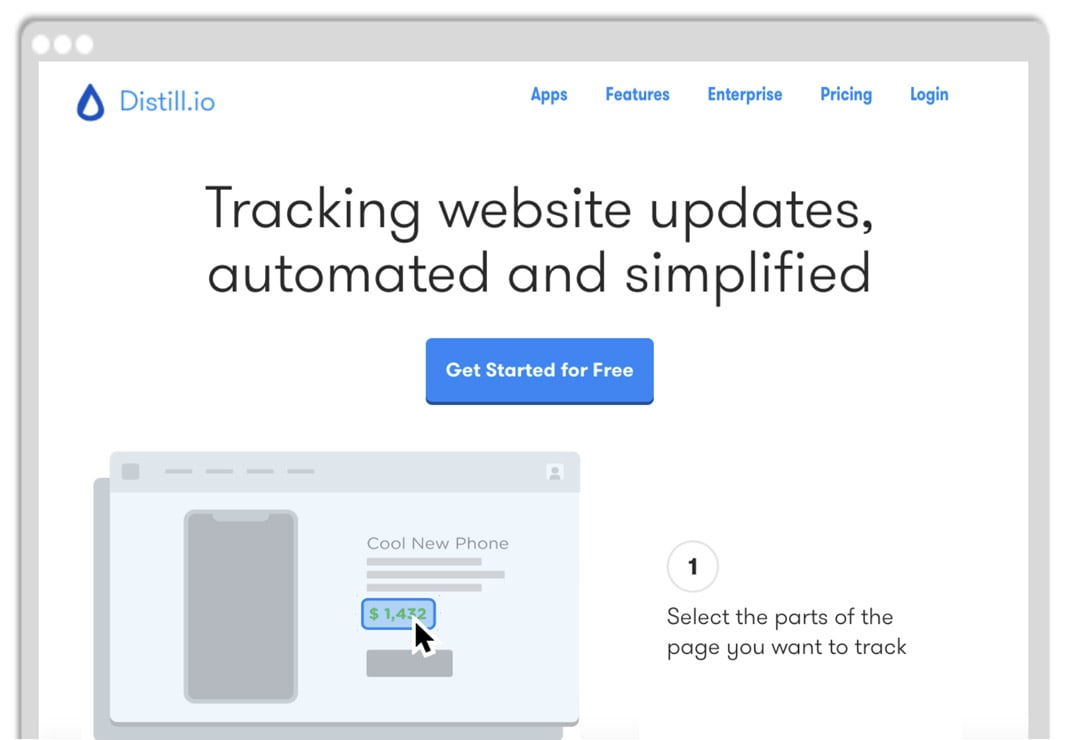
Distill.io offers both local and cloud-based monitoring. Local mode runs checks directly on your machine (useful if you want to avoid cloud dependency), while cloud mode runs on their servers for round-the-clock alerts even when your laptop is closed.
Key Features
- Visual Selector Technology: Set up monitors by visually selecting page elements you want to track, whether it's specific sections or complete content. Refine your selections using XPATH, CSS selectors, and regular expressions for precise monitoring.
- Advanced Filtering Conditions: Create alert rules to eliminate false positives. Check if monitored text contains numbers within your target range, matches specific expressions, or includes certain keywords. You can also combine multiple conditions together for more advanced filtering.
- Centralized Watchlist Dashboard: Manage all your monitors from one interface where you can view, edit, and organize your tracking activities, similar to Visualping's user dashboard.
- Automated Actions: Like Visualping's Perform Actions feature, Distill.io can navigate through login forms, click buttons, and access password-protected pages automatically.
Pricing
Free Plan:
- 25 monitors (5 cloud + 20 local)
- 6-hour cloud check interval
- 1,000 cloud checks/month
Starter Plan: $15/month
- 50 monitors, 10-minute cloud checks
- 30,000 cloud checks/month
Professional Plan: $35/month
- 150 monitors, 5-minute cloud checks
Flexi Plan: $80+/month
- 500+ monitors, 2-minute cloud checks
- Usage-based pricing beyond plan limits
Want local checks with an AI summary on every alert? Try Visualping free: local monitors run from your browser extension and are unlimited on the free plan.
Go deeper: How Distill.io compares as a Visualping alternative
2. ChangeTower
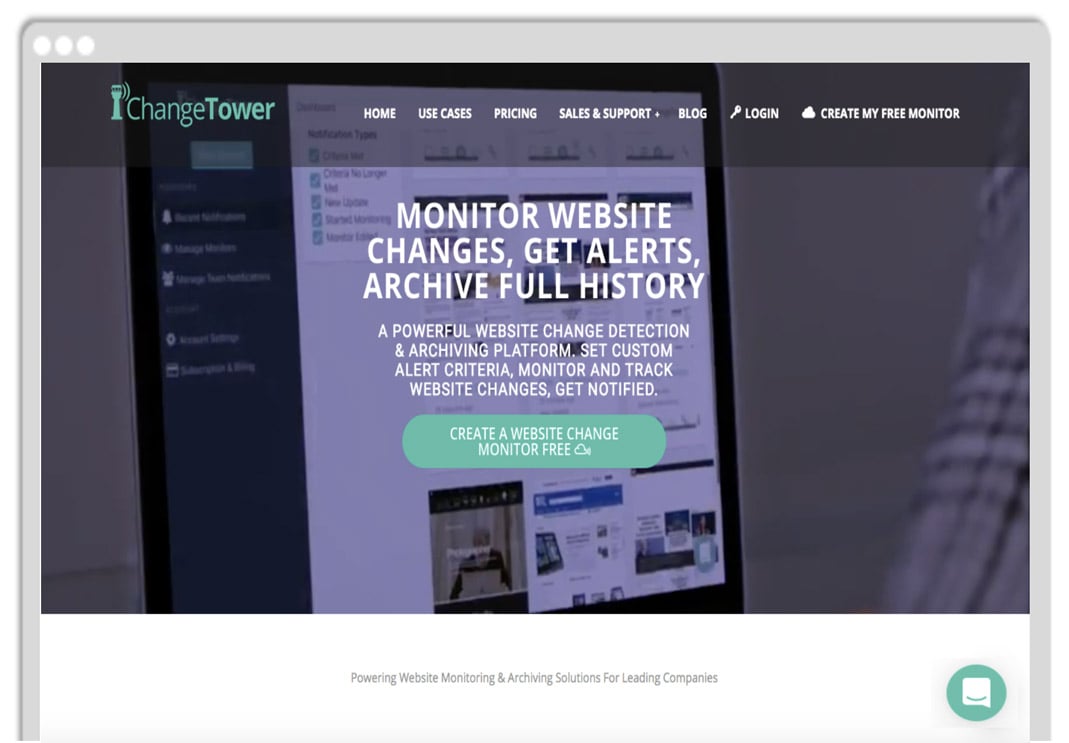
ChangeTower is a cloud-based website change monitoring solution that is known for visual tracking and offers multiple monitoring modes to suit different needs.
Key Features
Monitoring modes: ChangeTower tracks changes three ways: visual screenshot monitoring for image and layout changes, text-based tracking for specific keywords and phrases, and source code monitoring for HTML changes. These map closely to Visualping's Visual, Text, and Element Compare features, though Visualping also has a Compare "All" option.
- Multi-Condition Monitoring: Create custom alert conditions with multiple parameters. Like Visualping's trigger feature, you can define sensitivity by setting the percentage threshold for change detection.
- Uptime Monitoring: Receive immediate alerts when your monitored pages go down, so you catch availability issues quickly.
- Team Collaboration: Notify individual team members or entire groups with real-time email notifications for simplified workflow management.
Pricing
Free Plan:
- 3 monitored URLs
- 6 daily checks total
- 12-hour check interval
Power User: $9 to $158/month
Pricing depends on how many checks per month and months of data archive.
- 1,500 to 45,000 daily checks
- 3 to 12 month data archival
- Up to 500 monitored URLs
Enterprise Plans: Custom pricing (from around $299/month)
- Checks as frequent as every 3 minutes
- Data storage up to 12 years
- Priority support
3. Wachete
Wachete is a website change detection tool that offers solid monitoring capabilities at one of the most affordable price points on the market.

Key Features
- Multiple File Format Support: Track textual changes across various formats including PDF documents, MS Word (DOCX), Excel spreadsheets (XLSX), and JSON files.
- Dynamic Content Monitoring: Tracks JavaScript-heavy and dynamic web pages that update content without full page reloads.
- Summary Emails: Get daily or weekly summary emails with changes from several pages.
- Public Tracker Widget: Similar to Visualping's Button, install a button on your site so visitors can monitor your page updates.
Pricing
All Wachete plans include unlimited checks, and paid plans add 12 months of data retention.
| Plan | Price | Pages | Check interval | Notable extras |
|---|---|---|---|---|
| Free | $0 | 5 | Every 24 hours | No dynamic pages |
| Starter | $5.40/month | 50 | Every 60 minutes | 1 dynamic page, multi-part page selection |
| Standard | $10.90/month | 100 | Every 10 minutes | 2 dynamic pages, login-protected pages |
| Premium | $54.90/month | 500 | Every 5 minutes | 10 dynamic pages, proxy support, file format monitoring |
| Ultimate | $329.90/month | 3,000 | Every 5 minutes | 60 dynamic pages, everything in Premium |
4. PageCrawl
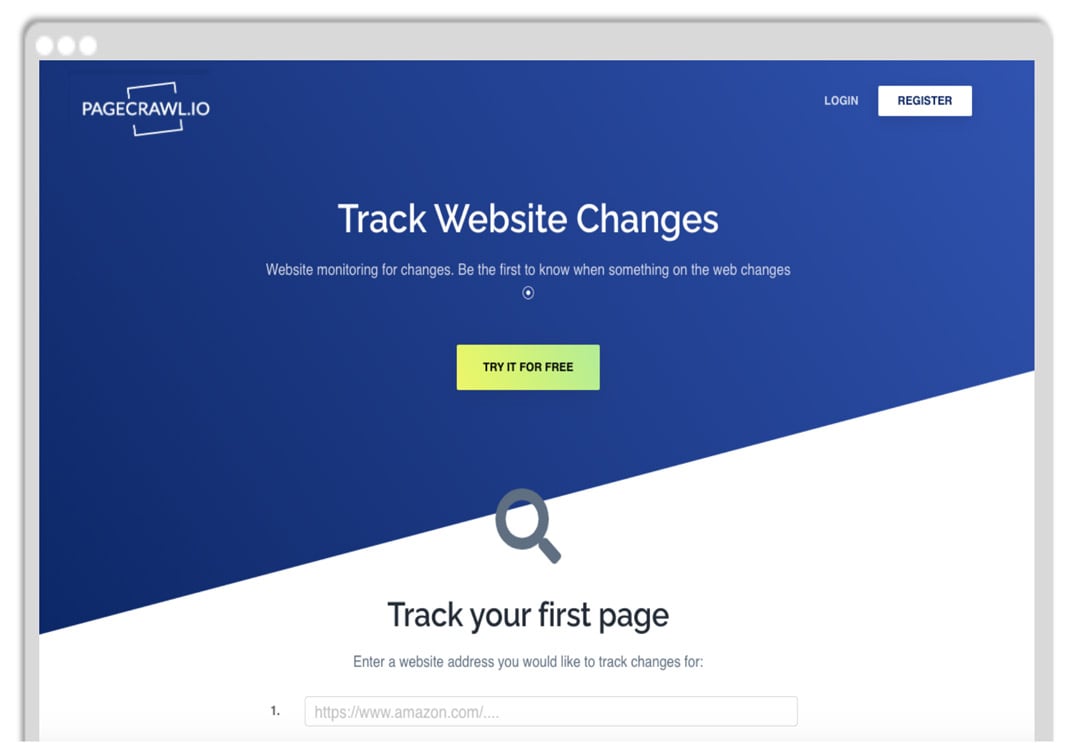
PageCrawl.io offers a usable free tier, with paid plans starting at $13.33/month (billed annually).
Key Features
- Multi-Element Tracking: Like Visualping and Wachete, PageCrawl allows you to monitor multiple specific elements on any web page simultaneously.
- Team Collaboration: Invite multiple users to your account, or create separate workspaces for different teams. Tracked pages are sharable with friends and team members.
- Flexible Notifications: Receive alerts via email or Slack, view monitored results as charts, and export your data.
- Bulk Management: Update URL configurations in bulk or use page templates.
- Integrations: Check your monitors in Google Sheets, or connect your monitoring workflow to other apps with Zapier.
Pricing
Free Plan:
- 6 monitored pages
- Checks up to every 60 minutes
- 220 checks/month, 90-day history
Standard Plan: $13.33/month (billed annually)
- Up to 200 pages
- 15-minute check intervals
- Up to 30,000 checks/month, 12-month history
Ultimate Plan: $83.25/month (billed annually)
- Up to 1,000 pages
- 2-minute check frequency
- 100,000 checks/month, unlimited history
An Enterprise tier sits between Standard and Ultimate for teams that need faster checks and more users.
Why Visualping Remains the Top Choice
Each alternative above does certain things well. A few things still set Visualping apart.
Every alert includes an AI summary explaining what changed and whether it matters, so you spend less time triaging noise (see how Visualping stacks up against other AI website monitoring tools). That payoff grows with volume, and Visualping runs at volume: 85% of Fortune 500 companies and more than 2 million users rely on it, on infrastructure built for high-volume enterprise monitoring. When something breaks, dedicated support answers fast, and real people handle it. The integrations are broad too: API access, data exports, Slack and email alerts, plus Perform Actions for getting through login-protected pages. Visualping has also been featured by NBC, The Wall Street Journal, The Washington Post, and The Telegraph.
With Visualping, local monitors run in your browser and are unlimited on the free plan, while cloud monitors keep checking around the clock even when your laptop is closed. Create a free account or compare Visualping's pricing plans to see which fits your monitoring volume.
Frequently Asked Questions
What are the best tools to monitor website changes?
The best website change monitoring tools include Visualping, Distill.io, ChangeTower, Wachete, and PageCrawl. Each fits a different priority: PageCrawl and Wachete compete on price, Distill.io leads on local monitoring and advanced selectors, ChangeTower bundles uptime monitoring, and Visualping pairs enterprise-scale monitoring with an AI summary of every change.
Are there free alternatives to Visualping?
Yes, every tool on this list has a free plan. Distill.io includes 5 cloud and 20 local monitors, ChangeTower covers 3 URLs with twice-daily checks, Wachete monitors 5 pages daily, and PageCrawl tracks 6 pages with one daily check each. Visualping's own free plan offers unlimited local monitors that run in your browser, along with cloud monitoring for pages you need checked around the clock. For a deeper comparison, see our roundup of the best free website change detection tools.
What is the difference between local and cloud website monitoring?
Local monitoring runs checks from your own computer, usually through a browser extension, so pages are only checked while your machine is on and the browser is open. Cloud monitoring runs on the provider's servers and keeps checking around the clock, which is what you want for overnight restocks or updates in other time zones. Distill.io and Visualping offer both; the other tools on this list run their checks in the cloud.
How often should I check for website changes?
Check frequency depends on your monitoring needs. For time-sensitive content like product availability or price changes, check every 5-15 minutes. For general competitor monitoring, hourly or daily checks suffice. For regulatory compliance, daily checks are typically adequate.
Can website monitoring tools track JavaScript changes?
Yes, most modern website change detection tools can monitor JavaScript-rendered content. Visualping, Distill.io, ChangeTower, and Wachete all support dynamic JavaScript websites. Ensure the tool you choose explicitly mentions JavaScript or dynamic content support.
Can these tools monitor pages behind a login?
Several can. Visualping's Perform Actions feature and Distill.io's automated actions navigate login forms before checking the page. Wachete supports password-protected pages on its Standard plan and above. Check each tool's plan limits, since login monitoring is often gated to paid tiers.
Want to monitor web pages for changes?
Sign up with Visualping to get notified of alerts from anywhere online, so you can save time, while staying in the know.
Emily Fenton
Emily is the Product Marketing Manager at Visualping. She has a degree in English Literature and a Masters in Management. When she’s not researching and writing about all things Visualping, she loves exploring new restaurants, playing guitar and petting her cats