How to Monitor Executive Leadership Changes at Target Companies
By Emily Fenton
Updated November 3, 2026
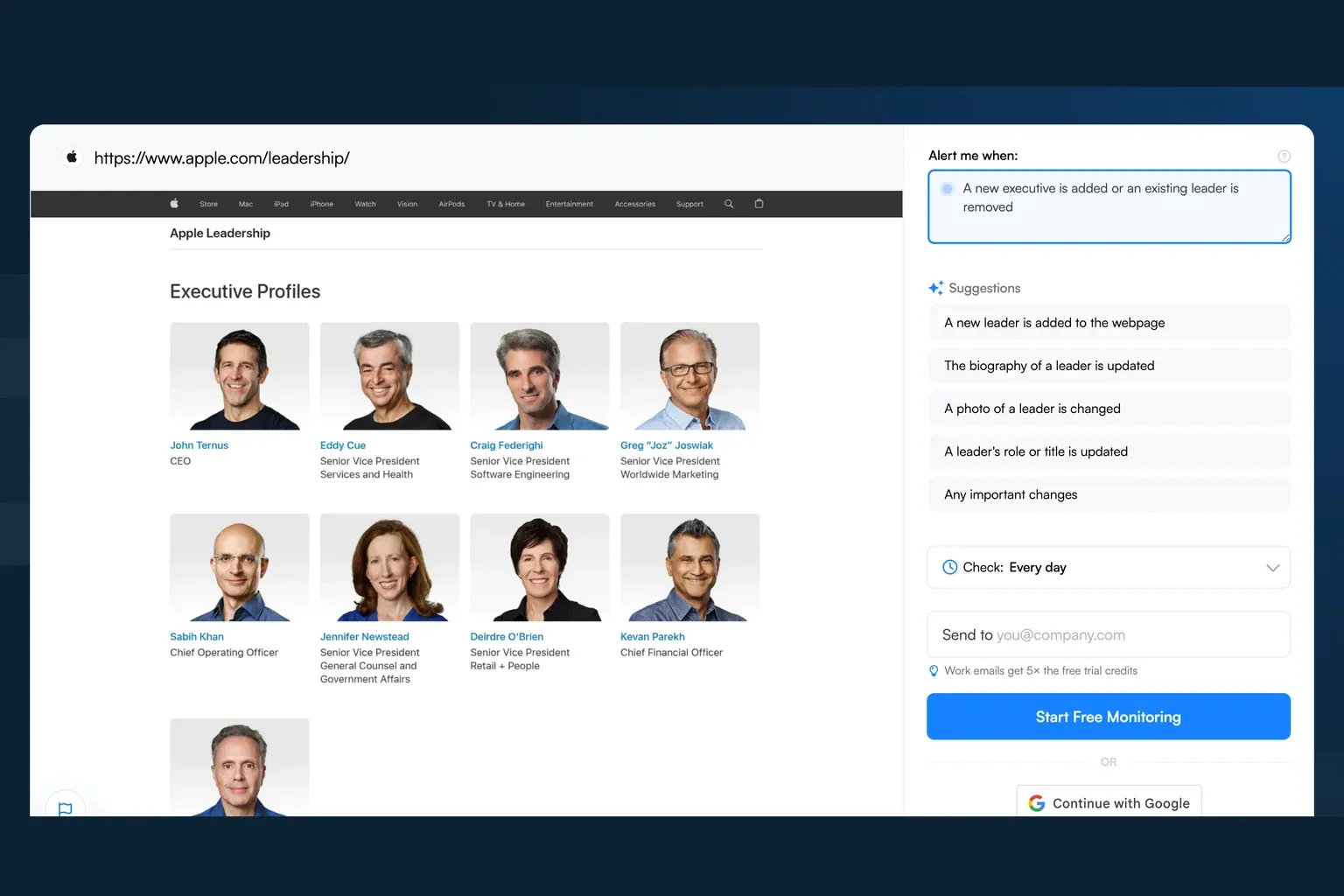
TL;DR: Leadership changes show up on a company's own pages: a new name on the leadership page, a profile that disappears, a vice-president opening on the careers site. Watch those pages with Visualping, write an "Alert me when" condition for joiners, departures and title changes, and check each alert against the company's announcement before you act. An executive search or business development team can run this across a list of 100 target companies on a Business plan.
To monitor executive leadership changes at a target company, watch the pages where the company publishes them itself: the leadership or management team page, the board page, the newsroom and, for senior openings, the careers site. A website monitor checks those pages on a schedule and alerts you when a name appears, disappears or changes title. This guide shows executive search, business development and competitive intelligence teams how to set that up and how to check each change before acting on it.
Start with the row that matches your job:
| Your team | What a leadership change tells you | Jump to |
|---|---|---|
| Executive search and business development | A departure, a new chief executive or a senior opening can mean a search mandate | Executive search and BD |
| Executive search research | Who sits in each role now, for candidate maps | Where changes show up |
| Sales and account teams | A new decision-maker at a target account, or a champion leaving a customer | Set up alerts |
| Competitive intelligence | A new head of a function can signal a change in strategy | CI teams |
How to find a company’s recent leadership changes
Start with the company’s leadership page and newsroom. Search the company name alongside the executive’s name or role, then open the original appointment or departure announcement. Record the person’s name, outgoing and incoming roles, announcement date, effective date, and source URL. Keep announcement and effective dates separate: someone may be named as a successor before taking the role.
Compare the announcement with the current leadership page. Check whether the appointment is permanent or interim, whether the predecessor is staying in another role, and whether a board appointment is being confused with an operating position. For public companies, the investor-relations news page is another place to check the company’s own account of the change.
Treat a missing biography or changed job title as a lead to verify. A website edit alone does not establish that someone left the company or explain why they moved. Mark unresolved changes as unconfirmed in your research notes and retain the source you checked.
Once you have a baseline, monitor the leadership and announcement pages for further updates. Assign a colleague to verify each relevant alert and update the record, including the effective date. This separates what the company has announced from what your team still needs to confirm.
Where leadership changes show up first
To monitor executive leadership changes reliably, watch more than one source. Each catches part of a change, and none catches all of it.
| Page | What it shows | What it misses | How often to check |
|---|---|---|---|
| Leadership or management team page | New names, removed profiles, changed titles | Why someone left; changes the company hasn't published | Daily for priority targets, weekly for the rest |
| Board of directors page | New and departing directors, chair and committee roles | Advisers the company doesn't list | Weekly |
| Newsroom and press releases | Appointment announcements, often with an effective date | Departures, which often get no release | Daily |
| SEC filings (US public companies) | Officer and director changes reported on Form 8-K | Private companies; roles below the officers the rule names | Daily for listed targets |
| Careers site | Vice-president and C-level openings | Confidential searches that are rarely posted | Daily for priority targets |
| LinkedIn and news coverage | Context and confirmation | Reliable automated access to LinkedIn | As a manual check |
Departures are often the change that appears only on the leadership page. Many appointments get press releases, while an executive leaving a private company often drops off the page with no announcement at all. A monitor on that page catches the removal on its next check. Appointment releases sit in the newsroom, and press release and newsroom monitoring covers how to watch those pages without wading through product news.
For US public companies, Form 8-K is the formal record. Under Item 5.02, companies report the departure or appointment of certain officers and directors, generally within four business days. SEC staff guidance counts a demotion, or the removal of an officer's duties, as a departure even when the title stays the same. A company can also hold a new officer's appointment until it announces it publicly (SEC Form 8-K interpretations). So a title on the leadership page can lag the filing.
Senior openings on the careers site are a strong signal for a search firm. An open chief financial officer or vice-president role often means someone left or the company is building a new function, and the firm that sees the posting first has the most time to respond. Careers sites get busy, so filter them with the careers template further down. For the careers-page setup itself, see how to set up alerts on a company's careers page.
Treat LinkedIn as a secondary signal. LinkedIn limits automated access, so a public company page may not load reliably, and you shouldn't sign in to LinkedIn through a monitor. A company's own leadership page and newsroom are more dependable.
What leadership changes mean for executive search and business development
Turnover at the top continues even in a slower year. US companies announced 1,226 CEO exits in the first eight months of 2026, down 18% from the same period of 2025, and 186 of them came in August alone, according to Challenger, Gray & Christmas. For a search firm, each of those exits can lead to two pieces of work: the replacement search, and the senior hires the new chief executive makes once they arrive.
A departure
When a leader's profile disappears and the departure checks out, the company may have a seat to fill, and the person who left may be ready for their next role. Check whether the company has named an interim leader or a successor (the verification steps above), then decide whether to pitch the search, approach the executive, or both.
A new chief executive
A new CEO or division head may bring in their own leadership team. Move the company into your priority group for the months after the appointment, and watch its careers site for vice-president and C-level openings.
A senior opening
A posted senior role suggests the company may be searching now, in-house, with another firm, or both. Seeing the posting on the day it appears gives you time to reach the hiring leader with relevant candidates before the brief is settled.
A board change
A board change may not lead to a mandate right away, but it helps you map relationships. A new director may become a client, a referee or a door into another company where they sit on the board.
Research
Researchers can use the same watchlist to keep candidate maps current. A changed title on a leadership page can update your map on the next check after the company publishes it.
An executive search firm that recruits for banks and fintech companies is testing this approach with Visualping. It watches the career sites of up to 100 target companies with an alert condition for vice-president-and-above roles. It also watches each company's leadership team page for joiners and departures, and it uses Discovery to find career pages it hadn't located yet.
That is a bigger setup than most. Of the 781 Visualping accounts with an active monitor on a leadership or board page on October 29, 2026, 591 watched a single page. Plan a watchlist of 100 companies as a list from the start, with bulk setup, labels and routing decided before the first alert arrives.
Ready to try it on your own list? Start a free Visualping account with the leadership pages of five target companies. The Free plan covers 5 pages and 150 checks a month, enough to check each page about once a day.
Set up leadership change alerts in Visualping
Step 1: Build the target list
To monitor executive leadership changes across a target list, write down the companies first, then find each one's leadership, board and careers pages. Where a page is hard to find, use the Discovery tab: describe the pages you want, for example the leadership team page of a particular bank, and Visualping suggests up to five pages per search. Discovery is on every plan, and searching doesn't use checks. The introduction to Discovery explains how the search works.
Step 2: Add the pages in bulk
On the Bulk tab, paste your list of page addresses, one per line, or paste address and title columns copied from a spreadsheet. The frequency, condition and alert settings you choose apply to every page in the list, and pages added in bulk are watched as full pages. Bulk adding and bulk editing are on every plan, up to your plan's page limit, and bulk URL monitoring covers importing and organizing larger lists.
Size the plan to the list. A watchlist of 100 companies with a leadership page and a careers page each is 200 pages, the limit of a Business 20K plan, which also includes 5 seats. Personal plans top out at 40 pages.
Step 3: Write the Alert me when condition
In the Alert me when field, describe the change you care about in plain language. Visualping's AI checks each detected change against it. When a change matches, the alert is flagged as important, the email subject starts with IMPORTANT, and the AI summary says what changed. AI Mode, the default, ignores style-only changes such as a new font or colour.
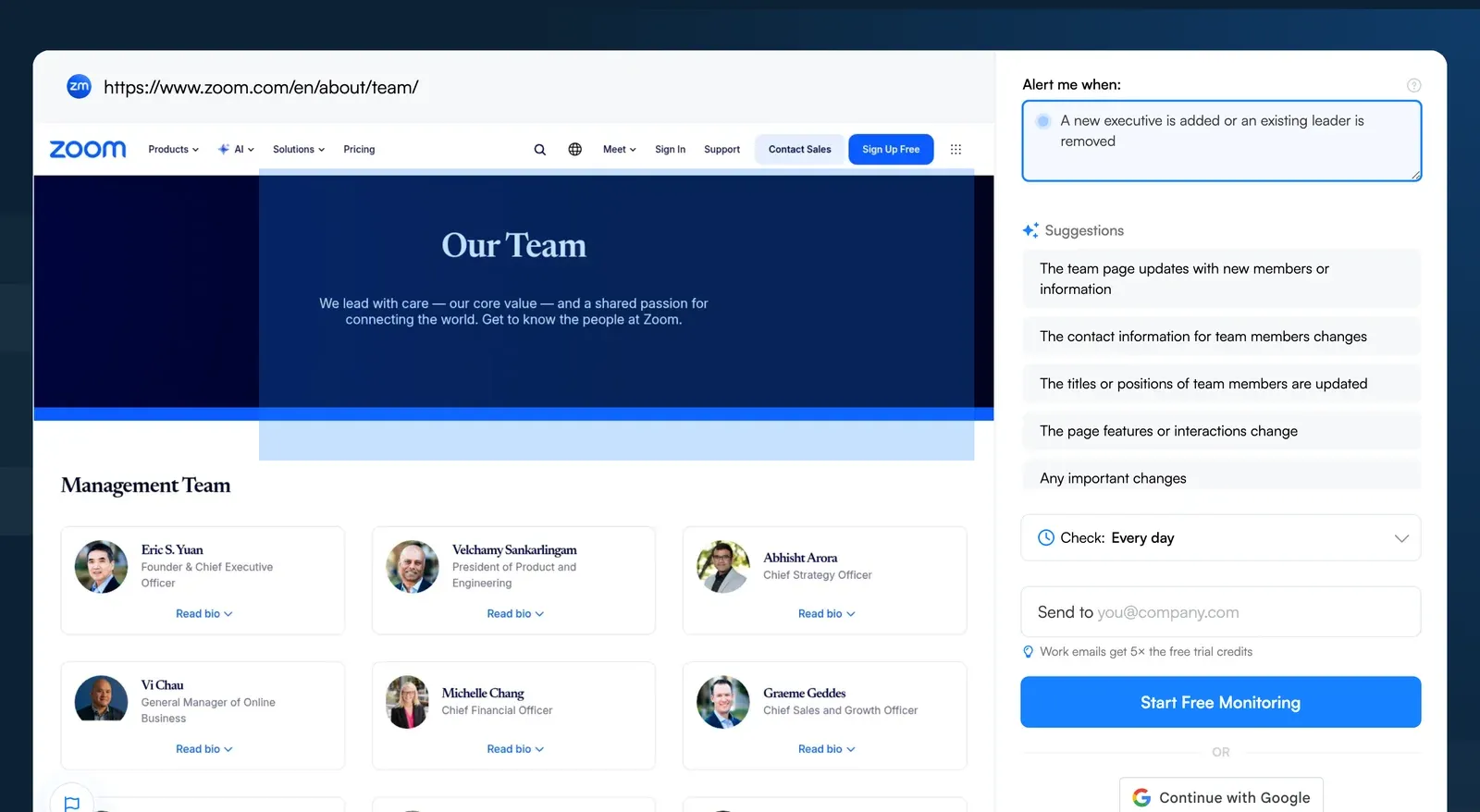 Paste the leadership page URL, then describe the change you want to hear about in plain language
The templates in the next section are a starting point, and writing AI alert criteria for important changes goes further.
Step 4: Choose how often to check
Daily is the default and suits most leadership pages. These pages do change. Of the 644 Visualping accounts that had watched a leadership or board page for at least six months, 411 (64%) had a change detected on one of those pages in the 90 days to October 29, 2026. A detected change can be a biography edit or a layout tweak as easily as a new executive, which is why the condition matters.
Each check of a page uses one check from your monthly allowance, whether or not anything changed. For planning, 100 pages checked once a day use about 3,000 checks a month (100 pages over 30 days), and the same 100 pages checked every six hours use about 12,000. Business plans can check as often as every 2 minutes, but one page on that schedule uses about 21,600 checks a month, more than the 20,000 in a Business 20K plan, so keep faster checks for the few careers sites where hours matter.
Step 5: Route alerts to the person who acts
Email, webhooks, n8n and Telegram work on every plan. Slack, Microsoft Teams, Google Sheets, Google Chat and Discord need a Business plan. The Google Sheets connection adds a row for each detected change. Each row holds the page address, the date and time, the AI summary, whether the change was flagged important, the added and removed text, and a link to the change. A researcher gets a running log to work from.
On Business, labels let you group monitors by target company or by search mandate, and scheduled Reports send a daily, weekly or monthly digest to workspace members. Solutions plans add custom data extraction. You specify the details, such as a role's title and location, and the extracted fields arrive as extra Google Sheets columns or in the webhook payload.
Teams with their own systems can use the Visualping API to create monitors and pull detected changes, including the AI summary, into a CRM or research database. The API comes with every plan and uses your plan's normal checks.
Step 6: Fix pages that need a click or a scroll
Visualping loads each page in a Chrome browser with JavaScript on, so team grids and job lists that appear only after the page's scripts run are still captured. Pages added from Discovery or the Bulk tab start without actions, which is fine for most leadership pages.
Some pages need more. If a leadership page hides biographies behind a "view all" button, or a careers site loads more roles as you scroll, open that monitor and add a click or scroll action. If a page puts its search box or filters inside an embedded frame, start with an iframe action, and for slow pages raise the wait time in the monitor's Advanced settings. Some sites use bot checks that can still stop a check. When that happens, the monitor reports an error instead of a change.
Alert criteria you can copy
Paste one of these into the Alert me when field, then adjust the role levels for your market. Each names what counts, what to ignore and what the summary should contain.
Leadership or management team page
Alert me when this page lists someone new, stops listing someone, or shows a different title for someone already listed. Mention it if a new title includes "interim" or "acting".
Do not alert for new photos, edited biographies, people moving position in the list, or design changes.
Summarize each change as: name, previous title, new title, and whether the person joined, left or changed title.
Board of directors page
Alert me when a director joins or leaves this board, or when a director becomes chair, lead independent director or a committee chair.
Do not alert for photo, biography or layout changes.
Summarize each change as: name, board role, and what changed.
Careers site: vice-president and above
Alert me when a new posting appears for a vice-president, senior vice-president, executive vice-president, managing director, head of a function, or any chief or C-level role, or when a posting for one of these roles is removed.
Do not alert for roles below vice-president, internships, or edits to existing postings.
Summarize each change as: job title, team or function, location, and whether the posting was added or removed.
Title ladders vary by bank, and director can sit above or below vice-president, so add director to the list if you place at that level. For newsroom pages, the press release monitoring guide linked above covers which announcements to flag, including executive moves.
Check each alert before you act
An alert tells you a page changed. Confirm what changed, and what it means, before you call anyone:
- Open the change in Visualping and compare the before and after captures. Change history is kept for 3 months by default, and Business plans can keep it for a year.
- Match the person by full name, previous title and previous employer, so you don't approach the wrong person with a similar name.
- Find the announcement and record its date and the effective date, using the steps at the top of this guide.
- Check for interim or acting titles, and for predecessors who stayed in another role.
- For US public companies, look for the Form 8-K.
- Give the alert one owner, who updates the CRM or candidate notes and decides on the outreach.
Notification settings are stored on each monitor, so you can send each group of target companies to the person who owns those accounts.
Website monitoring vs job change alerts
Many tools sold for tracking executive moves follow people. Recruiterflow defines a job change alert as an automated notification about a new role, employer, promotion or other employment change "for a candidate or business contact stored in a recruiting database" (Recruiterflow). Website monitoring follows the company, so the two cover different gaps.
| Job change alerts on saved contacts (contact databases, recruiting CRMs) | Leadership page monitoring (Visualping) | News and filing alerts | |
|---|---|---|---|
| Follows | People you saved or imported | Pages you choose at target companies | Published stories and filings |
| Catches | A tracked person's new employer or title | Joiners, departures and title changes the company publishes, including people you never saved; senior openings | Announced appointments; US officer and director changes on Form 8-K |
| Misses | People and vacancies outside your saved list, unless the tool also offers company watchlists | Changes the company hasn't published; companies without a leadership page | Departures with no announcement; most private companies |
| Best for | Following candidates and champions | Covering a target list of companies | Confirmation and context |
If you already pay for a contact database, use it for people and use page monitoring for the companies on your target list. If you don't, start with the pages: the leadership page, the careers site and, for US-listed companies, the filings. Customer teams can apply the same idea to their own accounts, and the guide to account expansion signals from customer hiring covers the hiring side.
What leadership changes tell competitive intelligence teams
A competitor's leadership page records its decisions at the top. A new head of partnerships can mean expansion or acquisition plans. A chief product officer hired from a payments company says something about product plans, and a general manager named for a region the competitor doesn't serve yet says something about where it plans to sell. Record each change with its announcement and effective dates, and read it next to what the competitor publishes elsewhere. How to monitor competitor websites covers the other pages worth watching, and what competitive intelligence covers explains the wider discipline.
Where leadership page monitoring falls short
When you monitor executive leadership changes through company pages, you see what each company publishes about its own leadership. The method doesn't follow individuals, and it has limits:
- Some private companies list only the founders, or no executives at all. For those, the careers site and the newsroom carry more of the signal.
- Companies update their pages on their own schedule. A page can lag an announcement, and a filing can lag a page.
- Confidential searches run by a retained firm are rarely posted, so a careers site with no senior openings can still hide an active search.
- A detected change is a lead. A removed profile can be a redesign, and a new title can be a correction.
- A site's bot check can stop a check. The monitor reports an error, and the page needs a manual look until the check works again.
Use page monitoring alongside your network and your database, and keep the source of every change you record.
Leadership change monitoring FAQ
What is the best software for tracking executive moves?
It depends on whether you follow people or companies. Contact databases and recruiting CRMs send job change alerts for people you've saved, and some add watchlists for whole companies, while executive data providers sell feeds of executive moves. Website monitoring tools such as Visualping monitor executive leadership changes on the companies' own leadership, board and careers pages, which covers people you have never saved. You can use a database for candidates and page monitoring for your target list.
Is there an API for tracking executive leadership changes?
Yes. The Visualping API creates monitors and returns detected changes with the AI summary, so you can send leadership changes into your own CRM or research database. It comes with every plan and uses your plan's normal checks.
How do I get alerts when executives move to a new company?
Watch both ends. The old company's leadership page shows the departure, and the new employer's leadership page or newsroom shows the arrival. If you follow specific people, a job change alert in a contact database or recruiting CRM covers the move from the person's side.
How do I get alerts on leadership changes at potential client companies?
List the companies, add their leadership and careers pages in bulk, and set an Alert me when condition for joiners, departures and senior openings. Then route each company's alerts to the person who owns the account.
How often should I check leadership pages?
Daily for priority targets and weekly for the rest. On October 29, 2026, 410 of the 712 Visualping accounts with leadership or board page monitors on a regular check interval had all of those monitors set to check weekly or less often. Monitors on advanced schedules weren't counted. A daily check uses seven times as many checks as a weekly one and can surface a change up to six days sooner, which matters most on the careers sites of your top targets.
Can I track board member changes?
Yes. Watch the company's board of directors page with the board template above. For US public companies, Form 8-K Item 5.02 also covers director departures and directors that the board elects between shareholder meetings.
Can Visualping monitor LinkedIn for leadership changes?
Use LinkedIn as a manual cross-check. LinkedIn limits automated access, so a public company page may not load on every check, and you shouldn't sign in to LinkedIn through a monitor. The company's own leadership page and newsroom give you a steadier record.
To monitor executive leadership changes at your own targets, start with the leadership pages of your five most important companies, read a week of alerts, and tighten the conditions before you add their careers pages and the rest of the list.
Visualping: competitor monitoring made simple
Get targeted updates from the competition on autopilot. Trusted by 85% of Fortune 500 companies.
Emily Fenton
Emily was the Product Marketing Manager at Visualping. She has a degree in English Literature and a Masters in Management.
More articles by Emily Fenton