How to Monitor Terms and Conditions Changes (2026 Guide)
By Kayla Zhu
Updated September 18, 2026
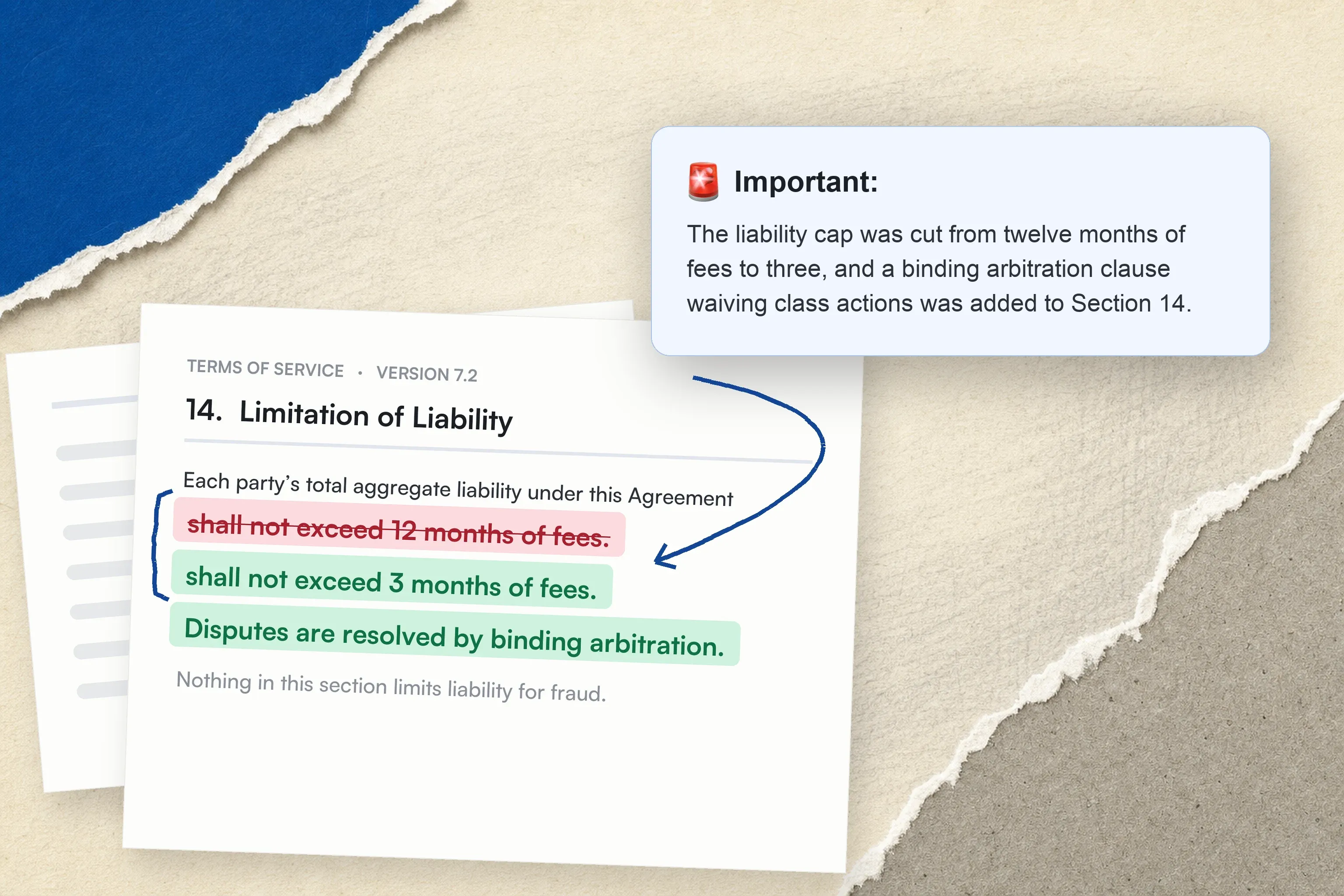
Terms and conditions change constantly. Vendors update their terms, shift liability, raise prices, and rewrite data clauses on a quiet schedule that nobody reads. Most companies don't notice until an auditor flags a gap, a finance team spots a new fee, or legal fields a question they can't answer. By then the new terms have already been in force for weeks.
If you sit in compliance, legal, or procurement, terms and conditions monitoring is how you close that gap. This guide shows what to watch, why it matters, and how to automate the tracking so material changes land in your inbox the day they go live.
Why terms and conditions changes matter
A T&C update is never cosmetic. It rewrites the contract you're operating under, often without a signature and sometimes without notice.
SaaS price changes. Stripe has adjusted its processing fees and card-network pass-throughs several times in the last three years. AWS revises pricing pages, reserved instance terms, and service-level agreements on a rolling basis. OpenAI shifted API pricing and usage tiers multiple times since 2023. Each change flows straight to your monthly invoice.
Data handling shifts. Post-GDPR, every major processor rewrote its terms of service to clarify data residency, sub-processor lists, and breach notification windows. The DSA and state-level US privacy laws triggered another round. If your DPA references a vendor's ToS version from two years ago, you may be out of sync with the current document.
Liability transfers. Vendors routinely add arbitration clauses, cap damages, or narrow warranty language. A single revised indemnification paragraph can shift risk from the vendor to you, and nothing about the vendor's login screen will tell you it happened.
Payment and renewal terms. Auto-renewal windows, cancellation notice periods, and late-payment penalties move around. Procurement teams have been caught paying for another year of a tool because a 60-day notice quietly became 90.
The smartest legal teams treat T&C pages as live documents and track them the same way finance tracks vendor invoices.
What triggers a T&C update
Knowing why vendors rewrite terms helps you predict when to expect changes and what to look for.
- Internal business decisions. Pricing changes, new product features, deprecated services, or a pivot in how the company positions itself.
- Regulatory pressure. GDPR, CCPA, the EU AI Act, the DSA, and sector rules like HIPAA or PCI DSS all force ToS rewrites. Expect a wave every time a major regulation takes effect.
- Product changes. New AI features often arrive with new data-use clauses. A vendor adding generative AI to its platform will almost always update terms to cover training data, output ownership, and liability.
- M&A activity. Acquired companies inherit the acquirer's legal framework. When a vendor gets bought, their terms usually get rewritten within six to twelve months.
- Competitive response. If a competitor gets sued or loses a ruling, other vendors in the category tend to harden their own terms to avoid the same exposure.
What legal teams actually monitor
Visualping runs change monitors on terms, privacy and other legal pages for 1,795 customers.
The pages move more than people expect. 46% of monitored legal pages recorded a change in the last 90 days.
Which vendors rewrite terms most often is the more useful question, and the answer is lopsided:
| Vendor legal pages | Customers watching | Pages changed in 90 days |
|---|---|---|
| Google Workspace | 15 | 82% |
| Anthropic | 35 | 80% |
| OpenAI | 28 | 80% |
| GitHub Docs | 17 | 79% |
| Atlassian | 23 | 63% |
| Microsoft | 25 | 61% |
| Google Cloud | 29 | 60% |
| Cloudflare | 18 | 50% |
| Apple | 25 | 40% |
| Adobe | 18 | 40% |
| 22 | 23% |
AI and developer platforms sit at roughly 80%, while a mature consumer platform like LinkedIn sits at 23%. If you are prioritising a monitoring list and can only watch a handful of pages, that gap tells you where to start.
One more number worth flagging: only 37% of legal-page monitors check daily or faster. Most run weekly or slower, which is a reasonable default for a contract that changes twice a year and a poor one for an AI vendor rewriting its terms every quarter.
How to monitor terms and conditions changes
There are two ways to track T&C updates, and most teams underestimate how much slips through the manual approach.
Manual monitoring means subscribing to vendor email lists, bookmarking legal pages, and running periodic reviews. It works for a handful of critical contracts if someone actually does the reviews on schedule. The problem is coverage. Vendors often bury material changes under generic subject lines like "We've updated our Terms," direct users to the full document without a redline, and count silence as consent. The notification tells you something moved, not what moved or whether it matters to you.
Automated monitoring watches the page itself. A change detection tool checks the T&C URL on a schedule, compares the new version against the last captured version, and alerts you the moment the text changes. You get the diff without reading the whole document, and you catch changes the vendor never announced.
For legal and compliance teams tracking dozens of vendors, automation is the only approach that scales.
How to set up automated T&C monitoring with Visualping
Visualping is a change detection tool built for exactly this kind of tracking. Here's how to set it up for terms and conditions monitoring:
- List your vendor and partner T&C URLs. Pull every critical SaaS tool, payment processor, cloud provider, and data vendor your company depends on. Get the direct URL to each legal page (terms of service, privacy policy, DPA, acceptable use policy).
- Enter each URL in Visualping. Paste the URL into the monitor creation field. Visualping renders the page and captures a baseline.
- Select the T&C section with visual area selection. Drag to isolate the body of the legal document. This tells Visualping to ignore page chrome like navigation, cookie banners, and footer links that change on every visit and create noise in your alerts.
- Set the check frequency. Daily checks work for most critical vendors. For the highest-stakes contracts (payment processors, your primary cloud provider), use five-minute or hourly checks. For lower-tier vendors, weekly is fine.
- Configure email alerts with visual diffs and AI summaries. Visualping sends an email the moment the page changes. The alert shows added text highlighted in green, removed text in red, and an AI summary that interprets the change in plain English. For legal teams that don't want to parse every redline personally, the AI summary is the difference between a one-minute triage and a two-hour review.
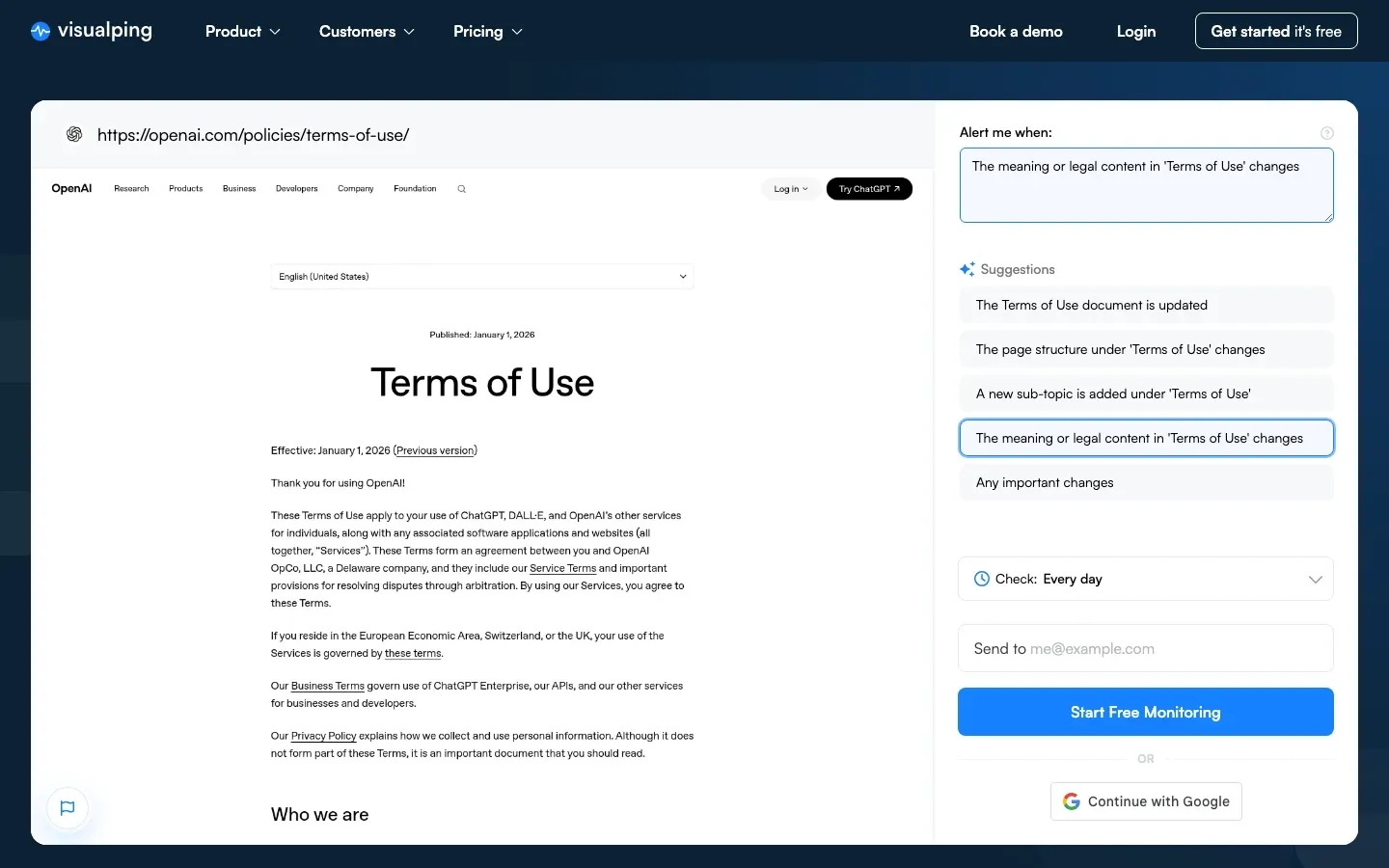 Visualping suggests conditions written for the page it loaded, including one for changes to legal meaning
For teams routing alerts to a Slack channel or a ticketing system, Visualping also supports webhook delivery so you can push changes straight to legal or compliance workflows without anyone watching an inbox.
Five T&C pages worth monitoring
Start here. These five categories cover the contracts most likely to hit your business when they change.
1. Cloud infrastructure (AWS, GCP, Azure). Service agreements, pricing pages, and SLA documents. A silent change to egress pricing or reserved instance terms can reshape your cloud bill.
2. Payment processors (Stripe, PayPal, Adyen). Processing fees, dispute policies, and acceptable use rules. Fee changes flow directly to unit economics. Acceptable use changes can put your business out of compliance overnight.
3. AI and ML providers (OpenAI, Anthropic, Google). Usage terms, data retention, training opt-outs, and liability caps. This category rewrites terms more often than any other right now. If your product embeds a third-party LLM, the vendor's ToS is effectively part of your own product terms.
4. Data processors and analytics (Mixpanel, Segment, Amplitude). DPAs, sub-processor lists, and data residency clauses. Any change here is a privacy team issue and often a contractual obligation to disclose to your own customers.
5. Major SaaS vendors your team depends on. CRM, support, HR, and finance tools. A renewal-notice change in your HRIS contract is the kind of thing that costs you a year of a seat license nobody's using.
Frequently asked questions
How do I get notified when a company changes its terms and conditions?
Put a change monitor on the terms page itself rather than relying on the vendor's notification email. Paste the URL into a tool like Visualping, select the body of the document so page chrome is ignored, set a check frequency, and you get an email showing exactly which clauses changed.
Do companies have to tell you when they update their terms?
It varies by jurisdiction and by what the contract says. Many agreements reserve the right to change terms with notice posted on the page itself, and treat continued use as acceptance. That is precisely why monitoring the page is more reliable than waiting to be told.
How often do vendors change their terms and conditions?
Across legal pages monitored on Visualping, 46% recorded a change within 90 days. The rate varies sharply by vendor type: AI and developer platforms run near 80% over the same window, while established consumer platforms can sit near 20%.
What is the difference between terms and conditions and terms of service?
In practice they are the same kind of document under different names, along with terms of use. What matters more is which related documents exist alongside them, because a privacy policy, DPA, acceptable use policy and SLA can each change independently and each may need its own monitor.
Can I track changes to a PDF version of terms and conditions?
Yes, though it is less reliable than monitoring an HTML page. Where a vendor publishes both, monitor the web version, which usually updates first and produces a cleaner diff.
How many vendor terms pages should we monitor?
Start with the contracts where a clause change would cost you money or create a compliance obligation: your cloud provider, payment processor, any AI vendor embedded in your product, and your data processors. Most teams on Visualping start with one page and expand from there.
From detection to response
Catching a T&C change is the first step. What matters next is how fast your team can assess the impact and decide whether to accept, push back, or switch vendors.
The legal teams that do this well have three things in place: a monitored list of vendor T&C URLs, a triage workflow that routes new alerts to the right reviewer, and a documented process for escalating material changes to procurement or the business owner. Visualping handles the detection layer. The regulatory change management guide covers the assessment and response workflow end to end, and how to choose regulatory change software walks through what to look for if you're evaluating tools for a larger compliance program.
For teams that also track legislation and rulemaking alongside vendor terms, legislative tracking software covers how to fold government sources into the same monitoring setup. And if you want to understand the AI summary layer in more detail, how to monitor a web page with AI breaks down how the plain-English interpretation works.
Terms and conditions monitoring used to be a reactive, once-a-quarter chore. With automated detection and AI summaries, it becomes a daily signal that feeds the same workflow you already run for regulatory intelligence. The goal is simple: when a vendor changes the rules, you know the same day, and you get to decide what happens next.
Want to stay on top of non-compliance?
Sign up with Visualping to detect issues from any web page online – before your business is on the line.
Kayla Zhu
Kayla is the Public Relations Specialist at Visualping and manager of Visualping's Journalist Program. She manages Visualping's media relations, content marketing, and social media.
More articles by Kayla Zhu