Open-Web Agents vs. Page Monitoring Agents
Updated May 26, 2026

A useful way to understand the agentic web is as two related architectures.
Visualping has been operating in the second architecture for nine years. When Google named information agents at I/O 2026, the press treated the announcement as a single category. It is not. The work of "watching the web for you" can be separated into two common systems with different inputs, freshness budgets, failure modes, and jobs to do. Visualping is a page monitoring agent, which sits in the second of those two systems.
This is the framework note, written down before the marketing departments water the words down.
The short version
Open-web agents scan the web for a topic. You hand them a question. They roam. Page monitoring agents verify state on a specific URL. You hand them a page. They watch.
In many workflows, both are useful, and treating them as the same thing can create mismatched expectations.
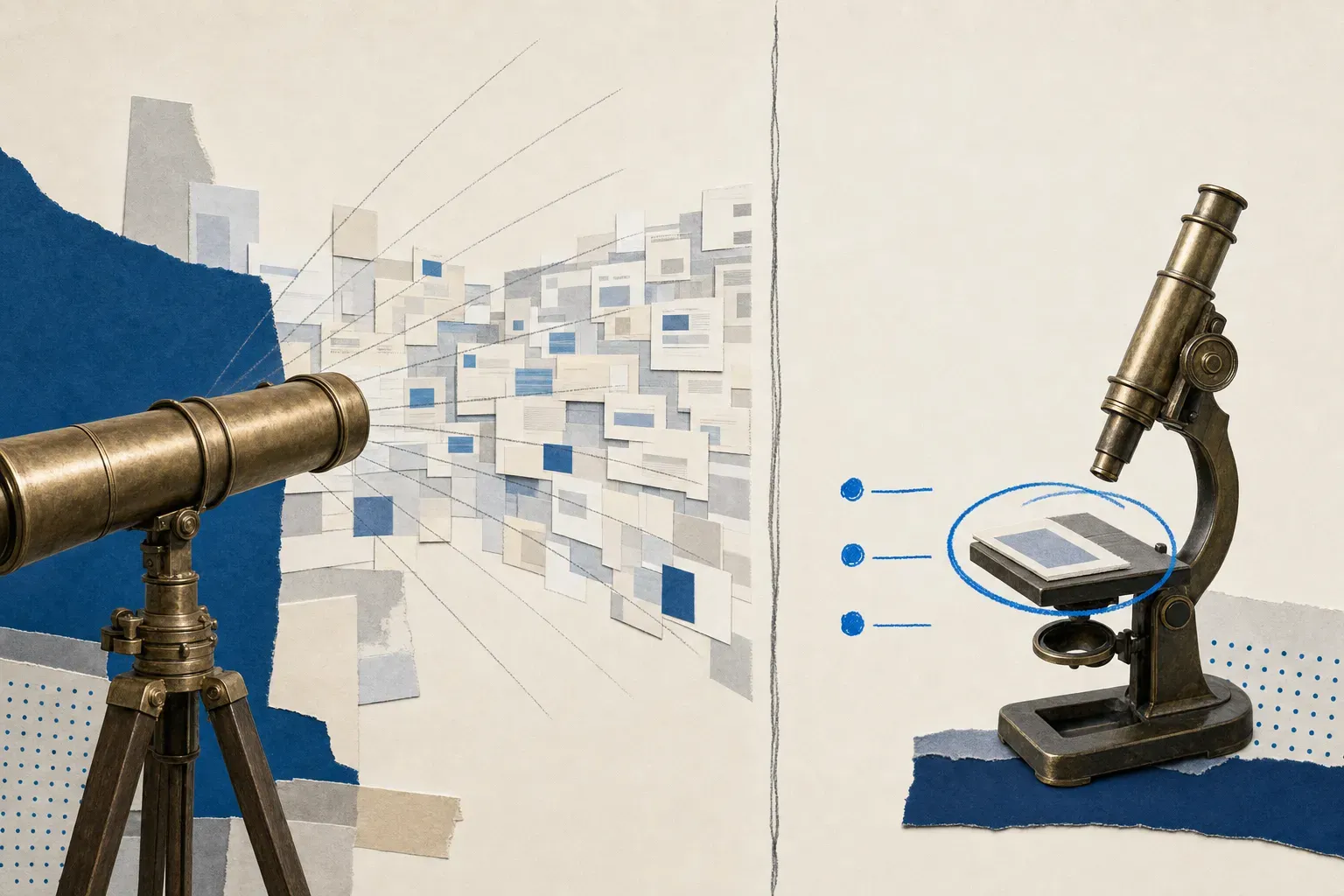 Two instruments, two jobs. Discovery scans the horizon; precision examines one specimen.
What is an open-web agent?
An open-web agent is an AI agent that continuously samples the open web on behalf of a user, synthesizes what it finds, and reports back. The input is a topic, a question, or a persistent interest. The output is a synthesized briefing across many sources.
Examples adjacent to this layer include Google's announced information agents and ChatGPT Pulse. Search and research products such as Exa and Perplexity can also support topic-level discovery, depending on how they are used.
Open-web agents typically rely on search and retrieval systems: crawling or sourcing pages, retrieving relevant material, ranking it, and summarizing it. What makes them "agentic" is that the work happens in the background, on a recurring basis, without the user re-typing the query. The freshness budget is often wide and shallow: the agent samples many sources rather than maintaining a deep, page-specific history for each one.
Strengths:
- Good when you do not know where the answer lives
- Good at synthesis across many sources
- Good at unstructured topics ("what is happening in fusion energy this week")
- Good at discovery
Limits:
- Not generally optimized to watch one specific page at a defensible cadence
- May not provide a page-specific audit trail of "what changed and when"
- Visual or structural changes on a single URL are usually not the core artifact
- Hallucinated or over-interpreted change reports can be a failure mode
What is a page monitoring agent?
A page monitoring agent is a system that watches one specific URL on a schedule, detects changes, classifies them, and routes an alert. The input is a URL. The output is a change event with a timestamp, a diff, and (if the platform is doing its job) an AI-generated summary of what changed and whether it matters.
One established product in this layer is Visualping, a page monitoring agent that has been doing this work since 2017.
Page monitoring agents inherit the architecture of testing and observability, not search. They poll, they diff, they alert. They do not synthesize across sources. They tell you, with timestamped evidence, that one specific thing changed on one specific page. (Older shorthand for the same product category is "page monitor"; the two terms refer to the same architecture.)
Strengths:
- Tight, repeatable cadence on a specific URL, with five-minute options on Business and sub-minute options for eligible Solutions configurations
- Visual diffing on many JavaScript-rendered pages
- AI classification of whether a change is important enough to alert on
- Timestamped evidence that can support compliance, legal, or audit review
- Page-monitoring costs are usually easier to model per URL; topic-level discovery costs depend on the breadth and frequency of the search.
Limits:
- You have to know which URL matters
- Will not discover a new page on its own
- Not primarily designed for synthesis across sources unless multiple monitors and downstream workflows are connected
Side by side
| Dimension | Open-web agents | Page monitors |
|---|---|---|
| Input | A topic or question | A URL |
| Output | Synthesized briefing | Change event with diff |
| Freshness | Wide, shallow (samples many pages) | Narrow, deep (one page on a tight schedule) |
| Cadence | Daily or on-demand | Five minutes to daily, per page |
| Evidence | Cited links, model summary | Visual diff, timestamped screenshot, AI classification |
| Failure mode | Hallucinated synthesis | Missed cadence, broken selector |
| Architecture lineage | Search and retrieval | Testing and observability |
| Named players | Google Information Agents, ChatGPT Pulse, Exa, Perplexity | Visualping and other page monitoring agents |
| Best for | Discovery and synthesis | Verification and audit |
The table is the whole argument. The two columns are different systems. A team that buys one and thinks it bought the other is going to be unhappy.
How they compose
The wrong frame is a single-stack winner-take-all (one product replaces all the others). The right frame is two architectures that hand off cleanly. They are more complementary than competitive. They feed each other.
A practical workflow:
- Discovery. An open-web agent watches a topic ("competitor pricing changes in enterprise CRM"). It samples the web, finds twelve relevant URLs, and notes which ones look load-bearing.
- Precision. Those twelve URLs get handed to a page monitoring agent with a five-minute cadence, a visual-diff configuration, and an AI prompt that flags pricing changes specifically.
- Action. When the page monitor fires a change event, a downstream agent decides what to do. That agent might be a sales agent, a competitive-intelligence agent, or a workflow in a coding tool. The actions are concrete: update the battlecard, alert the deal team, file the change in a ticket.
The discovery layer finds the page. The precision layer verifies the page. The action layer acts. Three jobs. Three systems. One architecture.
 Discovery feeds precision feeds action. Three jobs, three systems, one architecture.
This is also the most defensible answer to the question "is Google going to put us out of business?" Based on the announced consumer Search feature, Google's information agents appear closer to the discovery layer and should not be assumed to replace high-cadence monitoring of thousands of specified URLs with page-level evidence. That is a different system, with different economics, built by different people.
A decision matrix
If you are picking which layer to wire into your own workflow, the question is simple.
- You know the URL that matters → page monitoring agent. A specific competitor's pricing page, a regulator's docket, a tender board, your own deploy. Hand it to a page monitoring agent.
- You know the topic but not the URLs → open-web agent. A general interest in "AI regulation" or "fusion-energy funding announcements." Hand it to an information agent.
- You need a timestamped change record for compliance, legal, or audit → page monitor. Discovery agents typically do not provide the same page-specific evidence that a specific page changed at a specific time.
- You need synthesis across sources → open-web agent. Monitoring layers are not primarily built for synthesis. They produce page-specific events first; downstream agents can turn those events into narratives.
- You need both → wire them together. Discovery feeds precision feeds action.
What this means for builders
If you are building on top of AI coding agents, the architecture matters more than the buzzword.
Developers using Claude Code, OpenAI Codex, or Google Antigravity can run into the same wall. You ask the coding agent to "watch this dashboard and ping me when the build status changes." The agent reasons well. The agent writes code well. Without a persistent monitoring tool, the agent often has to rely on temporary code or an external scheduler for the actual watching.
It needs a monitoring primitive it can call.
Visualping can serve as that primitive. The Visualping MCP is in public beta and can be added as a remote custom connector in agent clients and workspaces that support MCP. For composability patterns, see Visualping in an MCP stack. The full walkthrough lives in the developer cornerstone for this series.
Wire Visualping into your AI agent.
In Claude: use the custom connector flow under Connectors and paste
https://visualping.io/mcp/sse. In ChatGPT: use the custom MCP connector flow when Developer mode or workspace connectors are enabled, then pastehttps://visualping.io/mcp/sse.The REST API is on every plan, including Free, for webhook and code-first patterns. For many individual developers, a paid Personal plan may be the practical entry point once usage exceeds Free-plan limits.
Once the connector is wired, the architecture from the earlier section becomes a concrete pipeline. The coding agent asks the open-web agent for candidate URLs. The coding agent asks Visualping to watch them. Visualping returns verified change events. The coding agent takes action.
A snapshot from the precision layer
A quick sample of what page monitoring agents do at scale, so the architecture is grounded in something concrete.
In a same-day snapshot of active Visualping monitors on May 24, 2026, 52,452 monitors ran on a five-minute-or-faster cadence. Use cases that often require faster monitoring include tender boards, regulatory dockets, SEC filings, status pages, and competitive pricing pages.
In a sample of 53,607 user-written alert conditions, common patterns included pricing, inventory availability, registration openings, and tender/RFP monitoring. Specific, named, scheduled outcomes.
In a sample of 53,607 user-written alert conditions, pricing-related conditions were a prominent observed pattern. That pattern maps to a common competitive-intelligence workflow: identify the pricing pages that matter, monitor them on an appropriate cadence, and use the resulting diff as an input to battlecard updates. An open-web agent can surface later coverage of a pricing change. A page monitoring agent surfaces the page state itself, with the screenshot, when the change happens. Two architectures, same market, different jobs.
Open-web agents typically produce summaries rather than monitor-level alert-condition datasets. The two systems generate fundamentally different artifacts, and that is the simplest test for which one you actually need.
Frequently asked
Is an open-web agent the same thing as an AI search engine?
No. An AI search engine answers a question on demand. An open-web agent runs in the background, on a recurring schedule, and surfaces changes or updates without the user asking each time. ChatGPT answering "what is the latest on fusion energy" is search. ChatGPT Pulse sending a daily fusion-energy briefing is an open-web agent.
Is a page monitor the same thing as a web scraper?
No. A web scraper extracts data on demand. A page monitor watches a page over time, detects changes, and alerts. Many scrapers are stateless extraction tools; monitors are designed to maintain state over time. A scraper can be the engine inside a monitor, but the monitor is the system that does the watching, classification, and alerting.
Why not just use an open-web agent to monitor specific pages?
It may be able to sample them, but it may not be designed to watch them at a tight cadence with a page-specific timestamped history. The architecture is built to sample many sources broadly, not to watch one source deeply. Trying to make a discovery agent into a precision monitor is the same kind of mistake as trying to make a search engine into a database. Both are possible at small scale; usually, neither is the right tool past that point.
What is the difference between an information agent and a monitoring agent?
"Information agent" is the consumer name Google gave to the discovery layer at I/O 2026. "Monitoring agent" is a category-adjacent term sometimes used for the precision layer. The cleaner distinction is the architectural one: discovery versus precision. Both are agents. Both can run on recurring schedules. They do different work.
Do open-web agents replace SEO?
Not on their own. They change which audience is reading your site. The third audience now is AI agents acting on behalf of users, which is a separate discipline called agent search optimization. Open-web agents are how that audience finds you. Page monitors are how a different audience (you, watching your competitor) keeps up with them.
What does "monitoring primitive" mean?
A monitoring primitive is a low-level building block for agents and workflows that need to know when web state changes. It exposes a small interface: create a monitor on a URL, get a webhook when something changes, read recent change events by ID. Higher-level agents call it the same way browsers call TLS or databases call an index. The Visualping MCP and REST API are both shaped this way.
Closing
Two architectures. Two jobs. One stack.
Some coverage may continue collapsing them into "AI search" for a while. The teams that get ahead are the ones that learn the vocabulary now: discovery and precision, open-web agents and page monitoring agents, synthesis and verification. The category Google named at I/O 2026 has a substrate. Naming it is the first step in being able to build on it. If you think the two-architecture frame breaks somewhere, that is the argument worth having.
Eric Do Couto is Head of Marketing at Visualping. He writes about the architecture of monitoring, AI agents, and the slow business of category formation.
Want to monitor web changes that impact your business?
Sign up with Visualping to get alerted of important updates from anywhere online.
Eric Do Couto
Eric Do Couto is the Head of Marketing at Visualping. He leads content strategy, growth operations, and brand positioning for website change detection.
More articles by Eric Do Couto