The 7 Best Free Website Change Detection Tools in 2026
Updated July 27, 2026
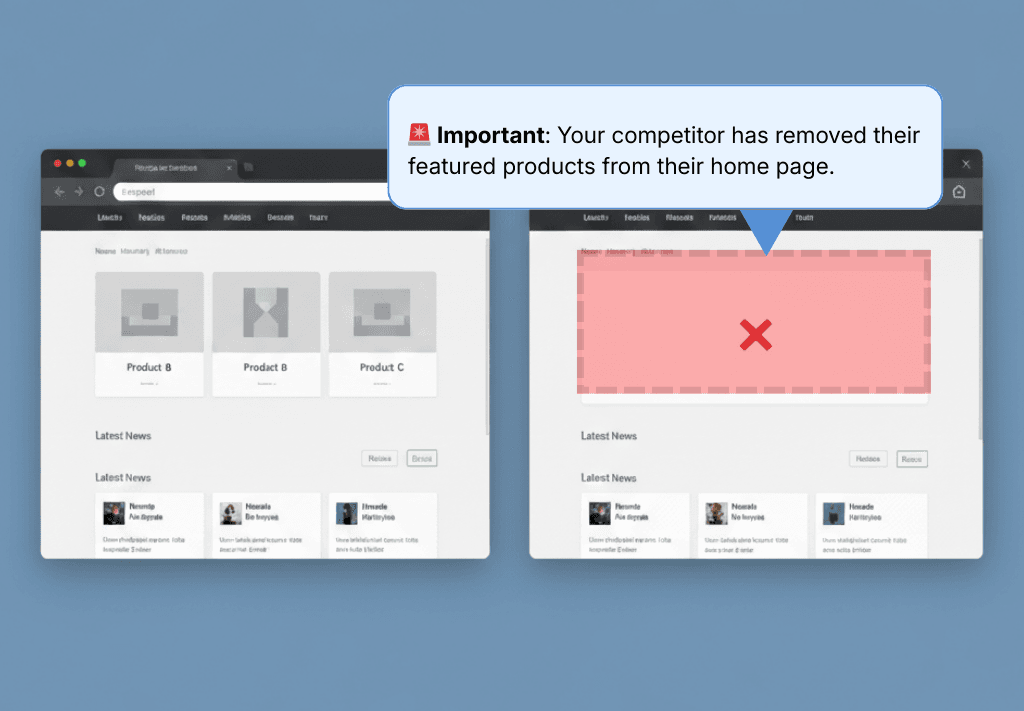
Keeping tabs on what's changing across the web, whether it's a competitor's pricing page, a regulatory update, or a product that's been out of stock for months, used to mean constant manual checking.
Refresh the page. Note what changed (or didn't change). Repeat tomorrow. That approach doesn't scale, and is frankly a huge waste of time.
Website change detection tools automate all of that. They watch the pages you care about and notify you the moment something important changes. The best tools in 2026 layer AI on top to filter out noise and surface only the changes that matter.
This guide compares the 7 best free website change detection and monitoring tools available right now. We re-verified every free tier limit against each vendor's live pricing page on July 27, 2026, because free plans change quietly and often. Each tool is evaluated on ease of use, free tier generosity, advanced features, and how well it supports real use cases like competitor website tracking, compliance monitoring, price tracking, and back-in-stock alerts.
Disclosure: This guide is written by the team at Visualping, one of the tools evaluated below. We've kept every claim verifiable, disclosed each tool's limitations honestly, and we recommend testing more than one tool. Your needs may be better served by a competitor.
Short answer: Visualping is the best free website change detection tool for most people, thanks to AI-powered alert conditions and the easiest setup of any tool we evaluated. PageCrawl.io has the most generous free tier for non-technical users. Changedetection.io is unbeatable for developers willing to self-host. The full comparison is below.
What to Look For in a Free Website Monitoring Tool
- Ease of use. Not everyone setting up a monitor is a developer. The best tools let you get your first alert running in under a minute.
- Free tier limits that actually work. Some tools advertise a free plan that barely offers anything. Others give you enough to genuinely do your job without paying.
- False alert reduction. A tool that pings you every time an ad refreshes or a cookie banner loads just buries the changes you care about in noise. Look for features that let you define what you're watching for.
- Advanced features. Keyword alerts, element-level tracking, AI summaries, integrations with other apps, these vary a lot between tools.
- Pricing that scales. If you're evaluating a tool for a team or a growing use case, you want to know what you're walking into before you hit the free tier ceiling.
2026 Leaderboard: Best Free Website Monitoring Tools at a Glance
| Tool | Free Tier (verified July 2026) | Check Frequency | Best For | 2026 G2 Rankings/Rating |
|---|---|---|---|---|
| Visualping | 5 pages, 150 checks/mo | 60 mins | Overall ease of use, AI-powered alerts | #1 in Website Change Monitoring, Website Screenshot, Competitive Intelligence & Regulatory Change Management. 4.6/5 (415+ reviews) |
| PageCrawl.io | 6 pages, 220 checks/mo, 15 AI summaries | Hourly | Generous free plan, easy to use | 4.9/5 on G2 (7 reviews) |
| Distill.io | 25 local monitors (5 in cloud), 1,000 checks/mo | 6 hours (cloud) | Power users, local monitoring | 4.6/5 on G2 (4 reviews) |
| Changedetection.io | Free forever (if self-hosted) | As fast as 5 min | Developers, self-hosters, unlimited URLs | Not ranked on G2 |
| ChangeTower | 3 monitored pages | Daily | Code/SEO change tracking | 4.6/5 on G2 (19 reviews) |
| UptimeRobot | Visual change detection on selected page areas | Not published | Uptime monitoring with basic change alerts | Not ranked in Website Change Monitoring on G2 |
| Wachete | 5 pages | Daily | Mobile apps, monitoring on a budget | Not ranked on G2 |
How We Evaluated These Tools
Free tiers decay. A limit that was accurate in February is often wrong by July, which is exactly the kind of change these tools exist to catch. So for this update:
- Every free tier spec was re-checked against each vendor's live pricing page on July 27, 2026. Where a vendor doesn't publish a limit (UptimeRobot's change tool, Wachete's free check frequency), we say so instead of guessing.
- We disclose what each tool locks behind paid plans, because the fastest way to waste an afternoon is discovering the feature you need is paywalled after setup.
- We know this market from the inside. Visualping's monitoring platform is used by more than 2 million users, including employees at 85% of Fortune 500 companies, and we evaluate competing tools continuously as part of our own research.
Best Free Website Change Detection Tools in 2026
Visualping
If there's one tool that consistently shows up at the top of independent reviews and rankings, it's Visualping. G2 currently ranks it #1 in Website Change Monitoring, and it holds the same top position in Website Screenshot, Competitive Intelligence, and Regulatory Change Management categories.
TechRadar, HubSpot, Hongkiat, and MakeUseOf all rank Visualping #1 in their respective roundups of the best website monitoring tools. That kind of consistency across independent sources is hard to fake, and in this case it's deserved.
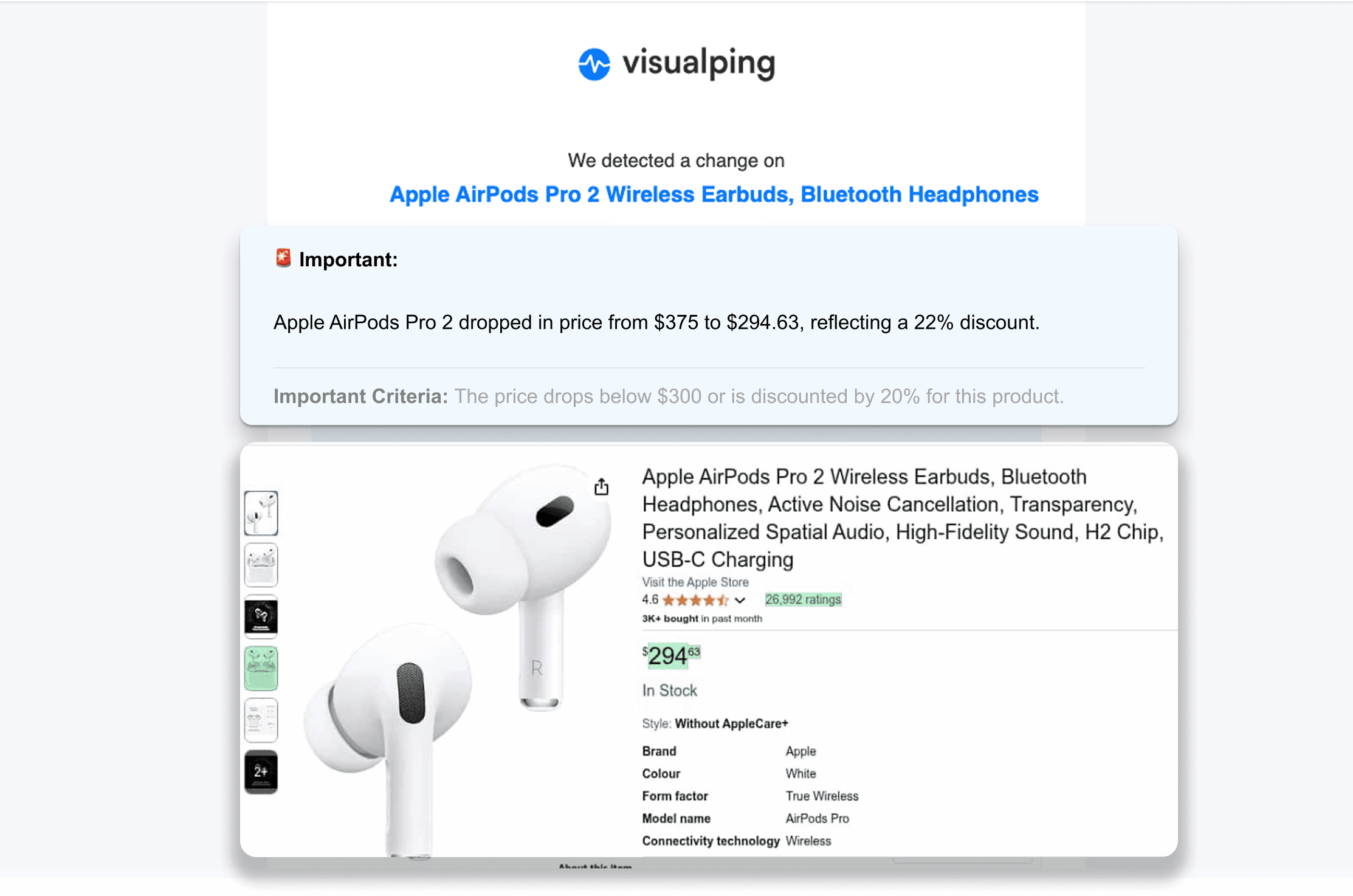
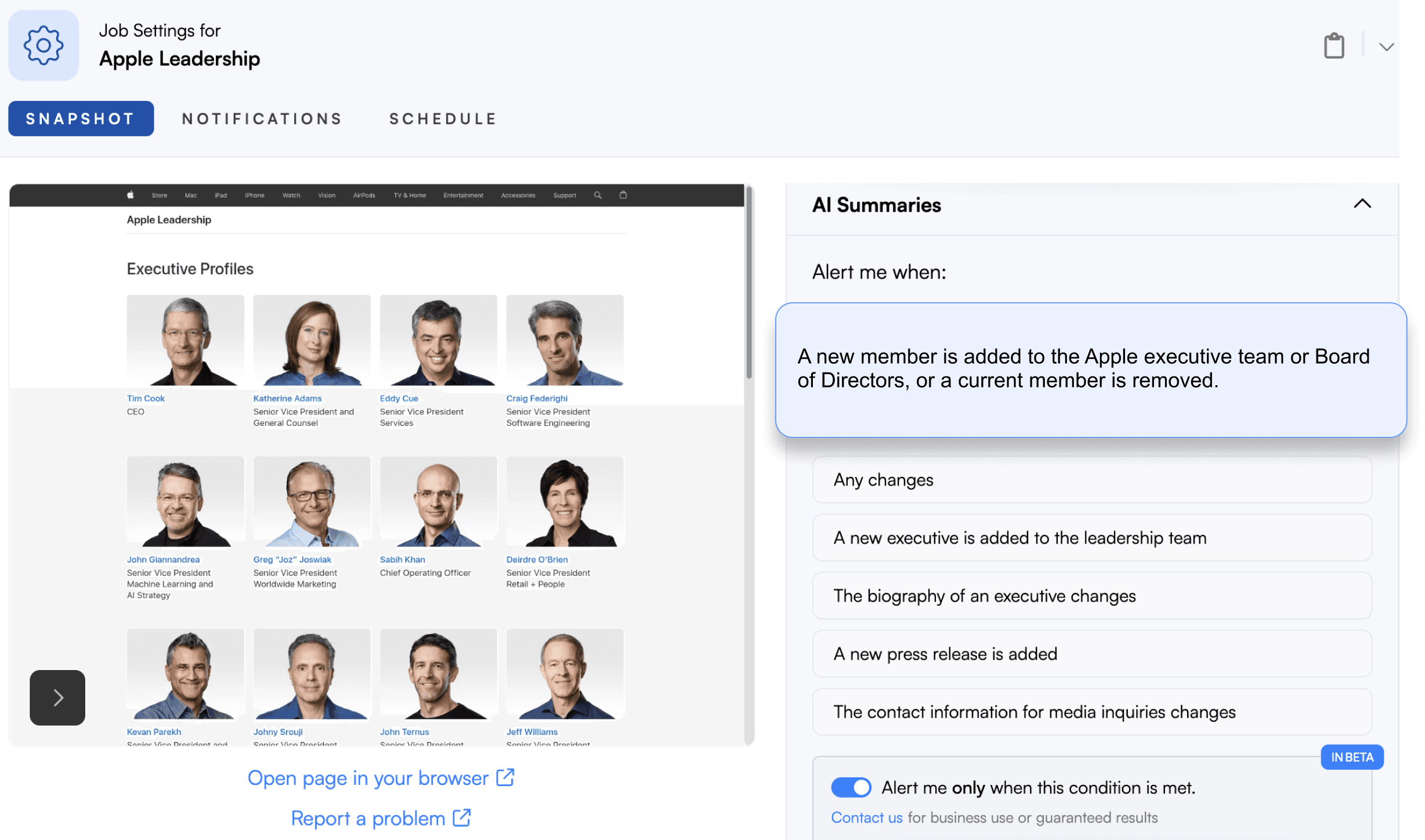
What makes it stand out: Most monitoring tools alert you when anything on a page changes. Visualping goes a step further: you set a condition in plain language for what actually matters to you, and it only notifies you when that condition is met.
Want to know if AirPods drop below $300, or fall more than 20% since the last check? That's the condition. If the price drops to $310, you won't hear a thing. The condition is essentially a simplified AI prompt. It could be "Alert me if an appointment on Tuesday between 5 and 6 PM becomes available," or "Alert me when my competitor launches a new product."
When a change matching that criteria is detected, Visualping AI flags whether the change is important and sends a concise two-to-three line summary explaining exactly what changed, so you never have to manually go check the page yourself.
Other standout features:
- Frictionless setup: Paste a URL, pick the page area, set a frequency, enter your email. Your account is created in the same step. Set up your first job in seconds.
- Concise alert summaries: AI-powered change summaries tell you exactly what changed so you don't have to examine before-and-after screenshots
- Actions and advanced features: Even on the free plan, users have access to advanced settings like actions (click, scroll, set up "wait" timers on the page) and proxies.
- Works with AI assistants: Visualping ships an API on every plan plus an MCP endpoint, so tools like ChatGPT and Claude can create and manage monitors for you.
Free plan includes (verified July 2026):
- 5 pages monitored
- 150 checks per month
- Hourly check frequency
Honest limitation: The free plan is genuinely useful for personal monitoring, but faster check intervals, team features, and other integrations (SMS, Slack, etc) all require a paid plan. Personal plans start at $10/month billed annually, and business plans at $100/month.
Who it's for: Teams tracking competitors, regulatory changes, or compliance updates who want AI-powered alerts without any technical setup. Personal users looking to track price drops, inventory levels, ticket availability.
PageCrawl.io
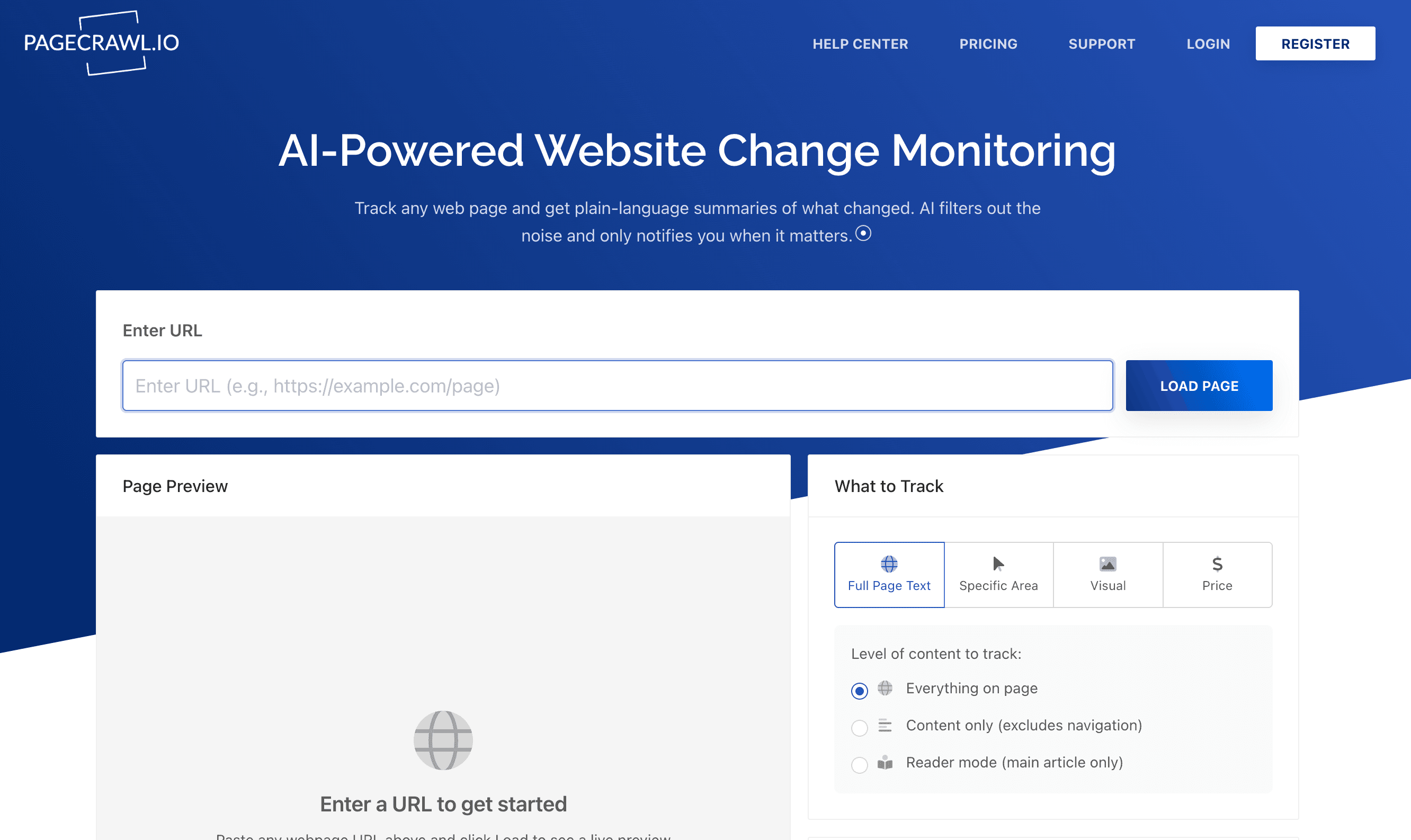
PageCrawl.io has one of the most generous free tiers of any tool on this list, and what's notable is what's included rather than just the page count. Most tools lock Slack, Teams, and Discord integrations behind paid plans. PageCrawl includes them for free.
What makes it stand out: PageCrawl's AI layer scores every detected change on a 0-100 importance scale. You set a threshold, and only changes that meet it trigger a notification. The AI learns from your feedback, mark something as irrelevant and it adjusts its filtering going forward.
Other standout features:
- Document monitoring: Tracks changes in public PDFs, Excel, Word, and PowerPoint files, plus Google Drive and SharePoint documents, in addition to standard web pages.
- Workspace sharing: Invite team members into your monitoring dashboard on the free plan, which most tools reserve for paid tiers.
Free plan includes (verified July 2026):
- 6 pages monitored
- 220 checks per month
- Hourly check frequency
- 15 AI summaries per month
- 90 days of history
Honest limitation: Email support isn't available on the free plan, and the tool is less established than major players like Visualping or Distill. The 220-check monthly budget also runs out fast if you actually use hourly frequency: one page checked hourly burns through it in nine days.
Who it's for: Teams and individuals who want strong free-tier functionality from day one, especially those monitoring document formats.
Distill.io
Distill.io has built a loyal following among power users who want granular, element-level control over what they monitor. It's less polished than Visualping, but it's just as configurable. For the right person, a researcher, a developer, someone who is more comfortable with technical tools, it's another solid and trustworthy free website change monitoring option.
What makes it stand out: Distill's visual selector lets you highlight exactly the element you want to watch on a page and ignore everything else. Its biggest free-tier advantage is local monitoring: monitors that run in your browser or desktop app can check as frequently as every 5 seconds, far faster than most cloud tools at any price.
Other standout features:
- Conditional alerts: Configure Distill to notify you only when a number falls within a defined range, specific text appears, or a regex pattern matches, instead of firing on every change.
- Broad content support: Monitors web pages, PDFs, JSON, XML, and RSS feeds, plus uptime checks, all from a single dashboard.
Free plan includes (verified July 2026):
- 25 local monitors (5 of them can run in the cloud)
- 1,000 cloud checks per month
- 30 email alerts + 100 phone push notifications per month
- Cloud check frequency: every 6 hours
Honest limitation: The interface has a steeper learning curve than most tools here, and the free plan is thinner than it first looks. Macros (automating clicks and logins before a check) require a paid plan, alert conditions have no AI filtering, and the 30-email monthly cap means a chatty monitor can exhaust your alerts in a week. Paid plans start at $15/month.
Who it's for: Developers and more technical folks who want precise element-level control and don't mind a bit of configuration to get there.
Related reading
- How to Monitor Website Changes
- Best AI Page Monitoring Agents in 2026
- Top Distill Alternatives
- Best Tools to Monitor Website Changes: 4 Visualping Alternatives
Changedetection.io
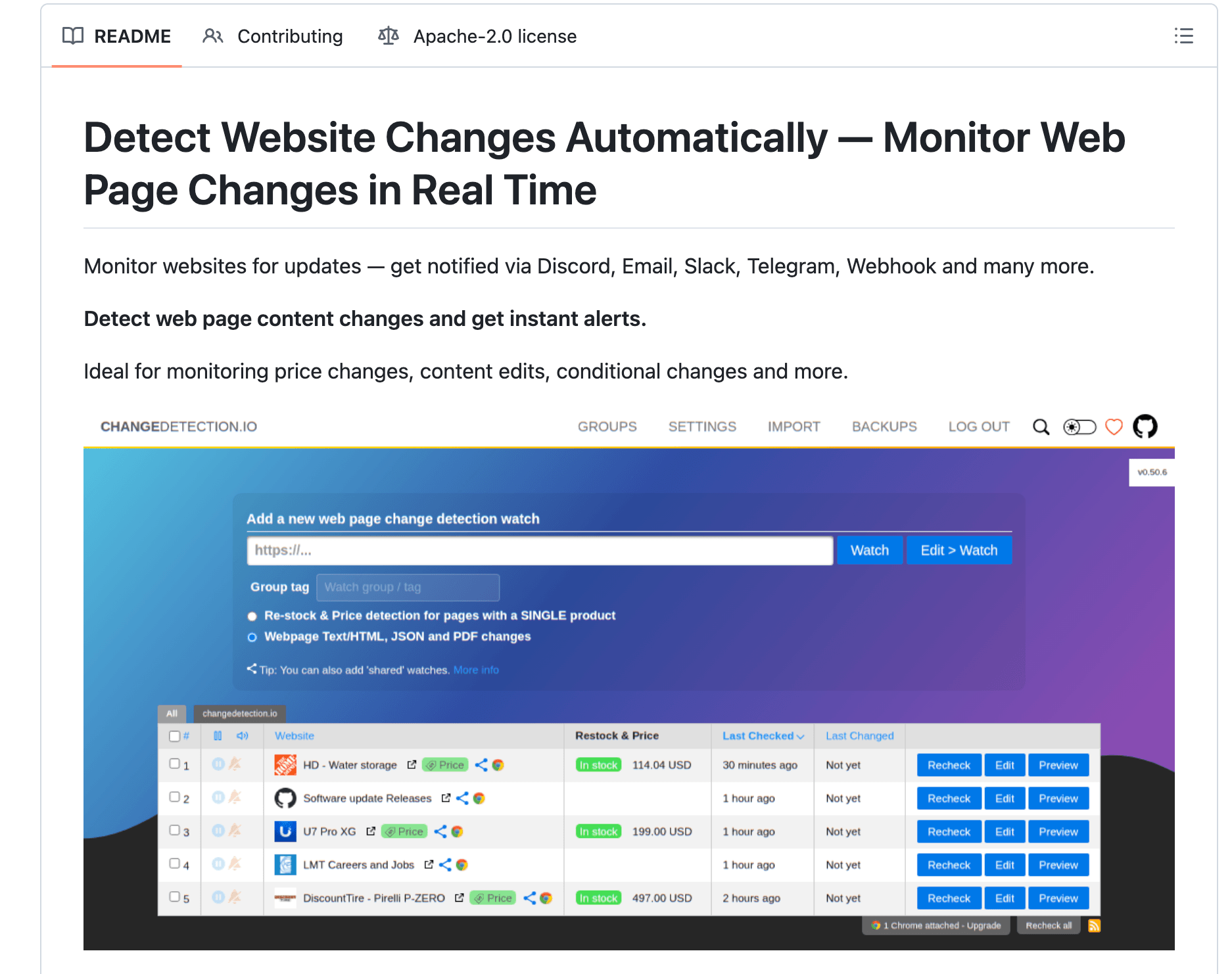
Changedetection.io is the only fully open-source tool on this list, and if you're comfortable with Docker, it's completely free to self-host with no limits on URLs, checks, or features. With over 20,000 GitHub stars and an active development community, it has earned serious credibility among developers and technically minded users who prefer to own their own monitoring infrastructure.
What makes it stand out: The combination of Browser Steps and a visual element selector means you can monitor content that's hidden behind logins, filters, or multi-step interactions, without paying extra for it. You automate the page interactions (log in, click a dropdown, accept a banner), then Changedetection.io runs the check on whatever's revealed. That's a level of flexibility that most tools reserve for enterprise tiers.
Other standout features:
- JSON and API monitoring: Use JSONPath or jq filters to track changes in structured data embedded in pages, useful for sites that load content dynamically through JavaScript.
- 85+ notification integrations: Slack, Discord, Telegram, Teams, email, and many more, all included.
Free plan includes (verified July 2026):
- Fully free and unlimited when self-hosted via Docker (cloud subscription at $8.99/month for up to 5,000 URLs)
- Check intervals as fast as 5 minutes (cloud)
- Real Chrome browser for JavaScript-heavy pages
- Access to European, US, and Tor proxies
Honest limitation: This is a developer tool first. The UI is functional but not polished, there are no AI change summaries, and self-hosting requires comfort with Docker. Not the right fit for non-technical users or teams.
Who it's for: Developers, researchers, and privacy-conscious users who want unlimited monitoring at no cost, who aren't scared of a bit of upfront technical setup.
ChangeTower
ChangeTower is a website monitoring tool that's great at catching changes to HTML source code, meta descriptions, hidden keywords, and SEO-related elements, a.k.a the kind of things that matter to technical teams and compliance officers but don't show up in a screenshot diff.
What makes it stand out: ChangeTower captures visual screenshots, text snapshots, and source code simultaneously for every check. That means you get visual and technical monitoring together in every check.
Other standout features:
- Conditional alerts: Define exact criteria for notifications, like keyword additions or removals, image changes, code-level updates
- Archive history: Every plan includes change history archiving, making it useful for compliance documentation and audit trails.
Free plan includes (verified July 2026):
- 3 URLs monitored
- Daily checks
- 1 month of archived change history
- Visual, text, and source code change capture
Honest limitation: The free tier is very limited for real-world use, and support response times can be slow. Paid plans start at $12/month.
Who it's for: SEO professionals, compliance teams, and technical users who need to track code-level or structural changes alongside visible content updates.
UptimeRobot
UptimeRobot is best known for uptime monitoring (is my site up or down?), but in 2025 it added a free visual change detection tool that now ranks among the most visible options in search. You paste a URL, highlight the section of the page you want to watch, and get an email with a visual snapshot and summary when that area changes.
What makes it stand out: If you already use UptimeRobot for uptime monitoring, adding change detection on a few pages means one less account to manage. The area-selection setup is genuinely simple.
Free tool includes (verified July 2026):
- Visual change detection on a selected page area
- Email alerts with a snapshot of what changed
- Runs on an UptimeRobot account (uptime monitoring free tier included)
Honest limitation: UptimeRobot doesn't publish page-count or frequency limits for the change detection tool, and change monitoring is an add-on to an uptime product rather than its core focus. There are no AI conditions, keyword alerts, or change summaries comparable to dedicated tools, and no change archive for compliance use.
Who it's for: People who already rely on UptimeRobot for uptime checks and need light change detection on a handful of pages, without advanced filtering needs.
Wachete
Wachete has been around since 2014 and remains a budget-friendly option with something rare in this category: native mobile apps for iOS, Android, and Windows, so change alerts land as phone notifications without email.
What makes it stand out: Wachete can monitor dynamic pages and pages behind logins, watch a whole page or a selected part, and connects to Slack, Teams, Discord, and Telegram. Paid plans are among the cheapest anywhere, starting at $4.90/month for 50 pages.
Free plan includes (verified July 2026):
- 5 pages monitored
- Email and mobile push alerts
- History with charts and spreadsheet export (up to 12 months, plan-dependent)
Honest limitation: Wachete doesn't clearly publish its free-tier check frequency (expect daily rather than hourly), the interface feels dated next to newer tools, and there is no AI-based noise filtering or change summarization.
Who it's for: Casual users who want free monitoring with mobile push notifications, and budget-conscious users who may outgrow the free tier but want the cheapest paid upgrade path.
So, Which Tool Should You Use?
That depends a lot on what you're actually trying to do.
For most people who want a clean, easy-to-use tool with AI summaries and a track record backed by third-party rankings, Visualping is the obvious starting point. The free tier is enough to evaluate it, and the G2 and independent review site rankings aren't marketing spin.
If you monitor a lot of pages and want to squeeze more out of the free tier, PageCrawl's free plan is hard to beat.
For technical monitoring, like HTML changes, SEO elements, code diffs, ChangeTower is a strong alternative.
If you're a developer or technically comfortable with Docker, Changedetection.io gives you unlimited monitoring for free, nothing else on this list can match that.
If you mainly need uptime monitoring with occasional change alerts, UptimeRobot covers both in one account. And if you want the cheapest paid upgrade path with mobile apps, Wachete is worth a look.
All of them offer free versions or trials, so there's no reason not to test a couple before committing.
Frequently Asked Questions About Free Website Change Detection
What is website change detection? Website change detection is the process of automatically monitoring a web page and getting notified when its content changes. Instead of manually checking a page every day, a monitoring tool does it for you and sends an alert when something important changes. The change could be a price update, a new product launch, a regulatory update, or anything else on the page you care about.
Are free website monitoring tools actually useful, or do you need to pay? It depends on the scale of what you're tracking. For personal use, like watching a handful of pages daily, the free tiers from tools like Visualping, PageCrawl.io, and Distill.io are genuinely functional. For teams, faster check frequencies, or bulk monitoring across dozens of pages, you'll typically need a paid plan. The good news is most tools offer enough on the free tier to figure out whether a paid plan is worth it before committing.
How do I avoid false alerts? Most tools let you narrow what you're watching by selecting a specific section of the page, setting a change threshold (only alert me if the change is above X%), or blocking ads and cookie popups from triggering notifications. Visualping's AI condition-setting takes this further, letting you define in plain language exactly what counts as an alert-worthy change.
Can these tools monitor pages that require a login? Some can. Visualping's "Actions" feature handles login flows and basic interactions. Distill.io's macro recording automates multi-step interactions before a check (paid plans). Changedetection.io's Browser Steps does the same for free if self-hosted. If monitoring behind a login wall is a core requirement, make sure to check that the specific tool supports it before signing up.
How often do these tools check for changes? It varies significantly by tool and plan. Free tiers typically check once per day, every few hours, or even hourly like Visualping and PageCrawl. Paid plans can go as fast as every 2 minutes (Visualping Business), every 5 minutes (changedetection.io cloud), or even faster for local monitors on Distill.io. If real-time or near-real-time detection matters to you, check the frequency limits carefully before choosing a free plan.
What's the best free website change detection tool overall? For most people, Visualping is the strongest starting point. It's the #1 ranked tool on G2, has the easiest onboarding, and it's the only tool with AI-condition-based alerting on a free plan. If you need more pages or integrations for free, PageCrawl.io is a close second. For developers who want unlimited monitoring at zero cost, Changedetection.io (self-hosted) is in a category of its own.
Other Resources
Try the #1 rated free website change detection tool
Monitor 5 pages free with AI-powered alerts. No credit card needed.
Eric Do Couto
Eric Do Couto is the Head of Marketing at Visualping. He leads content strategy, growth operations, and brand positioning for website change detection.
More articles by Eric Do Couto