Why Rank Position Data Lies (And How to See What Users Actually See) | Visualping Blog
Updated January 16, 2026
Last Updated: January 2026
Disclosure: This article is written by the Visualping team. We develop page monitoring agents that can be used for visual SERP monitoring. We've aimed to provide balanced, research-backed information, but you should be aware of our perspective when evaluating our recommendations.
TL;DR
- Position 1 CTR dropped 32% in 2025. Rankings stayed stable for many publishers while traffic collapsed because position numbers no longer reflect what users actually see.
- AI Overviews caused a 61% decline in organic CTR for queries where they appear, and now show on 30% of US desktop searches.
- Even queries without AI Overviews saw CTR drop 41% year-over-year. The entire SERP landscape is shifting, not just AI-affected queries.
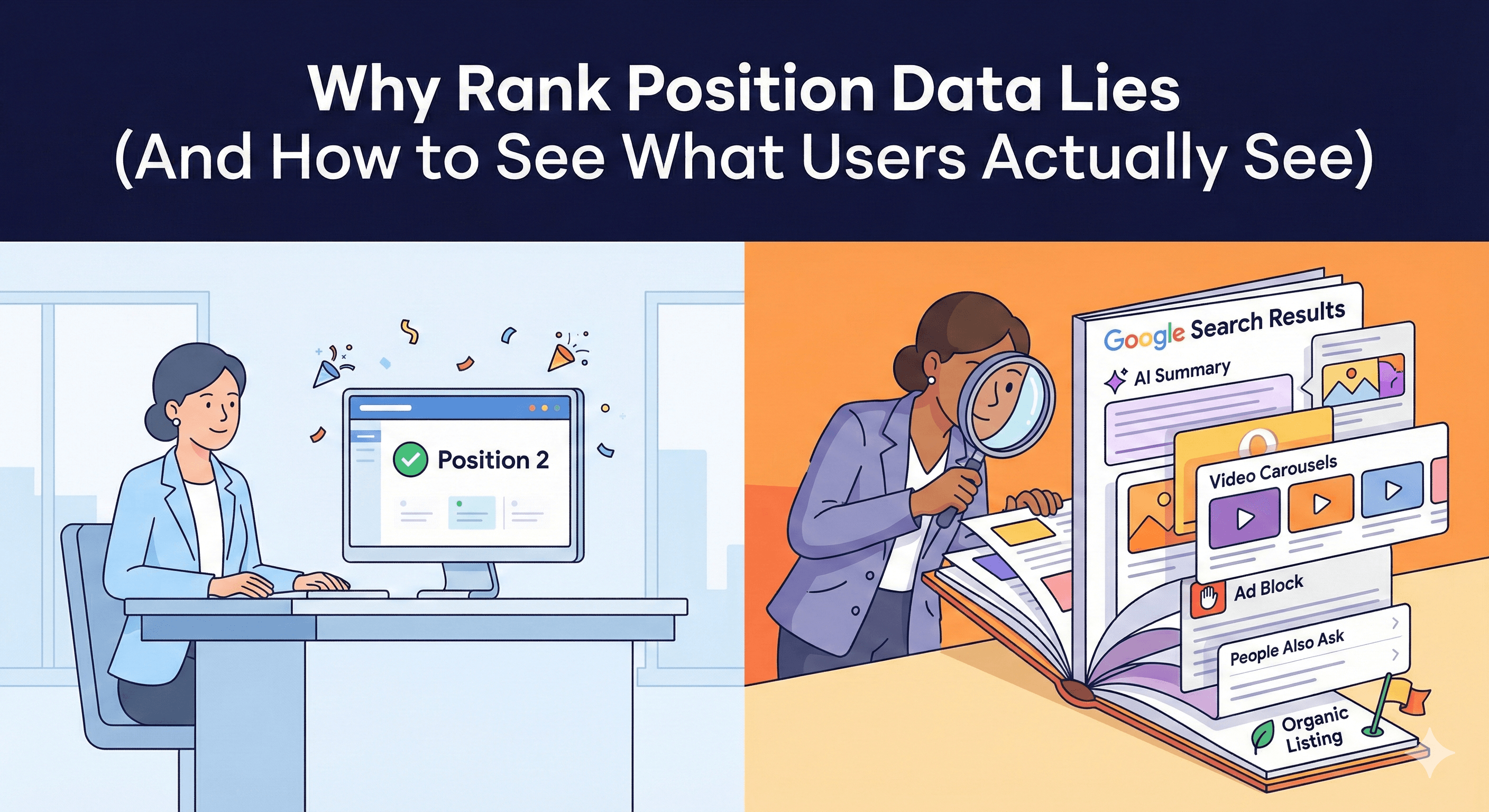
- Rank trackers report position. They don't show what's above your listing: ads, AI Overviews, featured snippets, People Also Ask, video carousels, and other features that push organic results below the fold.
- Visual SERP monitoring captures screenshots of actual search results, showing you exactly what users see and why your traffic may not match your rankings.
- Use both tools together: rank tracking for portfolio-level trends across thousands of keywords, visual monitoring for your 20-50 highest-value terms where understanding the full SERP context matters.
Your rank tracker says you're in position 2. Your traffic dropped 40% anyway.
This sucks... but it's the new reality of search.
In 2025, organic CTR for position 1 dropped 32% compared to 2024. Position 2 fared worse, declining 39%, according to a GrowthSRC study of 200,000+ keywords. Meanwhile, impressions are up across the board. The explanation is simple but uncomfortable: ranking position has become disconnected from what users actually see and experience on the search results page.
This article explains why traditional rank tracking increasingly fails to capture search reality, what's actually happening on the SERPs your customers see, and how visual SERP monitoring fills the gap your rank tracker cannot.
The Position Paradox: Rankings Up, Traffic Down
The Professional Publishers Association in the UK documented this phenomenon across multiple publishers. A lifestyle publisher's rankings remained stable or improved. Their CTR collapsed from 5.1% to 0.6%. An automotive publisher saw CTR fall from 2.75% to 1.71% despite holding the same positions.
One documented case showed impressions up 27.56% year-over-year while clicks dropped 36.18% and CTR fell from 5.98% to 3.35%, even though average rankings improved 14.01%.
How does traffic drop when rankings improve? Because position numbers no longer describe where your listing appears on the page users see.
What Position Data Cannot Tell You
Traditional rank trackers report a single number. That number answers one question: where does your URL appear in the ordered list of organic results? But this question has become increasingly irrelevant because organic results are no longer what dominates the search experience.
Consider what might appear above your "position 1" organic result for a typical informational query:
Up to 4 Google Ads with expanded sitelinks. An AI Overview that synthesizes information from multiple sources. A Featured Snippet pulling content from a competitor. An expandable People Also Ask section. An image or video carousel. A local map pack. A knowledge panel.
By the time a user scrolls to "position 1," they may have already found their answer without clicking anything. Or they may have scrolled three full screen lengths on mobile. Or the SERP layout may have changed entirely since yesterday.
Position 1 in 2019 meant being the first thing users saw. Position 1 in 2026 means being somewhere below an AI-generated summary that may or may not cite your content.
The AI Overview Effect
The data on AI Overviews is stark. Seer Interactive analyzed 3,119 informational queries across 42 organizations, tracking 25.1 million organic impressions from June 2024 through September 2025. Their findings:
Organic CTR for queries with AI Overviews fell 61%, dropping from 1.76% to 0.61%. Even queries without AI Overviews saw organic CTR decline 41% year-over-year. AI Overviews now appear for approximately 30% of US desktop searches as of September 2025. On mobile, AI Overview frequency increased 474.9% year-over-year.
Here's the critical insight for anyone relying on rank tracking: Google Search Console doesn't distinguish between AI Overview impressions and traditional organic impressions. When your content appears in an AI Overview citation, that counts as an impression. When users get their answer from the AI Overview without clicking, that tanks your CTR. Your rank tracker shows stable positions while your actual visibility transforms entirely.
Ahrefs found that AI Overviews reduce clicks by an average of 34.5% for the top organic search result, with that percentage growing for lower positions. For informational queries, MailOnline reported that ranking position 1 now delivers only about 13% CTR on desktop and 20% on mobile.
The Dynamic SERP Problem
Beyond AI Overviews, modern SERPs present a fundamental tracking challenge: they're no longer static.
SERP layouts change based on query intent, user location, device type, time of day, and continuous Google experiments. The same query searched by two people in the same city may show completely different SERP configurations. Features like People Also Ask expand dynamically as users interact with them. Product carousels, video results, and "Things to Know" sections appear and disappear based on factors traditional rank trackers cannot capture.
Featured snippets, which once dominated "position 0," have been pushed down the page by AI Overviews, slashing their performance metrics. Shopping widgets have quietly expanded in e-commerce SERPs, with "Popular Products" and "Under X Price" features claiming more real estate. Forum discussions from Reddit and other platforms now appear prominently for many queries after Google's partnership announcements.
Your rank tracker sees none of this. It reports a number. That number tells you where you'd rank if the SERP were still a simple list of links. It doesn't tell you what users actually see.
What Visual SERP Monitoring Captures
Visual SERP monitoring takes screenshots of actual search results pages, capturing the complete picture your rank tracker misses. Instead of abstracting the SERP into position numbers, it shows you exactly what a user sees when they search your target keywords.
This approach answers questions rank trackers cannot:
What's above my organic listing today? An AI Overview that wasn't there yesterday? A new video carousel? More ads than last week? Visual monitoring captures the complete SERP layout, not just your position within it.
How much has the SERP changed? Compare yesterday's screenshot to today's. See exactly which features appeared, disappeared, or expanded. Understand whether your traffic drop correlates with SERP changes rather than ranking changes.
What does my actual visibility look like? Position 3 below the fold is not the same as position 3 above a minimal SERP. Visual evidence shows what users actually encounter.
Are my competitors gaining SERP features I'm not tracking? Traditional rank tracking shows competitor positions. Visual monitoring shows whether they're capturing featured snippets, appearing in AI Overview citations, or dominating video carousels.
What's happening with branded SERPs? For reputation management, seeing exactly what appears when someone searches your brand name matters more than knowing your homepage ranks position 1.
The Workflow: Combining Position and Visual Data
Visual SERP monitoring doesn't replace traditional rank tracking. It complements it. The most effective approach uses both:
Rank tracking tells you: Position changes over time. Keyword portfolio performance. Broad ranking trends across hundreds or thousands of keywords.
Visual monitoring tells you: Why position changes may not reflect traffic changes. What SERP features are affecting your keywords. The actual user experience of searching your terms.
A practical workflow looks like this:
Set up rank tracking for your core keyword portfolio with your existing tools. Configure visual monitoring for your highest-value keywords, perhaps 20-50 terms that drive significant traffic or revenue. When you notice rank/traffic disconnects in your data, check your visual SERP archive to understand what changed. Use visual evidence to document SERP volatility for stakeholder reporting. Monitor branded SERPs visually to catch reputation issues traditional tracking misses.
Setting Up Visual SERP Monitoring
Visualping monitors webpage changes and captures screenshots automatically. For SERP monitoring, you configure it to track specific Google search result URLs for your target keywords.
The setup process:
-
Construct your search URL. Google search URLs follow a standard format:
https://www.google.com/search?q=your+keyword+here. Add parameters for location and language if needed. -
Set monitoring frequency. Daily monitoring works for most keywords. High-priority terms might warrant more frequent checks.
-
Configure change detection. For SERP monitoring, you typically want to capture visual changes rather than just text changes, since SERP layout shifts matter as much as content changes.
-
Build your historical archive. Over time, you accumulate a visual history of how your target SERPs have evolved, giving you data to correlate with traffic patterns.
The result is a timestamped screenshot archive showing exactly what each SERP looked like on any given day. When traffic drops, you have visual evidence of what changed on the actual search results page.
Specific Use Cases
Tracking AI Overview expansion. Google Search Console won't tell you when AI Overviews start appearing for your keywords. Visual monitoring will. When you see an AI Overview appear in your screenshots, you can immediately check whether your content is being cited.
Documenting SERP volatility for clients. Instead of explaining why rankings stayed stable but traffic dropped, show clients the visual evidence. Screenshots demonstrating increased ad load, new SERP features, or AI Overview expansion make the case more effectively than position data alone.
Competitive SERP intelligence. Monitor competitor brand SERPs to see how they're appearing in search. Are they capturing featured snippets you're missing? Are their knowledge panels more developed?
Reputation monitoring. For branded searches, visual monitoring catches issues like negative news articles appearing in knowledge panels, competitor ads on your brand terms, or unflattering People Also Ask questions.
Historical SERP analysis. Building a long-term archive of SERP screenshots for your key terms lets you identify patterns. Which months see increased ad loads? When do certain SERP features appear seasonally?
Limitations of Visual Monitoring
Visual SERP monitoring has its own constraints:
Scale limitations. Taking and storing screenshots is more resource-intensive than collecting position numbers. You'll monitor dozens of keywords visually, not thousands.
Personalization variation. SERPs vary by user. Your screenshots capture one version of the SERP, but individual users may see different layouts based on their search history and location.
Manual analysis. Unlike rank tracking with automated alerts for position changes, visual monitoring often requires human review to identify meaningful changes.
Not a replacement for rank tracking. You still need traditional rank data for keyword portfolio management, trend analysis, and competitive benchmarking at scale.
Adapting to the New SERP Reality
The marketers thriving in 2026 have stopped optimizing solely for rankings. They're optimizing for visibility, which is increasingly different.
Seer Interactive summarized the shift: "Your SEO strategy cannot rely on changing your targeting to avoid AI Overviews. You'll need a strategy that reframes your KPI as maintaining your share and visibility, rather than simply driving traffic."
This means tracking metrics rank tools weren't designed to capture: share of voice in AI responses, citation frequency in AI Overviews, visibility across SERP features, not just organic position.
Visual SERP monitoring won't save you from declining organic CTR. Nothing will, because that decline reflects fundamental changes in how Google presents information. But visual monitoring gives you the complete picture of what's happening on the search results pages that matter to your business.
When your rank tracker says position 2 and your traffic says otherwise, you need to see what users actually see. That's not something a number can show you.
FAQ
Can visual SERP monitoring track AI Overview citations?
Visual monitoring captures screenshots showing whether AI Overviews appear and which sources are cited. However, it doesn't automatically extract citation data into structured reports. You'll see the citations in your screenshots and can manually track which sites are being referenced over time.
How often should I monitor SERPs visually?
For most keywords, daily monitoring provides sufficient granularity to catch major SERP changes. High-priority terms, particularly branded searches or keywords driving significant revenue, may warrant more frequent monitoring. Weekly monitoring is generally too infrequent to catch the SERP volatility that characterizes modern search.
Does visual monitoring work for local SERPs?
Yes, but you need to configure location parameters correctly. Google search URLs can include geographic parameters to simulate searches from specific locations. This is particularly important for businesses with local SEO concerns, since local pack results vary significantly by location.
What's the difference between visual SERP monitoring and SERP API tools?
SERP APIs like SerpApi extract structured data from search results, giving you parsed information about SERP features, rankings, and elements in database-friendly formats. Visual monitoring captures screenshots showing exactly what the page looks like. APIs are better for automated analysis at scale; visual monitoring is better for understanding the actual user experience and catching visual changes that structured data might miss.
How do I explain SERP changes to clients or stakeholders?
Visual evidence is often more persuasive than position data. When a client asks why traffic dropped despite stable rankings, showing before-and-after screenshots of the SERP transformation is more compelling than explaining AI Overview impact statistics. Build a practice of archiving SERP screenshots so you have visual documentation when questions arise.
Should I monitor competitor SERPs or just my own keywords?
Both have value. Monitoring your own target keywords shows you what stands between your content and user clicks. Monitoring competitor brand SERPs reveals their SERP presence, knowledge panel development, and vulnerability to competitive tactics. For comprehensive competitive intelligence, consider monitoring both.
Sources
- GrowthSRC: Google Organic CTR 2025 Study of 200K Keywords
- Seer Interactive: AIO Impact on Google CTR September 2025 Update
- seoClarity: Impact of Google's AI Overviews Research Study
- Digital Content Next: Google's AI Overviews Linked to Lower Publisher Clicks
- The Digital Bloom: 2025 Organic Traffic Crisis Analysis Report
- Dataslayer: Google AI Overviews Impact 2025
- Gen3 Marketing: Google SERP Changes
Want to monitor the web with AI?
Sign up with Visualping to track web changes with AI and save time, while staying in the know.
Eric Do Couto
Eric Do Couto is the Head of Marketing at Visualping. He leads content strategy, growth operations, and brand positioning for website change detection.
More articles by Eric Do Couto