Direct vs. Indirect Competitors: Definitions and 8 Examples
Updated June 12, 2026

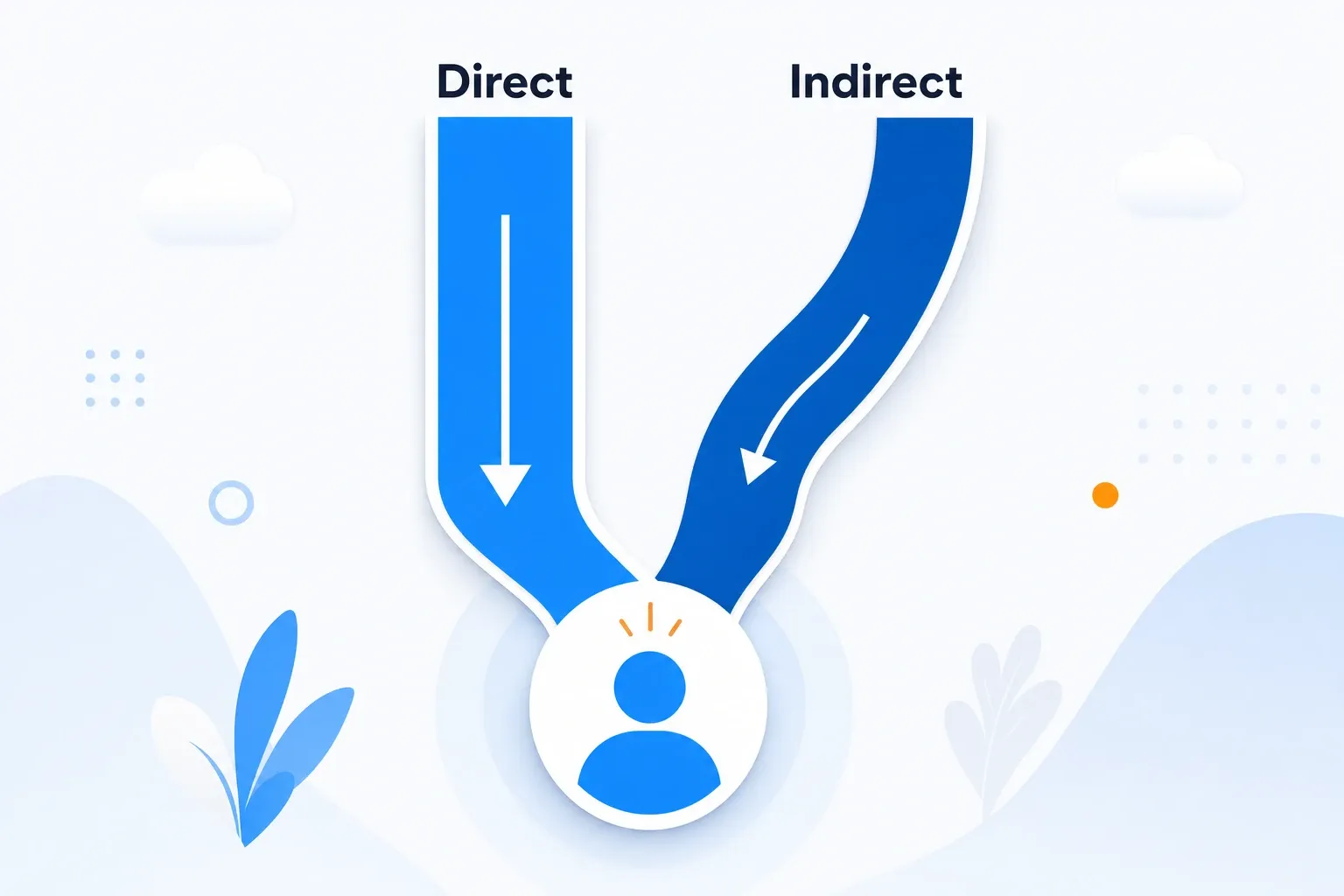
Direct competitors sell the same solution to the same customers you do. Indirect competitors solve the same customer need with a different solution. The split sounds academic until budget season: customers rarely compare you only against lookalikes, and the rival that reshapes your category usually arrives from the indirect side. Below: clean definitions, 8 real examples in pairs, and what to watch on each kind of competitor's website.
Direct and indirect competitors, defined
A direct competitor offers the same type of product to the same market: a prospect could swap them for you with no change in behavior. An indirect competitor satisfies the same underlying need through a different category of solution, so the swap changes how the job gets done, but the budget and the need are the same.
The customer decides which is which. If buyers shortlist you together, you're direct, whatever your two websites claim. If buyers solve the problem without your category at all, that winning alternative is indirect competition, and it caps your market just as effectively. However you order the phrase, indirect vs direct competitors is a distinction that lives in buyer behavior, never in your own category labels.
The line is just as real in B2B. For a CRM vendor, another CRM is direct competition. The indirect competitor is the spreadsheet plus an ops hire, which runs half the sales pipelines on earth and wins deals no rival ever sees in a bake-off.
Direct vs indirect: the working differences
| Direct competitor | Indirect competitor | |
|---|---|---|
| What they sell | Your solution, their logo | A different solution to the same need |
| How the customer sees it | "Which of these do I pick?" | "Do I even need that category?" |
| Biggest risk to you | Losing the deal | Losing the category |
| Time horizon | This quarter's pipeline | Next year's market |
| What to watch on their site | Pricing, features, comparison pages | Positioning, use cases, who they name as their customer |
The short version: direct competitors take deals, indirect competitors take markets. You need eyes on both, at different cadences.
8 examples of direct and indirect competitors
Four familiar markets, each as a pair.
Coca-Cola. Pepsi is the direct competitor: same product type, same shelf, same occasion. The indirect side is coffee chains and energy drinks competing for the same beverage moment. Where encroachment shows publicly: energy brands adding cola-adjacent flavors and case formats on their product pages.
Netflix. Other streaming services are direct: same subscription, same screen, same evening. The indirect side is gaming and short-video apps competing for the identical hours of attention. Where it shows publicly: gaming platforms' pricing pages drifting toward subscription bundles that read like streaming plans.
McDonald's. Burger King is direct: interchangeable meal, interchangeable drive-through. The indirect side is grocery prepared-food counters and meal kits solving "dinner in ten minutes" without a restaurant. Where it shows publicly: grocers expanding ready-to-eat sections and delivery promises on their store pages.
Nike running shoes. Adidas is direct: same shoe wall, same runner. The indirect side is home-fitness platforms competing for the fitness budget and the workout itself. Where it shows publicly: connected-fitness brands positioning their subscriptions against "gear spend" in their own marketing pages.
The 4 types of competitors
Classification gets more useful with two more categories. Direct and indirect are the two main types; substitute and potential competitors complete the standard four:
- Direct: same solution, same market. Compete on execution.
- Indirect: different solution, same need. Compete on category choice.
- Substitute: the customer's do-nothing or do-it-manually option, often the largest rival of all. (In Porter's strategy framework, substitutes cap every market's pricing.)
- Potential: companies one adjacent move away from entering your market, visible early in their hiring pages and product announcements.
How to classify any rival in 60 seconds
Three questions settle the classification for any company on your radar:
- Do our buyers compare us in the same deal? Check their comparison pages, review-site categories, and what your own lost-deal notes say. Shortlisted together means direct.
- Could their product replace the need, even badly? If a customer could plausibly say "we just use X instead," they're indirect, regardless of how different the products look.
- Whose budget line do they bill against? Two companies drawing on the same budget line are competitors of one kind or the other; a company billing a different budget is usually noise.
The highest-signal evidence for question two comes from one interview question, asked of recent lost deals: "what did you do instead?" The answers name indirect competitors no category map or search result will surface, in the customer's own words. Log the answers in the competitor classification worksheet (.docx, no email gate), ten rivals to a page with evidence and watch cadence per row.
When a rival flips categories, it happens in public: an indirect player adds your use case to its homepage, or a direct one retreats upmarket. The classification is a snapshot, which is why it needs a re-check cadence.
Why the split matters for competitive intelligence
The classification sets your monitoring cadence. Direct competitors justify tight watching: their pricing and feature pages move your deals this quarter, which is why CI teams keep competitor tracking on those pages at weekly-or-faster checks. Indirect competitors need a different watch: monthly eyes on positioning and use-case pages, where a category encroachment announces itself long before it reaches your pipeline.
Where teams get burned varies by stage. Startups underestimate the substitute (the prospect does nothing, or keeps the spreadsheet). Scale-ups underestimate indirect category plays. Incumbents underestimate potential entrants. Whatever your stage, the blind spot is usually one row of the four-type table, and it's rarely the direct row you're already staring at.
Two practical moves. First, classify your top ten rivals explicitly; most teams discover they're over-watching two direct competitors and ignoring the indirect one growing fastest. Second, give each class a home: direct competitors each get a card in your sales battlecard template, and indirect competitors get a watch on the one page where their category ambitions would show first. Both feed the same map of your competitive advantage: knowing who competes with you is step one of knowing where you actually win.
Setting the watches takes minutes with competitive monitoring: select the pricing table or positioning section on each rival's page, and changes arrive as plain-English alerts instead of quarterly surprises.
Want to catch a category shift early? Monitor an indirect competitor's positioning page free. The day their homepage starts speaking to your customers, you'll know. Setup takes about a minute.
Frequently asked questions
What is an example of a direct and indirect competitor?
For Coca-Cola, Pepsi is a direct competitor (same product, same occasion) while a coffee chain is indirect (different product, same beverage moment). The pattern holds in any market: direct rivals sell your solution, indirect rivals solve the same need a different way, and both draw from the same customer budget.
What are the 4 types of competitors?
Direct (same solution, same market), indirect (different solution, same need), substitute (the manual or do-nothing alternative), and potential (companies one move away from entering). Most teams track direct competitors closely and under-watch the other three, which is where category surprises come from.
Who is an indirect competitor?
An indirect competitor is any company that satisfies your customer's underlying need with a different type of solution. A meal-kit service is an indirect competitor to fast food; a spreadsheet is an indirect competitor to most software. If winning them means the customer stops needing your category, they're indirect competition.
What are the two main types of competitors?
Direct and indirect. Direct competitors offer the same solution to the same market and compete for individual deals. Indirect competitors meet the same need through a different solution and compete for the category itself. Healthy competitive analysis assigns every serious rival to one of the two and watches each accordingly.
Want to monitor web changes that impact your business?
Sign up with Visualping to get alerted of important updates from anywhere online.
Eric Do Couto
Eric Do Couto is the Head of Marketing at Visualping. He leads content strategy, growth operations, and brand positioning for website change detection.
More articles by Eric Do Couto