Website Monitoring for Event-Driven Investing: Tracking Primary Sources
Updated October 29, 2026
Disclosure & Editorial Standards: This article is written by the Visualping marketing team. It covers how Visualping can be used to support event-driven trading and investment monitoring workflows. Visualping may benefit if you choose to purchase our product. We encourage you to try our free trial first and evaluate whether our approach fits your investment process.
For portfolio managers and analysts running event-driven investing strategies, a useful monitoring workflow includes the original documents behind an event.
Regulatory approvals, enforcement actions, clinical trial updates and antitrust decisions can be published on agency websites. Page monitoring agents check selected pages and alert you when a check detects a relevant change.
Visualping can support that research workflow. Coverage depends on whether it can load the source page, the check schedule, available checks and notification settings. A page alert does not establish that you received the information before the market.
This article covers how event-driven investors can use it, and where it fits into a broader monitoring workflow.
What Is Event-Driven Investing?
Event-driven investing seeks returns from company-specific developments such as mergers, restructurings and financial distress. HFR's strategy definitions include merger arbitrage, distressed/restructuring and special situations within event-driven strategies.
The following list combines those strategy categories with regulatory developments an analyst may track:
- Merger arbitrage: Positions based on a proposed transaction's terms and likelihood of completion. A spread can compensate investors for the risk that a deal fails or changes.
- Special situations: Company-specific catalysts such as spin-offs and divestitures.
- Distressed investing: Securities of companies facing financial distress or restructuring.
- Regulatory catalysts: Decisions such as an antitrust clearance that affect an investment thesis or pending transaction.
Key Takeaway: Monitoring can inform an analyst's assessment of an event. The investment outcome also depends on valuation, event risk and execution; receiving an alert does not guarantee a profitable trade.
Tracking Sources Across an Event-Driven Book
An analyst may need to follow regulatory decisions, company announcements and court or agency documents across several sources. A practical source list might include a CMA merger case page, SEC enforcement releases and an FDA advisory committee calendar.
Start with each source's own distribution options. The SEC provides RSS feeds for press releases, litigation releases and EDGAR company and latest-filing searches. The FDA publishes an advisory committee calendar.
Financial terminals also carry original reporting and breaking-news alerts. Coverage and delivery differ by source and service. Test the specific pages you need rather than assuming a page monitor will beat a terminal or newswire.
How Page Monitoring Agents Support Event-Driven Strategies
Visualping checks web pages it can access and sends alerts after detecting changes. For fundamental PMs and analysts, candidate sources include the following. Confirm that each page loads the relevant content in the preview before relying on it:
Regulatory and government sources:
- Antitrust and competition authority rulings (FTC, DOJ, EU Commission, UK CMA, etc.)
- Published FDA approval information and advisory committee updates
- SEC filings and enforcement actions
- Legislative updates and pending bills
Company-level monitoring:
- Pricing pages, product pages, and executive leadership changes
- Press releases and investor relations pages
- Patent filings and trademark changes
Macro and sector-level signals:
- Agency calendar updates and hearing schedules
- Index reconstitution notices
- Earnings calendar changes
Cloud checks can run as often as every two minutes on Personal 10K and Business plans, subject to the monthly allowance. One page checked every two minutes for 30 days needs 21,600 checks, more than Personal 10K's 10,000 or Business 20K's 20,000. Failed checks also use allowance, and monitoring pauses when it runs out. An alert follows detection and processing; the interval is not a guarantee of delivery at publication. See the current plan limits.
Example: UK Clearance of the Broadcom/VMware Acquisition
The CMA cleared Broadcom's acquisition of VMware on August 21, 2023. The agency described the transaction as $69 billion: $61 billion of equity plus $8 billion of assumed debt. Its case page records the final report, a summary and a press release.
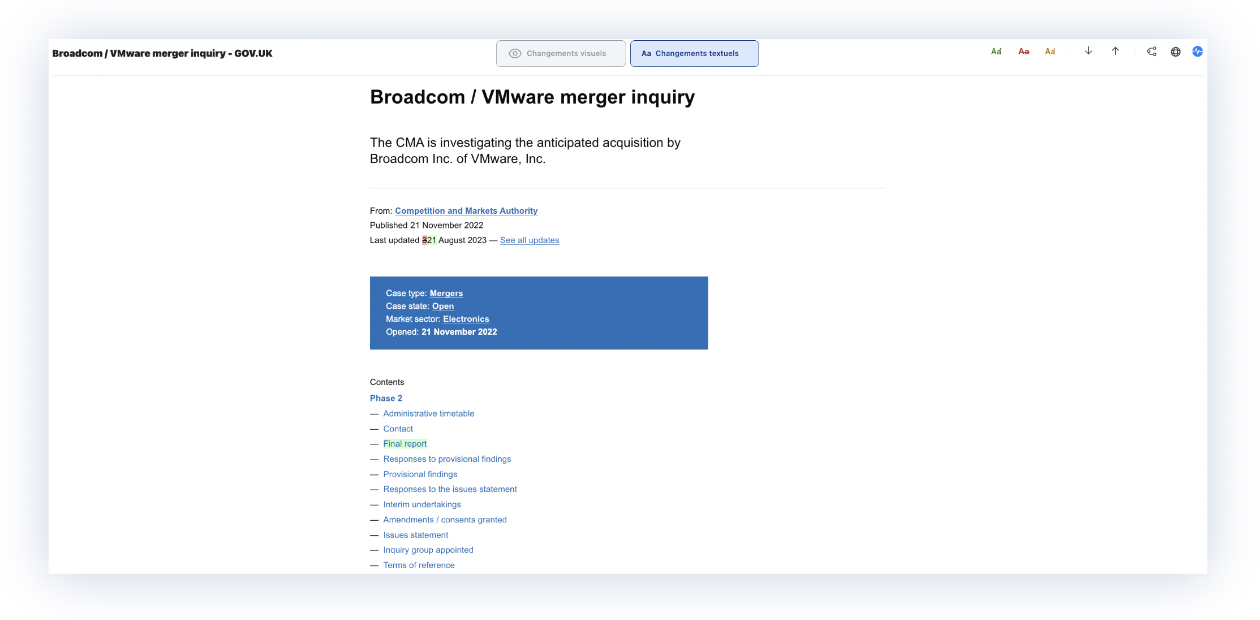 Screenshot retained from an earlier version of this article. Its capture source and time were not recovered; it does not establish when the page changed, whether an alert was sent or a lead over news coverage.
For a similar pending transaction, an analyst could monitor the case page for a new report or decision, then read the full agency document and assess any conditions. The case illustrates a source to follow. It does not demonstrate a trading return or a measured advantage over a newswire.
Why This Use Case Matters Beyond a Single Deal
A transaction can require several authorities' decisions. Keep a source list for each deal and identify which agency page publishes the decision, supporting documents and subsequent updates.
Visualping can automate scheduled checks on those pages. Email, webhooks and REST API access are included on every plan; native Slack, Microsoft Teams and Google Sheets integrations require Business. Custom spreadsheet workflows through the API require your own integration. All checks draw from the plan's allowance.
Key Takeaway: Use the alert as a prompt to review the original decision, including conditions and remaining approvals. A clearance from one jurisdiction does not establish that every condition for closing has been met.
How Visualping Compares to Other Market Monitoring Approaches
Choose tools by the sources and tasks they cover. The table gives evaluation questions, rather than a measured speed ranking.
| Approach | Role in a workflow | What to check before relying on it |
|---|---|---|
| Web change monitoring | Check selected pages and review detected changes | Can the service capture the needed content? What check interval, allowance and alert rules apply? |
| Financial terminals | Market data, original reporting and news alerts | Does the subscription cover the source, instrument and event you need? |
| Filing feeds and document search | Follow filings or search a defined document collection | Which documents are covered? Are native feeds available, as with SEC EDGAR? |
| Custom web scrapers | Build a source-specific collection workflow | Who will implement, test and maintain capture and delivery? |
| News services | Follow reporting and published announcements | Does the service cover your sources? How will you verify timestamps for a latency comparison? |
A page monitor can sit alongside market data and news tools. Evaluate it against your own source list, capture results and alert requirements.
What "Most Efficient Tool for Monitoring Market-Moving Events" Actually Means
The answer depends on the source and the task. Use these checks when designing your workflow:
Source selection. Identify the pages material to a position, and confirm that the monitor preview contains the relevant information. Review source access rules and any required authentication.
Signal filtering. In Alert me when, describe the decision or document you want to detect. Alert me only when the AI condition is met is on by default and turns on when you enter a prompt. Confirm it and the intended notification channels are enabled. AI can misclassify a change; review the source document. To receive alerts for every detected change, turn off Alert me only when the AI condition is met and keep the intended notification channels enabled. The prompt guide explains these controls.
Delivery and integration. Email and webhooks can route detected changes into a review process. Business plans add native Slack, Microsoft Teams and Google Sheets integrations. Test the destination and assign a reviewer before depending on the workflow.
Getting Started
To use Visualping for event-driven research, start with a targeted list of sources material to your current positions:
- Competition authority pages for pending deals in the portfolio
- FDA approval databases and advisory committee calendars for any biopharma positions
- SEC enforcement and litigation releases for special situations
- Relevant government agency calendars and ruling pages
Test the page preview, choose a check schedule that fits your allowance, and verify delivery. Use AI conditions for contextual relevance or Text changes keyword alerts when you need exact word matching.
Contact us for more information or to try Business free for 14 days, with no credit card required.
Frequently Asked Questions About Event-Driven Investing
Can web monitoring detect an event before a financial terminal?
It may, but this article does not establish a repeatable lead over a terminal or newswire. A check must successfully capture the change before Visualping can alert you. To compare services, use matched events and distinguish the source's publication time, detection time, delivery time and the first news report, with consistent timezones.
What types of events can investors track using services that monitor public company events?
Candidate sources include competition authority case pages, published FDA decisions and advisory committee calendars, SEC filings and enforcement releases, and company investor-relations pages. Check each page's access requirements and preview. Use native feeds where they meet your needs.
How does event-driven trading differ from other hedge fund strategies, and what role does timing play?
Event-driven strategies focus on company-specific developments such as mergers or restructurings. Timing can affect a position, but event probability, valuation, liquidity and deal terms also matter. A catalyst's timing and outcome may be uncertain. Detecting a web change alone does not establish an executable opportunity or a profitable trade.
Interested in finding out more about how you can use Visualping to power your investing strategies? Contact us for more information, or to get started on our free Business trial.
Related Resources:
Monitor sources for your investment research
Choose a source page, verify its preview and receive alerts after relevant changes are detected on scheduled checks.
Eric Do Couto
Eric Do Couto is the Head of Marketing at Visualping. He leads content strategy, growth operations, and brand positioning for website change detection.
More articles by Eric Do Couto