Website Monitoring for Event-Driven Investing: How to Get Market-Moving Information First
Updated March 3, 2026
Disclosure & Editorial Standards: This article is written by the Visualping marketing team. It covers how Visualping is used to support event-driven trading and investment monitoring workflows. Visualping may benefit if you choose to purchase our product. We encourage you to try our free trial first and evaluate whether our approach fits your investment process.
The Bloomberg terminal tells you what the market already knows. That's useful. It's just not the same as knowing first.
For portfolio managers and analysts running event-driven investing strategies, the timing gap between when an event is published and when it hits a major financial data platform can be where the opportunity lives, or disappears.
Regulatory approvals, enforcement actions, clinical trial updates, antitrust decisions: these are published directly on government agency websites, often hours before they're indexed by newswires or databases.
Page monitoring agents address exactly this gap. Investors use them to monitor primary web sources directly, receiving alerts as soon as a page changes, not when a journalist files a story or a database updates its feed.
Visualping is used by 5 of the top 10 hedge funds by AUM and operates at a 99% crawl success rate for some of the largest funds in the world, a roughly 25% improvement over what's typical across the industry.
This article covers how event-driven investors use it, and where it fits into a broader monitoring workflow.
What Is Event-Driven Investing?
Events-driven investing is a strategy focused on exploiting pricing inefficiencies created by corporate or regulatory events.
These funds focus on pricing inefficiencies caused by corporate events such as mergers, acquisitions, restructurings, bankruptcies, or other significant corporate actions, identifying mispriced securities based on differentiated views of value-unlocking catalysts, event probabilities, and post-event valuations.
The strategy encompasses several sub-approaches:
- Merger arbitrage: Capturing the spread between a target company's trading price and the acquisition price after a deal is announced
- Special situations: Spin-offs, divestitures, index reconstitutions, and other structural corporate changes
- Distressed investing: Debt or equity in companies going through financial or operational distress
- Regulatory catalysts: FDA approvals, antitrust rulings, enforcement actions, and similar government decisions that directly affect a company's prospects
According to Preqin data, event-driven funds represent approximately 8% of all hedge fund strategies, roughly the third-largest category.
That's a significant slice of the industry organized around the premise that information asymmetry exists and can be exploited... but only if you actually have the information faster.
Key Takeaway: Event-driven trading is not just about knowing what event will happen. It's about knowing when it happens, often before the broader market has absorbed it. That timing difference is the strategy.
The Information Problem Every Fundamental PM Faces
The analyst's job description, simplified: know your portfolio better than anyone else. In practice, that means tracking updates from regulatory bodies, company websites, court dockets, government portals, and dozens of other primary sources, consistently, reliably, and in real-time.
It's a lot. The sources that matter most for event-driven trading are often government or agency pages that don't offer reliable RSS feeds, aren't indexed in real time by databases, and publish updates without announcements.
An antitrust clearance notice on a UK competition regulator's site. A new enforcement action buried in an SEC enforcement page. An FDA advisory committee posting.
Traditional financial data platforms are built for depth and breadth of coverage, not for catching the moment a niche government page updates. Bloomberg and similar terminals are lagging indicators in this context. By the time an event appears there, the market has already moved.
Analysts need to get insights fast enough to take advantage of new information before the rest of the market has access to it. That's the core problem Visualping can solve for you.
How Page Monitoring Agents Support Event-Driven Strategies
Visualping monitors any public web source for changes and sends near real-time alerts when something on the page updates. For fundamental PMs and analysts, the practical applications span a wide range of the sources they track already:
Regulatory and government sources:
- Antitrust and competition authority rulings (FTC, DOJ, EU Commission, UK CMA, etc.)
- FDA approvals, rejections, and advisory committee updates
- SEC filings and enforcement actions
- Legislative updates and pending bills
Company-level monitoring:
- Pricing pages, product pages, and executive leadership changes
- Press releases and investor relations pages
- Patent filings and trademark changes
Macro and sector-level signals:
- Agency calendar updates and hearing schedules
- Index reconstitution notices
- Earnings calendar changes
The monitoring frequency is what makes this genuinely useful: Visualping can check a page for changes as often as every two minutes. When an antitrust regulator clears a deal in the early hours before U.S. markets open, that alert reaches the monitoring user's inbox at the moment of publication, not hours later.
Case Study: UK Clearance of the Broadcom/VMware Acquisition
Merger arbitrage lives and dies on regulatory timelines. When Broadcom announced its $69 billion bid to acquire VMware (VMW.N), the deal required clearance from multiple competition authorities across different jurisdictions, each publishing their decisions independently, on their own websites, on their own schedules.
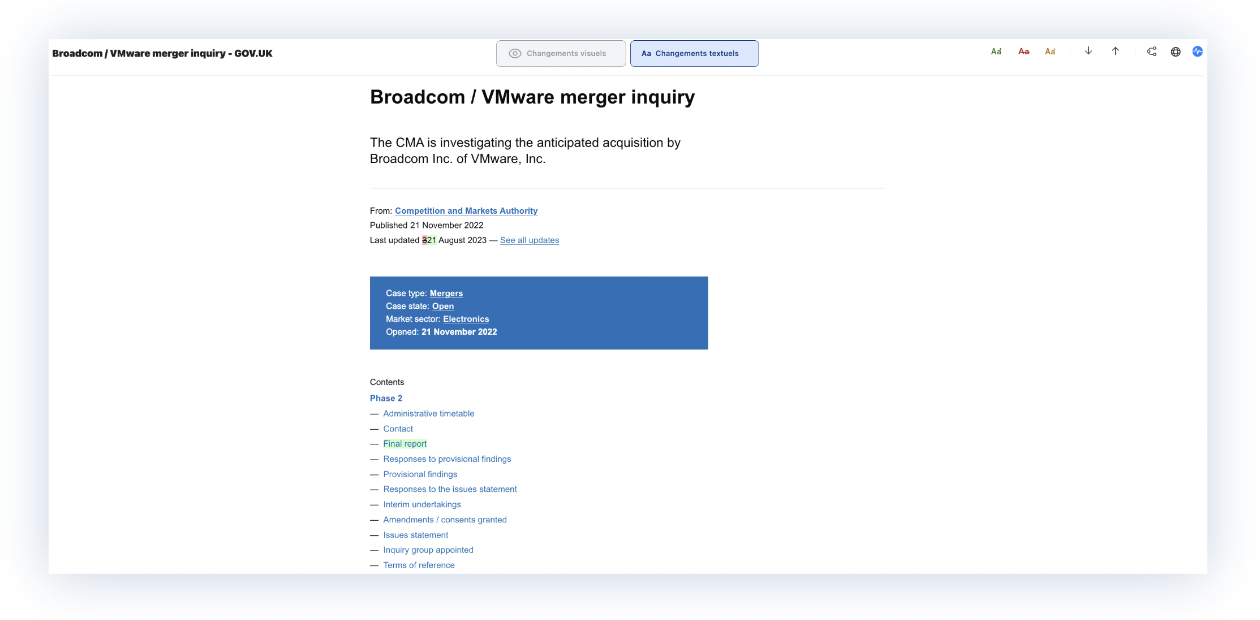
The UK's Competition and Markets Authority posted its clearance on the morning of August 21, 2023, well before U.S. markets opened. Visualping, monitoring the CMA page directly, detected the update at 6:37 AM.
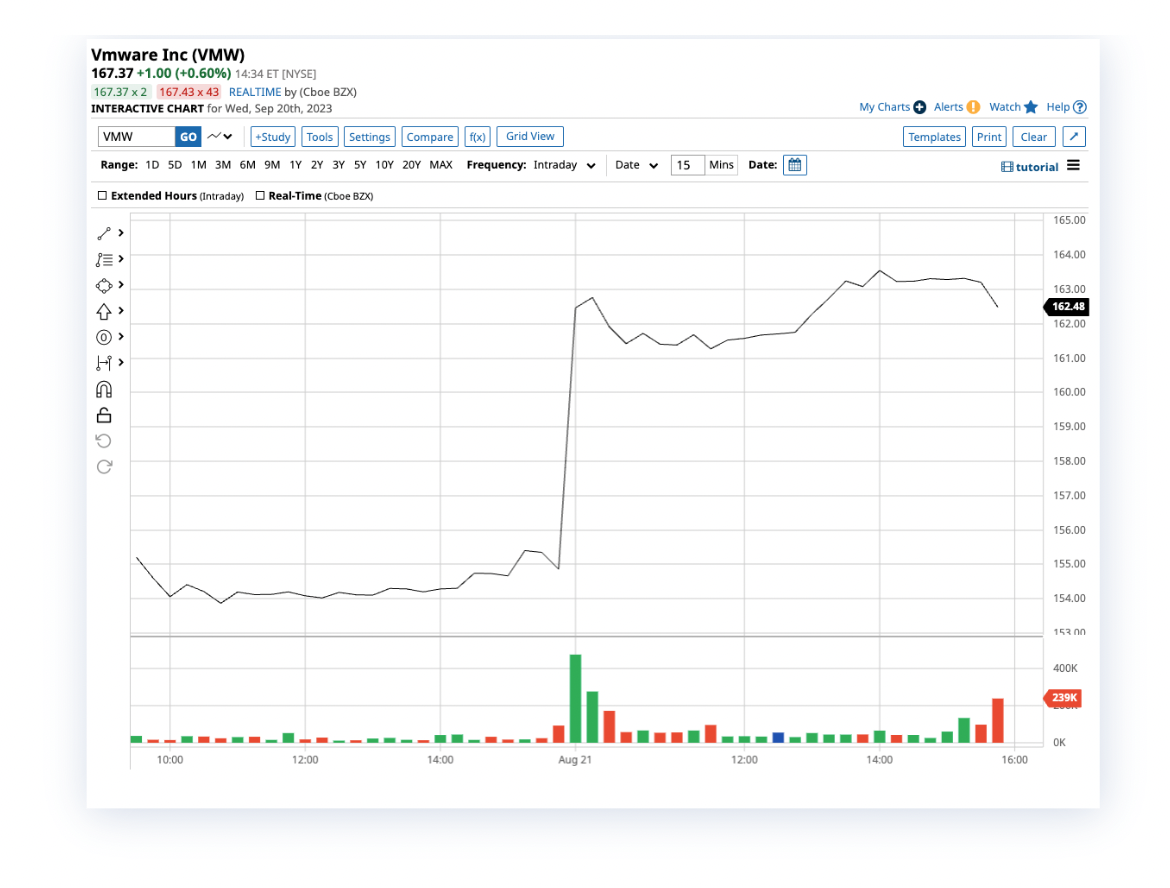
VMware opened on the NYSE at $162 that morning — up from $154 at the prior close. Thomson Reuters published the story at 11:51 AM, more than five hours after the page changed.
Timeline:
- Fri Aug 18: VMware closes at $155
- Mon Aug 21, 6:37 AM: CMA approval detected by Visualping
- Mon Aug 21, 9:30 AM: VMware opens at $162
- Mon Aug 21, 11:51 AM: Reuters publishes the story
The five-hour gap between Visualping's alert and the Reuters story is the window that mattered. An arbitrageur monitoring the CMA page directly had confirmed clearance information before the spread closed — before most of the market knew the deal had been approved.
This is what primary source monitoring looks like in practice. The CMA didn't announce the decision through a newswire. It posted to its website. The investors who were watching that page got the signal first.
Why This Use Case Matters Beyond a Single Deal
The Broadcom/VMware clearance is one event from a continuous deal calendar. At any given time, dozens of significant M&A transactions are awaiting regulatory decisions across multiple jurisdictions, the FTC, DOJ, EU Commission, UK CMA, and various national competition authorities each running their own review processes on their own timelines, posting decisions to their own websites.
A merger arbitrageur with positions across several pending deals cannot manually monitor every relevant competition authority page for every deal in the book. The monitoring scales because Visualping handles the page-checking automatically, fires alerts the moment something changes, and routes them to wherever the analyst works (email, Slack, MS Teams, or directly into a spreadsheet via API).
The workflow is the same whether you're watching for a clearance, a conditional approval with remedies, or a block. All of them post to the same competition authority sources. All of them can be monitored from the same Visualping dashboard.
Key Takeaway: Merger arbitrage monitoring is a high-frequency version of the same problem Visualping solves across all event-driven investing: primary source pages update before the news propagates. The fund watching the source page directly gets the signal before the spread moves.
How Visualping Compares to Other Market Monitoring Approaches
The most efficient tool for monitoring market-moving events depends on what kind of events you're tracking. Here's how the main categories compare:
| Tool Type | Examples | Best For | Limitations for Event-Driven Use |
|---|---|---|---|
| Web change monitoring | Visualping, Distill.io | Primary source detection on any public page; pre-newswire timing | Requires user to define sources; doesn't cover paywalled content |
| Financial terminals | Bloomberg, Refinitiv | Broad market data, news aggregation, pricing | Lagging on niche regulatory pages; everyone sees the same feed simultaneously |
| Pre-built alert databases | AlphaSense, Sentieo | Structured document search across filings, transcripts | Limited to indexed content; no custom web source monitoring |
| Custom web scrapers | Engineering-built tools | Highly tailored data extraction | Slow to configure; reliability issues; ongoing maintenance burden |
| News aggregators | Factiva, Dow Jones Newswires | Broad press coverage, syndicated releases | Still downstream from the original source publication |
Visualping is not a replacement for a Bloomberg terminal. It fills a specific gap: monitoring the primary source pages that terminals and databases don't cover in real time. For a fundamental PM running a news-based trading strategy on regulatory catalysts, that's the gap that matters.
What "Most Efficient Tool for Monitoring Market-Moving Events" Actually Means
The phrase comes up a lot in discussions of alternative data, and the answer depends on the specific workflow. A few practical notes from how multi-strategy hedge funds tend to use Visualping:
Source selection is the strategy. Visualping monitors whatever page you tell it to. The information advantage comes from identifying which regulatory, corporate, or agency pages are material to your positions, and monitoring those before an event is expected. This is where analyst expertise and the tool combine.
Signal-to-noise filtering matters. Visualping's AI features allow users to set very specific criteria for alerts so you're only getting alerted of important changes. Apage that updates frequently (like a large regulatory database) only fires an alert when the change contains language relevant to a specific holding or thesis.
Integration with existing workflows. Alerts can route to MS Teams, Slack, email, or directly into spreadsheet-based models via API. For pods that want change data feeding into their own systems, the API allows Visualping to act as a live data source rather than just an alert tool.
Getting Started
Investors using Visualping for event-driven and news-based trading workflows typically start with a targeted list of the sources most material to their current book:
- Competition authority pages for pending deals in the portfolio
- FDA approval databases and advisory committee calendars for any biopharma positions
- SEC enforcement and litigation releases for special situations
- Relevant government agency calendars and ruling pages
From there, the AI keyword filtering reduces noise, and alert routing connects Visualping's detection to wherever analysts actually work through webhooks and API.
Contact us for more information or to get started on a 14-day free trial.
Frequently Asked Questions About Event-Driven Investing
What is the most efficient tool for monitoring market-moving events before they hit the Bloomberg terminal?
For events published on primary source websites like regulatory rulings, antitrust clearances, FDA approvals, government agency decisions, web change monitoring tools like Visualping can detect updates at the moment of publication, often hours before they appear on financial terminals or newswires. Bloomberg and similar platforms aggregate news efficiently across broad sources, but they're downstream from the original publication. If the investment thesis involves government or regulatory catalysts, monitoring the source page directly closes that timing gap.
What types of events can investors track using services that monitor public company events?
Fundamental and multi-strategy investors use web monitoring tools to track a wide range of public sources: competition authority rulings (FTC, DOJ, EU Commission, UK CMA), FDA approvals and advisory committee updates, SEC filings and enforcement actions, company leadership changes, pricing and product updates, index reconstitution notices, and legislative developments. Any public web page that is material to an investment thesis is a candidate for monitoring. The key advantage over curated databases is flexibility, you're not limited to content that's been indexed by an editorial team.
How does event-driven trading differ from other hedge fund strategies, and why does information timing matter more?
Most hedge fund strategies involve a long research horizon, building a thesis over weeks or months before taking a position. Event-driven trading is different because the catalyst has a known trigger: a merger approval, an earnings release, a regulatory decision. The pricing inefficiency exists only for a window of time after that event, before the market digests the new information. Funds that detect the event faster can act before the spread closes. That's why information timing is not just a nice-to-have in this context, it is, in many cases, the strategy itself.
Interested in finding out more about how you can use Visualping to power your investing strategies? Contact us for more information, or to get started on our free Business trial.
Related Resources:
Want to monitor web changes that impact your business?
Sign up with Visualping to get alerted of important updates, from anywhere online.
Eric Do Couto
Eric Do Couto is the Head of Marketing at Visualping. He leads content strategy, growth operations, and brand positioning for website change detection.
More articles by Eric Do Couto