Best Compliance Monitoring Software and Tools in 2026
By Anika Gupta
Updated October 22, 2026

Compliance monitoring software automates the checks, evidence collection and alerts that keep an organization in line with regulations, industry frameworks and its own policies. The best tool depends on which half of the job you need. For internal controls and audit evidence, Vanta, Drata, Sprinto and Hyperproof fit tech companies, Optro (formerly AuditBoard) fits enterprise audit and SOX teams, and MedTrainer fits healthcare. For regulatory changes posted on government and industry websites, a change monitor such as Visualping watches the source pages. Most compliance teams need both.
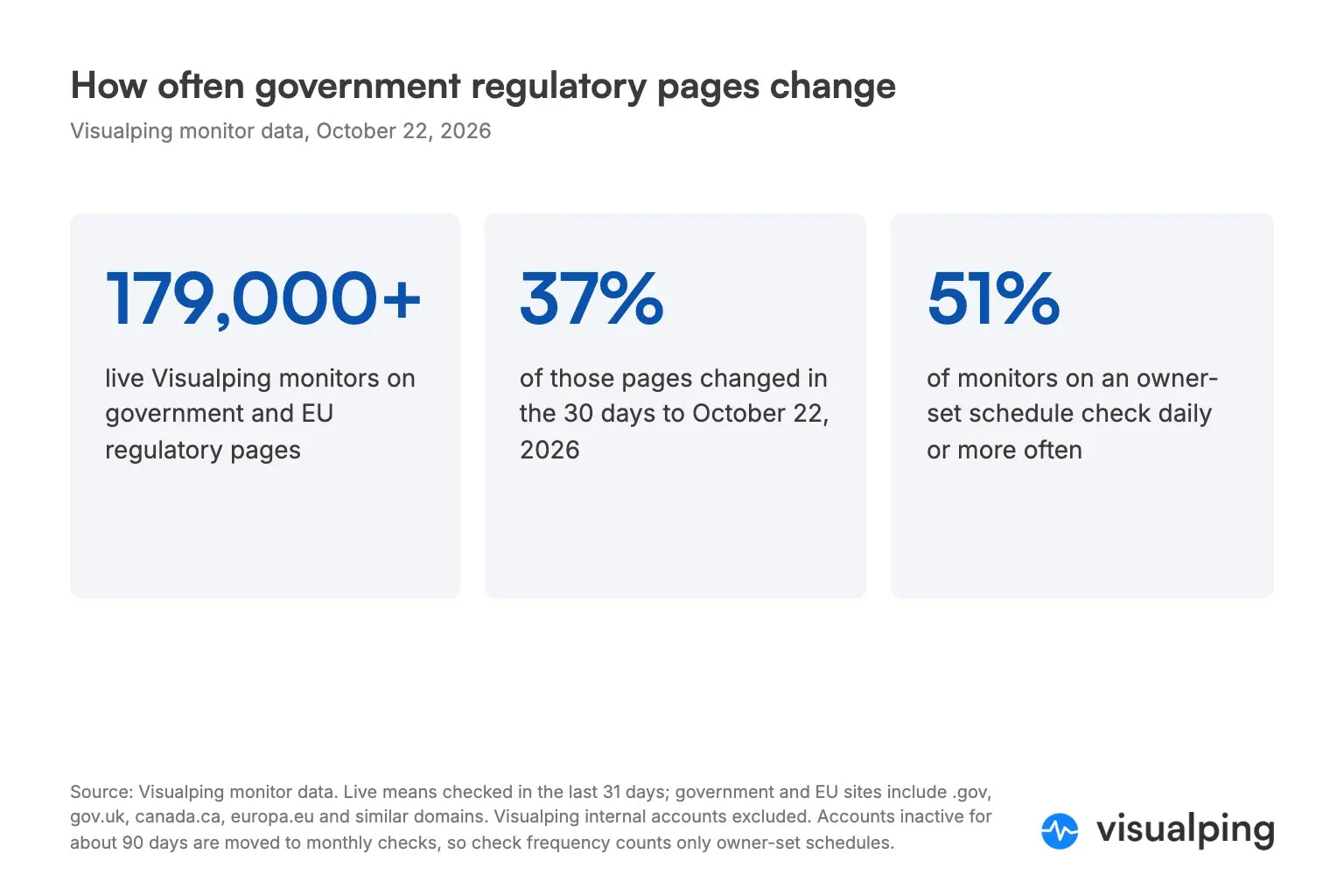
The external side moves faster than most teams expect. A rule posted on a Friday can change your obligations by Monday. More than 179,000 live Visualping monitors watch government and EU regulatory pages, and 37% of those pages changed in the 30 days to October 22, 2026. A spreadsheet tracker and a calendar reminder won't catch that.
This guide compares nine compliance monitoring tools across both jobs, from full GRC platforms to website change detection, so you can match the software to your compliance workflow.

The 9 tools compared at a glance
| Tool | Primary use case | Best for | Framework coverage | Starting price |
|---|---|---|---|---|
| Visualping | External regulatory monitoring | Tracking government and industry website changes | Any (monitors the source) | Free; paid from $10/mo billed annually |
| Hyperproof | Multi-framework compliance | 3+ overlapping frameworks | 160+, mapped through a common control set | Custom |
| Vanta | Cloud compliance automation | SaaS and tech companies | SOC 2, ISO, HIPAA, GDPR and more | ~$10K/year (third-party estimate) |
| Drata | Compliance as code | Engineering-heavy mid-market | 30+, including SOC 2, ISO, HIPAA, CMMC | ~$15K/year (third-party estimate) |
| Optro | Enterprise audit and SOX | Fortune 500, regulated enterprise | SOX, SOC, risk, ESG, AI governance | Enterprise (contact) |
| LogicGate | Custom GRC workflows | Teams wanting no-code flexibility | Configurable | Custom |
| MedTrainer | Healthcare compliance | Medical practices, health systems | HIPAA, OSHA, credentialing | Custom |
| TeamMate Risk & Compliance (formerly StandardFusion) | IT security GRC | Security teams, TeamMate audit users | 150+ frameworks | Custom |
| Sprinto | Fast first certification | Startups, SMBs | SOC 2, ISO, HIPAA, GDPR, PCI, 200+ standards | Custom (SMB-focused) |
What to look for in compliance monitoring software
Pin down your evaluation criteria before you compare tools. The right platform depends on your industry, team size and framework count, and on whether you need internal control monitoring, external regulatory tracking or both.
Framework coverage
Check how many frameworks the tool supports out of the box. If you're juggling SOC 2 alongside HIPAA, GDPR and ISO 27001, you need pre-built mappings. Configuring frameworks by hand adds months to deployment.
Automation depth
Automation is the line between compliance tracking software and compliance monitoring software. Tracking tools record status that people update. Monitoring tools test controls continuously, collect evidence automatically and alert you when something falls out of compliance.
Integration coverage
Your compliance software has to plug into the systems it monitors: cloud infrastructure (AWS, GCP, Azure), identity providers (Okta, Azure AD), HR systems, code repos and ticketing tools. Every manual data entry point you remove is one less thing to chase before an audit.
Reporting and audit readiness
When auditors arrive, the platform should produce the evidence packages they ask for. Look for pre-built report templates, audit trail exports and dashboards that show your compliance posture at any point in time.
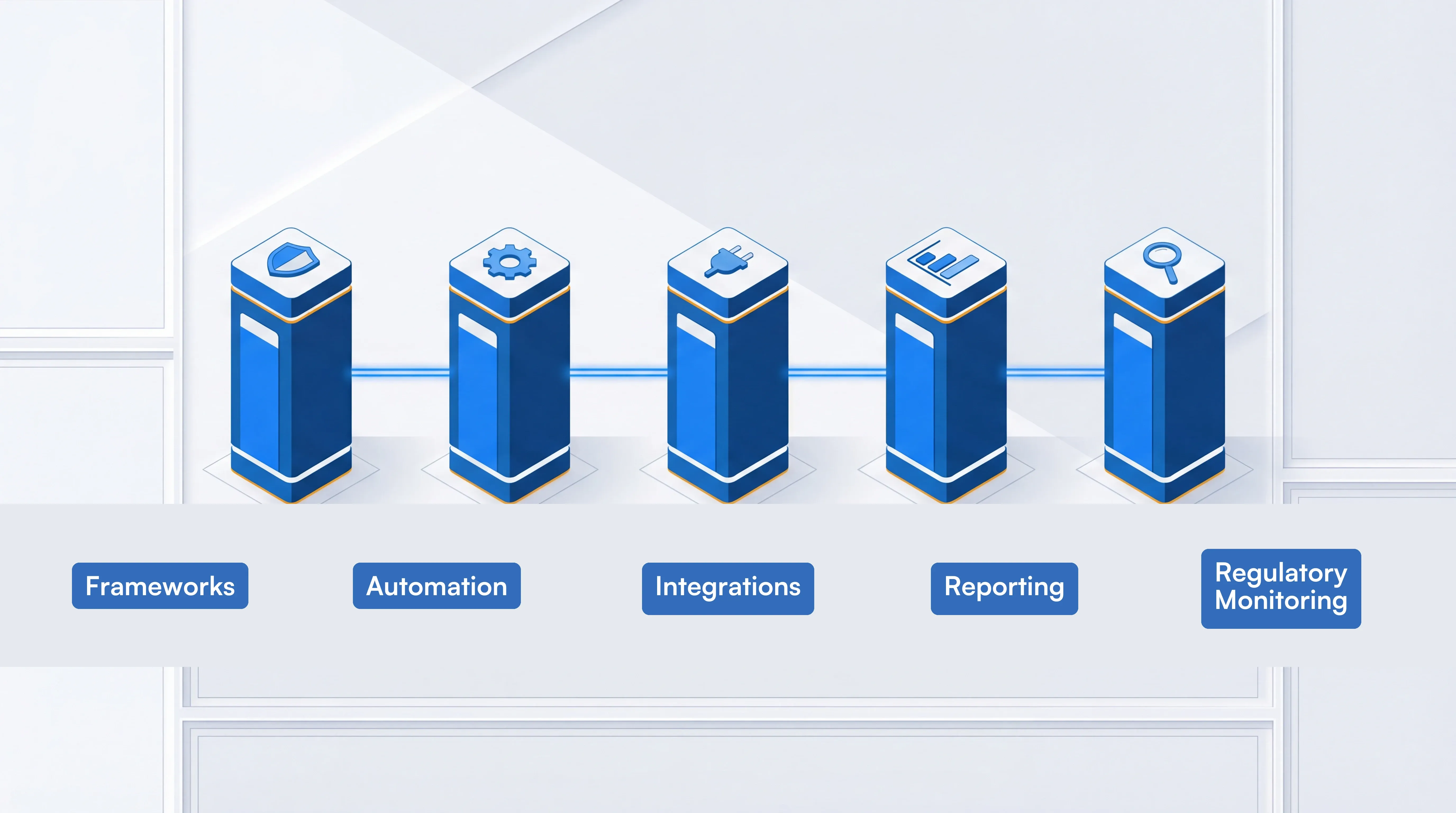
External regulatory monitoring
Internal controls cover half the picture. Regulations change on government websites, in Federal Register notices and in industry body announcements. Tools that track regulatory changes across multiple websites close the gap between what your controls do and what regulators currently require.
Editor's note: Visualping is our product. For managing internal compliance programs across frameworks like SOC 2, ISO 27001 and HIPAA with automated evidence collection and audit preparation, Hyperproof and Vanta are purpose-built. For mid-market compliance automation with continuous control monitoring, Drata is the stronger choice. Visualping monitors external web pages for regulatory text changes; it does not manage compliance workflows, map controls to frameworks or produce audit-ready reports. Each tool below lists its limitations, including ours.
9 best compliance monitoring tools for 2026
1. Visualping: best for monitoring external regulatory changes
Visualping is a website change monitoring tool that watches any web page and alerts you when it updates. Compliance teams point it at regulatory websites, government portals and industry body announcements instead of opening dozens of pages by hand every week.
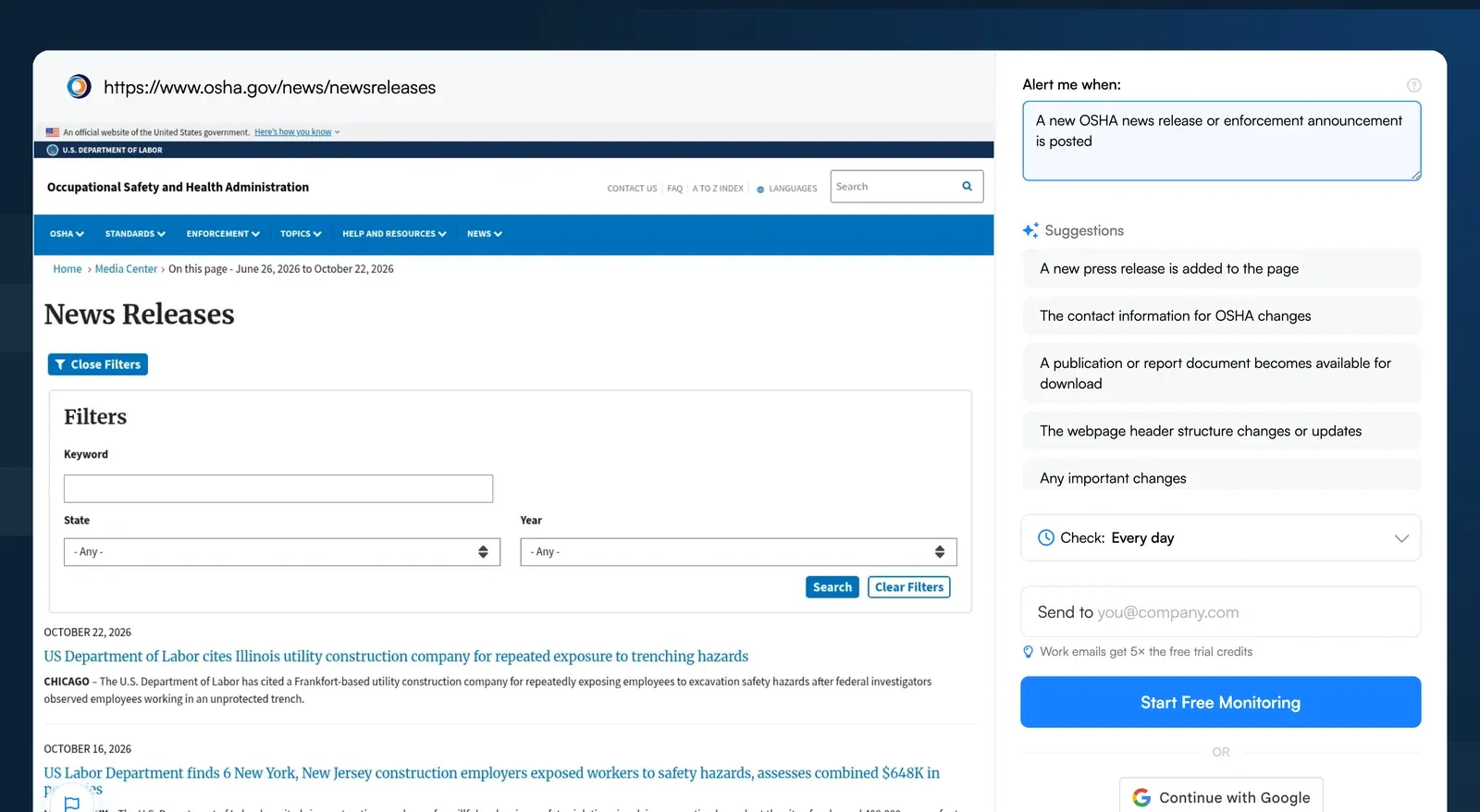
How it works for compliance: Paste the URL of any web page and describe what matters in the "Alert me when" box, for example "a new final rule or guidance document is posted." New monitors run in AI Mode, and you can crop a monitor to one section of the page in its settings. Visualping checks the page on your schedule, as often as every 2 minutes on Personal 10k and Business plans (hourly on Free), and alerts you when the content changes. Each alert includes an AI summary of what changed, and by default Visualping only alerts you on changes its AI judges important. Before-and-after screenshots and a highlighted diff stay in the monitor's change history (three months by default, up to a year on Business plans).
The data behind it: More than 179,000 live monitors on Visualping track government and EU regulatory pages (.gov domains, europa.eu and similar), set up by nearly 31,000 accounts. Of those pages, 37% changed in the 30 days to October 22, 2026.
Key compliance use cases:
- Tracking regulatory changes across OSHA, FDA, SEC, FCA and other government portals
- Monitoring terms of service changes from vendors and partners for contract compliance
- Checking that partner and reseller websites still match your approved claims, with partner compliance monitoring
- Watching industry body websites (FINRA, ISO, PCI SSC) for framework updates
- Monitoring SEC filings and EDGAR updates for financial compliance
Pricing: Free plan (5 pages, 150 checks a month). Paid plans start at $10/month billed annually ($14 month to month) for individuals and $100/month billed annually ($140 month to month) for business teams.
Best for: Compliance teams that need to monitor external regulatory sources alongside their internal GRC platform.
Limitations: Visualping only watches external web content. Internal controls and evidence collection need a GRC platform like the ones below.
2. Hyperproof: best for multi-framework compliance programs
Hyperproof is a compliance operations platform built for organizations juggling several frameworks at once. Its Hypersync connectors collect evidence from connected systems automatically, on demand or on a set schedule, which takes the screenshot-gathering out of audit prep.
Key features:
- A common control set mapped across 160+ supported frameworks, including SOC 2, ISO 27001, NIST, GDPR and PCI DSS
- Framework content for newer regulations such as DORA and the EU AI Act
- Cross-framework control mapping, so one test can satisfy overlapping standards
- Risk register with configurable assessment workflows
Pricing: Custom pricing; Hyperproof doesn't publish list prices.
Best for: Organizations managing 3+ compliance frameworks that want to stop testing the same control twice.
Limitations: The platform takes upfront configuration. Organizations with a single framework may find it overbuilt.
3. Vanta: best integration network for cloud-native companies
Vanta has one of the largest integration libraries in compliance automation. Vanta says it runs hourly automated tests across 400+ integrations covering cloud infrastructure, identity providers, HR systems and developer tools. Its trust centre lets organizations share their compliance posture with customers.
Key features:
- 400+ integrations for automated evidence collection
- Continuous control monitoring with hourly automated tests
- Trust centre for publicly sharing security posture
- Support for SOC 2, ISO 27001, HIPAA, PCI DSS, GDPR and more
Pricing: Not published. Third-party estimates put entry plans around $10,000/year, scaling with company size and framework count.
Best for: SaaS companies and tech startups pursuing SOC 2 or ISO 27001 where speed to compliance matters.
Limitations: Pricing isn't public, and costs rise as you add frameworks and headcount.
4. Drata: best automation for mid-market organizations
Drata competes directly with Vanta, with customizable workflows and compliance-as-code tooling for engineering teams.
Key features:
- Continuous automated monitoring across connected cloud, identity, HR and developer systems
- Customizable compliance workflows and control frameworks
- Compliance-as-code capabilities for engineering-heavy teams
- 30+ pre-built frameworks, including SOC 2, ISO 27001, HIPAA, CMMC and NIST 800-53
Pricing: Not published. Third-party estimates put entry plans around $15,000/year, with framework add-ons on higher tiers.
Best for: Mid-market companies with several framework requirements and engineering teams that want compliance automation inside their existing workflows.
Limitations: As with Vanta, pricing isn't public, and each added framework raises the cost.
5. Optro (formerly AuditBoard): best for enterprise audit and SOX compliance
Optro, formerly known as AuditBoard, rebranded in March 2026 to reflect its move beyond audit into full GRC. The company says more than half of the Fortune 500 use the platform, and Gartner named AuditBoard a Leader in its 2025 Magic Quadrant for GRC Tools, Assurance Leaders.
Key features:
- GRC Intelligence platform spanning internal audit, SOX compliance, risk management and ESG
- AI features across audit, risk and compliance workflows
- Collaboration tools that connect the first, second and third lines of defence
- Acquisition of FairNow adds AI governance capabilities
Pricing: Enterprise pricing (contact for quote), aimed at large organizations with complex audit and compliance structures.
Best for: Large enterprises in heavily regulated industries (banking, insurance, pharmaceuticals) that need SOX compliance, internal audit and risk management on one platform.
Limitations: Its enterprise focus and pricing put it out of reach for most small and mid-market teams.
6. LogicGate Risk Cloud: best no-code GRC platform
LogicGate Risk Cloud is a no-code GRC platform where compliance teams build their own workflows, risk registers and assessment processes without developer help.
Key features:
- No-code workflow builder for custom compliance processes
- Configurable risk registers and assessment frameworks
- Integrations with Jira, Slack, ServiceNow and DocuSign, plus thousands of apps through Zapier
- Custom connections through Risk Cloud Connect and an integration services team
Pricing: Custom quotes. You buy the Applications (workflow sets) you need plus licences for the Power Users who build and run them; standard and external users are included.
Best for: GRC teams that want compliance workflows shaped around their own processes without writing code.
Limitations: A no-code platform means more configuration up front than a pre-built one.
7. MedTrainer: best for healthcare compliance
MedTrainer is built for healthcare compliance. It puts credentialing, training and compliance management in one platform for medical practices and health systems.
Key features:
- Online incident reporting with escalation workflows and trend dashboards
- Policy and document management that tracks revisions, approvals and staff acknowledgements
- A training library and policy templates built around HIPAA, OSHA and accreditation requirements
- Credentialing with primary source verification, exclusions monitoring and automated licence verification
Pricing: Custom pricing based on organization size and module selection.
Best for: Healthcare organizations that want compliance training and management in one place, particularly those handling HIPAA, OSHA and credentialing obligations.
Limitations: Healthcare only. Other regulated industries need a general-purpose GRC platform.
8. TeamMate Risk & Compliance (formerly StandardFusion): best for IT security compliance
TeamMate Risk & Compliance, formerly StandardFusion, is a GRC platform focused on IT security compliance. Wolters Kluwer acquired StandardFusion in January 2026 and has since integrated it into TeamMate, its audit and assurance platform, so audit, risk and compliance run in one system. It is sold as modules (risk, compliance, policy, vendor, privacy, business continuity and incident) that you combine to fit your program.
Key features:
- Risk management with qualitative and quantitative risk assessment
- Audit management with evidence collection and tracking
- Compliance management for documenting and tracking regulatory protocols
- Vendor management with third-party risk questionnaires and assessments
- Policy management with approval workflows and version control
- Library of 150+ pre-built compliance framework mappings
Pricing: Custom pricing through Wolters Kluwer, based on the modules you select.
Best for: IT security and compliance teams whose internal audit group already runs TeamMate, or organizations that want audit and GRC on a single platform.
Limitations: The product changed owner and name in 2026. Existing StandardFusion customers should confirm which features and integrations carried over before they renew.
9. Sprinto: best for startups chasing a first certification
Sprinto calls itself an autonomous trust platform and says more than 4,000 companies use it, from Series A startups to enterprises. For smaller teams, its pitch is continuous monitoring and a fast path to a first certification.
Key features:
- Continuous control monitoring with real-time compliance status
- Automated evidence collection through cloud integrations
- Compliance programs for SOC 2, ISO 27001, HIPAA, GDPR, PCI DSS and 200+ other standards
- Built-in security training and policy management
Pricing: Not published; plans are scaled for smaller organizations.
Best for: Startups and SMBs pursuing their first compliance certification.
Limitations: Sprinto now markets to enterprises too, but large organizations with complex, multi-jurisdiction programs should confirm in a demo that it covers their scope.
How to choose the right compliance monitoring software
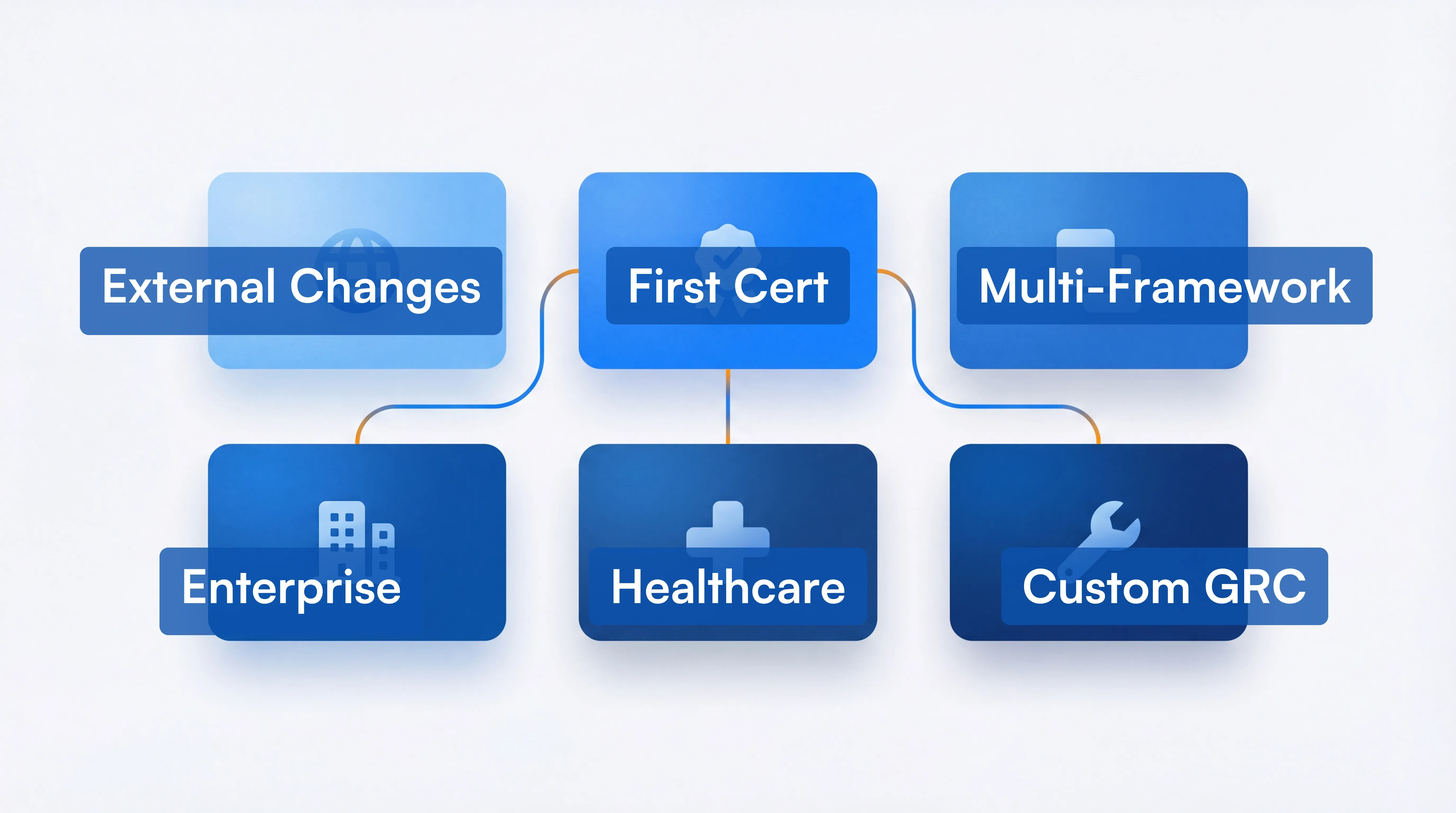
Start with what you need to monitor.
| If you need to... | Start with | Why |
|---|---|---|
| Monitor external regulatory changes | Visualping | It watches the regulator and industry pages where rule changes appear, and pairs with a GRC platform for internal controls |
| Automate internal controls for a first certification | Vanta, Drata or Sprinto | Fastest route to SOC 2 or ISO 27001; pick on budget, integrations and team size |
| Manage 3+ compliance frameworks | Hyperproof | Cross-framework control mapping cuts duplicate evidence collection |
| Run SOX compliance at enterprise scale | Optro | One platform for internal audit, SOX and risk management |
| Meet healthcare-specific obligations | MedTrainer | Credentialing, training and compliance management in one place |
| Build workflows around your own process | LogicGate | No-code builder that takes longer to set up but fits your exact process |
The external column is the one teams underestimate. Of the 179,000 live Visualping monitors on government and EU pages, about half of those still on a schedule their owner picked check daily or more often, and 37% of the pages changed in the 30 days to October 22, 2026. Checking that many pages by hand stops working well before audit season.
For most organizations, the answer is a combination: an internal compliance platform paired with external regulatory monitoring that tracks the sources those regulations come from.
Frequently asked questions
What is compliance monitoring software?
Compliance monitoring software automates the tracking, evidence collection and reporting needed to stay aligned with regulatory standards, industry frameworks and internal policies. It replaces spreadsheet trackers and periodic manual audits with continuous monitoring and automatic alerts. For a deeper explanation, see our complete guide to compliance monitoring.
Is compliance tracking software the same as compliance monitoring software?
They overlap, and many platforms now do both. Compliance tracking software records the status of obligations, tasks and evidence, usually updated by people. Compliance monitoring software checks continuously and alerts you when a control fails or a requirement changes. If you need an alert when a control fails, look for continuous monitoring rather than a tracker.
How much does compliance monitoring software cost?
Costs range widely. Website monitoring tools like Visualping start with a free plan, with paid plans from $10/month billed annually. Cloud compliance platforms like Vanta and Drata don't publish prices, but third-party estimates start around $10,000 to $15,000 a year. Sprinto's GRC pricing guide puts typical GRC software at $20,000 to over $150,000 a year, and enterprise platforms such as MetricStream and Archer price by users, modules and deployment type.
Can one tool handle all compliance monitoring needs?
Most organizations use at least two compliance monitoring tools: one for internal controls and evidence collection (like Hyperproof, Vanta or Drata) and one for external regulatory monitoring (like Visualping). The internal platform automates audit preparation. The external tool tracks the regulatory changes your compliance program has to respond to.
What is the difference between compliance monitoring and compliance management?
Compliance monitoring is the continuous surveillance of controls, regulations and obligations. Compliance management is the broader discipline of designing, running and maintaining a compliance program. Monitoring is one part of management, focused on detection and alerting rather than program design, training or remediation.
How do I monitor regulatory changes across multiple jurisdictions?
Watch the regulatory websites in every jurisdiction where you operate. Enterprise regulatory intelligence platforms such as CUBE specialize in this, with pricing quoted on request. A more accessible approach is setting up website monitors on each regulator's page and receiving change alerts by email or webhook. For financial compliance, that means monitoring bodies like the SEC, FCA, FINRA and the relevant central banks.
What compliance frameworks does monitoring software typically support?
The most commonly supported frameworks include SOC 2, ISO 27001, HIPAA, PCI DSS, GDPR, SOX, CMMC, NIST 800-53, NIST CSF, FedRAMP and CCPA. Enterprise platforms support 100+ frameworks. The number of pre-built framework mappings determines how much manual configuration your team does during implementation.
Keep up as vendors and rules change
This market moves fast. In 2026 alone, Wolters Kluwer acquired StandardFusion in January (it now sells as TeamMate Risk & Compliance) and AuditBoard rebranded as Optro in March.
Whatever you choose for internal compliance, regulatory change management starts with knowing when the rules change. Visualping monitors the web pages where those changes appear first.
Want to monitor web changes that impact your business?
Sign up with Visualping to get alerted of important updates from anywhere online.
Anika Gupta
Anika Gupta is a former Marketing Intern who wrote about competitive intelligence and marketing strategy for the Visualping blog.
More articles by Anika Gupta