How to Track FDA Warning Letters and 483s Automatically
Updated November 2, 2026

TL;DR: FDA posts warning letters on one searchable page, mostly on Tuesdays, and posts selected Form 483s in a separate FOIA reading room weeks after the inspection. FDA's email sign-up and reading room RSS feed send everything, with no filter for one company. Visualping watches a filtered FDA search URL or the reading room and alerts you when your company, a competitor or a CMO appears. Four pages checked daily fit inside the Free plan's 150 monthly checks.
An FDA warning letter is the agency's formal notice that it found significant violations at a firm, and FDA posts redacted copies on its warning letter page. Form 483s, the inspection observations that often come first, live somewhere else and appear on a different schedule. This guide shows where each record is published and how to get an alert when a new one names your company, a competitor or a supplier.
Which FDA records should your team track?
Different teams need different slices of FDA's enforcement data. Find your row, then skip to the section that matters.
| You're... | Track these FDA pages | Suggested check |
|---|---|---|
| Regulatory affairs or QA, watching your own sites | Warning letter search filtered to your company plus the FOIA reading room | Daily |
| Supplier quality, watching CMOs and API suppliers | Reading room (by FEI number) plus import alerts | Daily |
| Competitive intelligence, watching rival manufacturers | Filtered warning letter searches for each competitor | Daily, or hourly on weekdays |
| CI consultancy covering many clients | One monitor per client or competitor search, routed by webhook or API | Daily |
FDA warning letter vs Form 483
The two documents sit at different points in the same process, and they carry different weight.
A Form FDA 483 is handed to company management at the end of an inspection when an investigator has seen conditions that, in their judgment, may violate the Food, Drug, and Cosmetic Act. FDA's own Form 483 FAQ says the 483 "does not constitute a final Agency determination." FDA weighs it together with the Establishment Inspection Report, the evidence collected on site and the company's response before deciding what to do next.
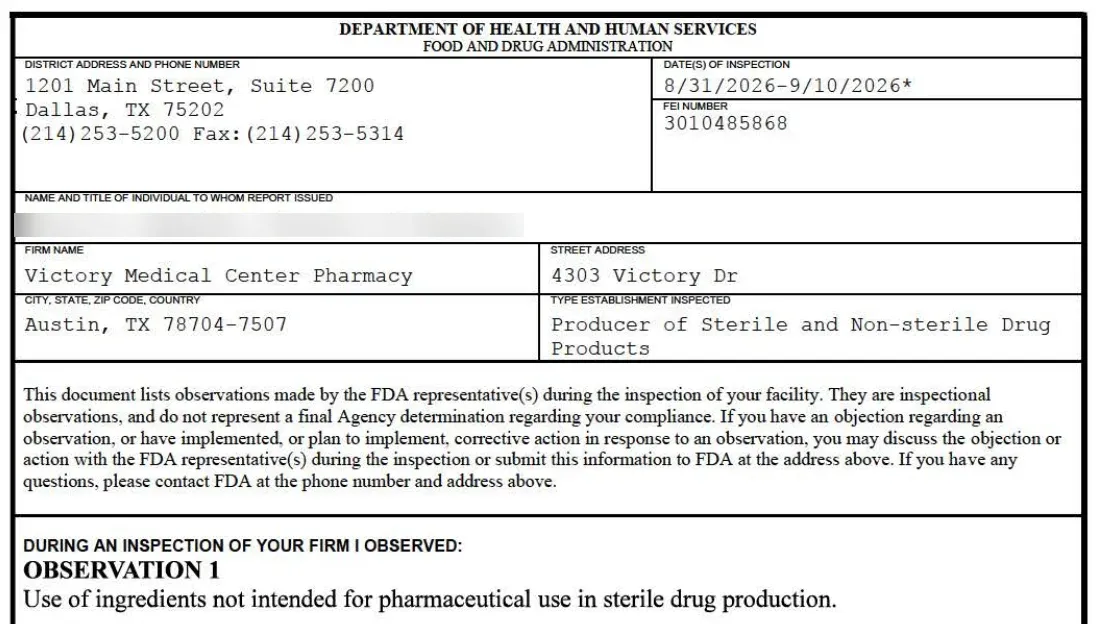 The top of a Form FDA 483, posted in FDA's reading room. The FEI number sits in the top right. Source: FDA. The name of the individual it was issued to is blurred.
A warning letter comes later, and only for what FDA calls "violations of regulatory significance." According to Chapter 4 of FDA's Regulatory Procedures Manual (July 2024 edition), a warning letter is "informal and advisory" and does not commit FDA to enforcement action. It does put the firm on notice, though, and it usually asks for a written response within 15 working days.
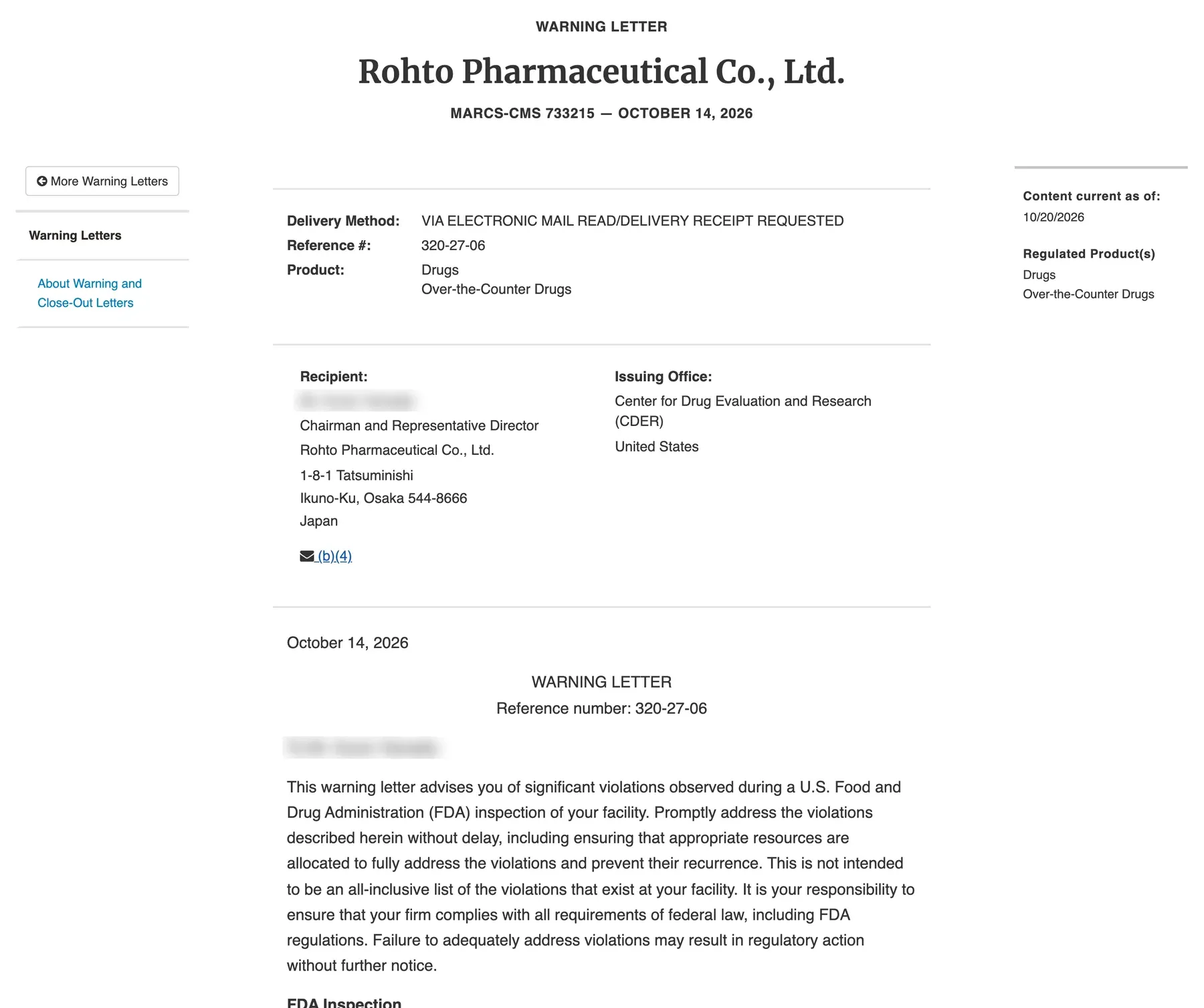 A warning letter as FDA posts it: company, MARCS-CMS number, issue date, regulated product and issuing office at the top. Source: FDA. Individual names are blurred.
| Form FDA 483 | FDA warning letter | |
|---|---|---|
| Issued by | The investigator, at the close of an inspection | An FDA center or program office, after review |
| What it means | Observations of possible violations | FDA's position that significant violations exist |
| Final agency determination? | No | No (FDA treats it as advisory) |
| Expected response | Encouraged, in writing, with a corrective action plan | Requested, usually within 15 working days |
| Published? | Only some, in the FOIA reading room | All issued letters, redacted, on the warning letter page |
| Follow-up record | Inspection classification (NAI, VAI or OAI) | Response letter and close-out letter, when issued |
A third document matters for tracking. FDA may issue a close-out letter once it has verified, usually through a follow-up inspection, that a firm corrected the violations in a warning letter. The close-out program covers warning letters issued on or after September 1, 2009. For a competitor or a supplier, a close-out letter is often the signal you were waiting for.
Where FDA publishes warning letters, 483s and import alerts
FDA spreads these records across five places. Each one updates on its own rhythm, and only one has an RSS feed.
| FDA source | What it holds | How it updates | FDA's own alert |
|---|---|---|---|
| Warning letter page | Every warning letter (redacted), with response and close-out flags | New letters mostly on Tuesdays | Topic-level email sign-up |
| OII FOIA Electronic Reading Room | Selected Form 483s and inspection reports | Weeks after the inspection, or years later | RSS feed of every new record |
| Inspection Classification Database | NAI, VAI and OAI results by project area | Weekly | None |
| FDA Data Dashboard | Inspections, compliance actions (warning letters, injunctions, seizures), recalls, import refusals | Inspections dashboard updated weekly; API needs credentials | None |
| Import alerts by publish date | Detention without physical examination (DWPE) lists, such as Import Alert 66-40 for drug GMP failures | Listed by last publish date | None |
The FDA warning letter database page
The warning letter page works as FDA's warning letter database. Each row shows the posted date, the letter issue date, the company, the issuing office and the subject, plus columns for a response letter and a close-out letter. You can filter by issuing office, issue date, posted date and year, and a Download XLSX button exports the results.
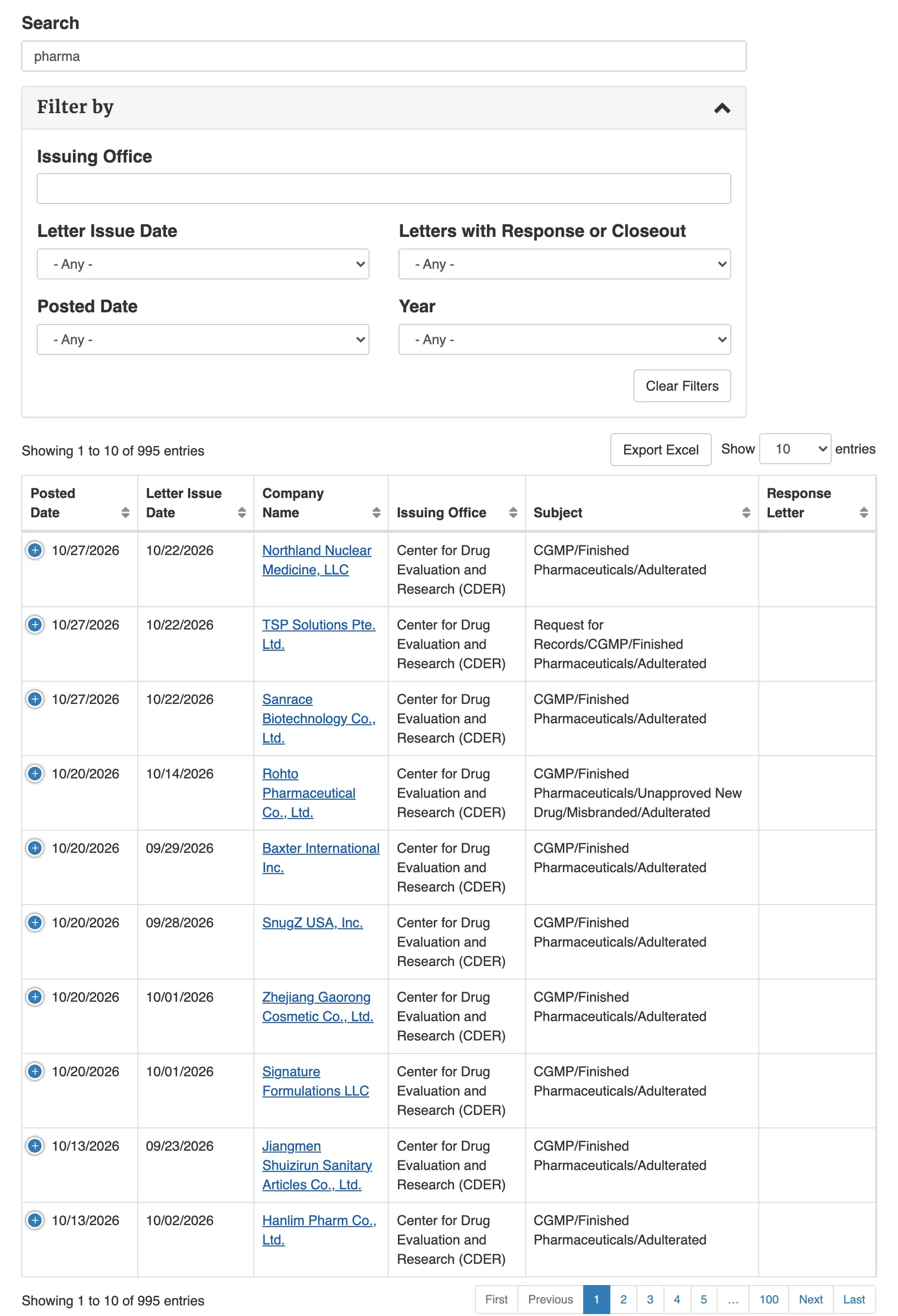 FDA's warning letter page with a search term applied. The search term carries into the page URL, which is what you monitor. Source: FDA.
The posted date and the issue date are not the same, and the gap matters. We pulled the spreadsheet that FDA's Download XLSX button returned on October 27, 2026, which held 1,000 letters posted between January 2021 and April 2026. Three out of four (750 of 1,000) carried a Tuesday posted date. The median letter went up 11 days after FDA issued it, and a quarter took 26 days or longer. On the live page that same day, one letter issued on August 26, 2026 had just been posted on October 27.
So if a supplier tells you "we haven't heard anything from FDA," the letter may already exist and simply not be public yet.
The FOIA reading room for Form 483s
Form 483s do not have a page of their own. FDA posts them in the Office of Inspections and Investigations (OII) FOIA Electronic Reading Room through two routes. The first is proactive disclosure, where FDA chooses to publish a record. The second is the three or more rule, which requires FDA to post a record once three or more people have requested it under FOIA (5 U.S.C. § 552(a)(2)(D)).
FDA is explicit about the limits. Records that qualify under neither route "will not appear here, even if an inspection took place." Company responses to 483s are generally not posted, and records come off the page after five years.
Each row lists the record date, company name, FEI number, record type (483 or EIR), state, country, establishment type and publish date. In the five newest 483 rows on October 27, 2026, the publish date came 22 to 42 days after the record date. The reading room's RSS feed that same morning also carried a record dated June 2016, published in October 2026. Old 483s can surface at any time once enough people ask for them.
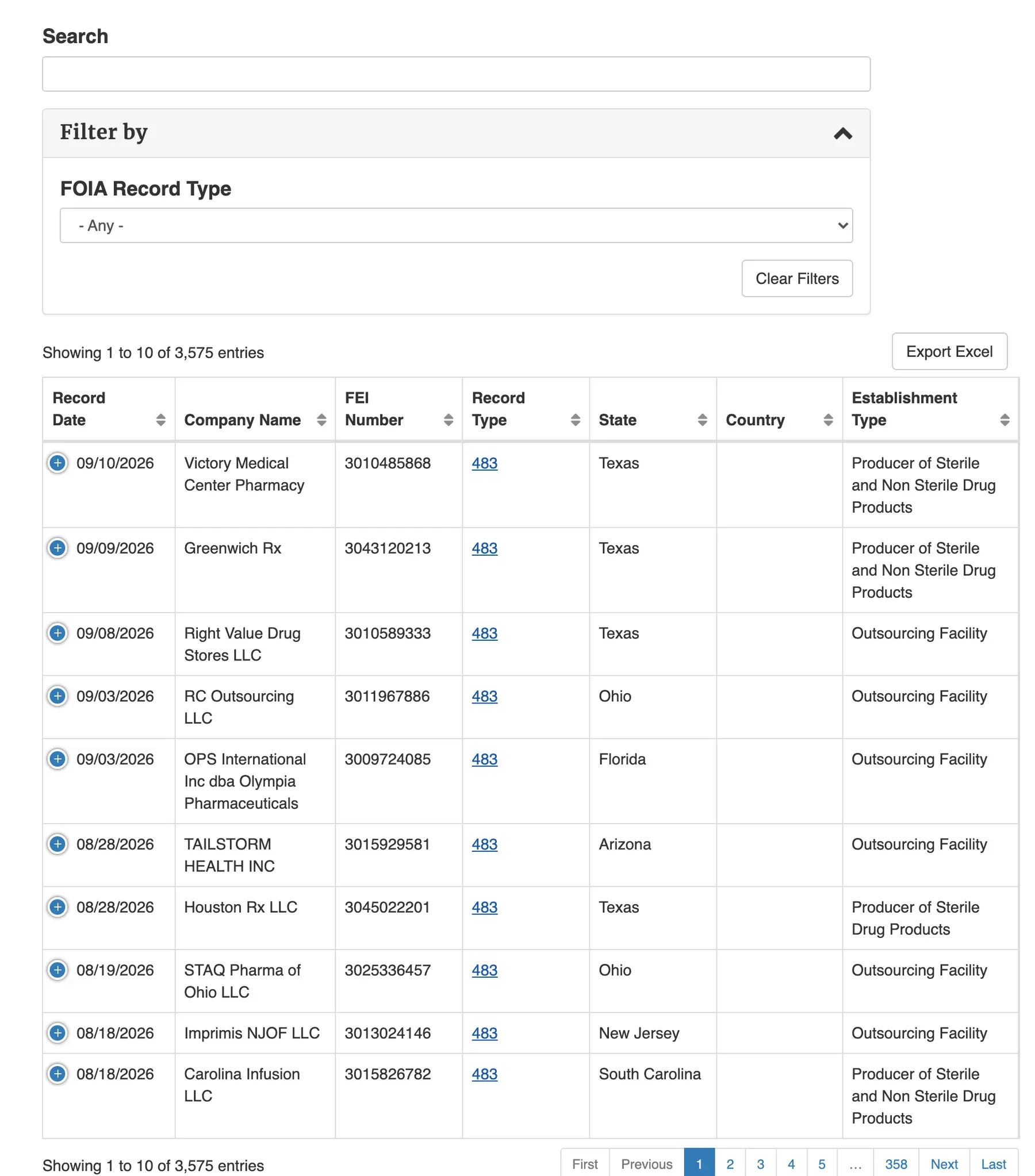 The OII FOIA Electronic Reading Room. Each 483 row carries an FEI number, the most reliable field to watch. Source: FDA.
What FDA's own alerts cover and where they stop
FDA does offer alerts, and for some teams they are enough. The warning letter page has an email sign-up box ("Get regular FDA email updates delivered on this topic"), and the reading room has an RSS feed that lists each newly posted record with the company, city, record date and FEI number. If you want every warning letter in your inbox, sign up there.
 FDA's sign-up box on the warning letter page takes an email address and nothing else. Source: FDA.
The gaps show up when you need something narrower. On October 27, 2026:
- The email sign-up form asked for an email address only. It had no field for a company name, product or FEI number.
- FDA's list of RSS feeds included the reading room but no feed for warning letters.
- Neither alert flags a change to an existing row, such as a close-out letter or a posted response added to a letter from last year.
- Nothing covers the Inspection Classification Database or the import alert lists, where a supplier can be added without any new letter.
That is the job for a page monitor. Point it at the narrow view you care about, and it tells you when that view changes.
How to set up FDA warning letter alerts in Visualping
The warning letter page accepts its search as a URL parameter, and FDA filters the results on the server. That means you can monitor a page that only ever lists letters matching your company. Setup takes a few minutes per company.
Step 1: Build a filtered search URL. Add ?search_api_fulltext= and the company name to the warning letter page address:
https://www.fda.gov/inspections-compliance-enforcement-and-criminal-investigations/compliance-actions-and-activities/warning-letters?search_api_fulltext=YourCompany
Results come back newest first. Use the shortest distinctive form of the name ("Acme Pharma" rather than "Acme Pharmaceuticals, Inc."), because FDA lists firms under legal names, "dba" names and former parent names. The search also matches text inside the letters, so a competitor search can return letters sent to other firms that mention it. For CI teams, that is a feature.
Step 2: Paste the URL into Visualping and pick a mode. You have two good options:
- Text mode with keyword alerts. Add your company names, subsidiary names and product names as comma-separated keywords and set the match to "added." Keywords are case-insensitive, match whole words and allow up to 200 entries. Keyword alerts work only in Text mode, and they replace the usual change threshold, so only a keyword match triggers an alert.
- AI mode with an "Alert me when" condition. Write the rule in plain English, such as: "Alert me when a new warning letter appears for any company in this list: [names], or when a close-out letter or response letter is added to an existing row. Ignore layout changes." Visualping AI reads each change against that condition and marks it important or not. AI conditions and AI summaries are available on every plan, including Free.
Step 3: Set the check frequency. FDA posts most letters on Tuesdays, so a daily check catches almost everything within 24 hours. One page checked daily uses up to 31 checks a month, so four pages (124 checks) fit inside the Free plan's 150. If you need same-day alerts, use the advanced schedule to check hourly during US business hours on weekdays. That is roughly 180 checks a month per page, which fits the Starter plan's 1,000. The fastest interval on higher plans is every 2 minutes, which is far more than FDA's posting rhythm needs.
Step 4: Route the alert. Email alerts, webhooks and the REST API come with every plan, including Free. Webhooks send a JSON payload that a ticketing tool, a regulatory intelligence database or Zapier can pick up. Native alerts to Slack, Microsoft Teams and Google Sheets are part of Business plans, which suits a QA channel or a shared CI tracker.
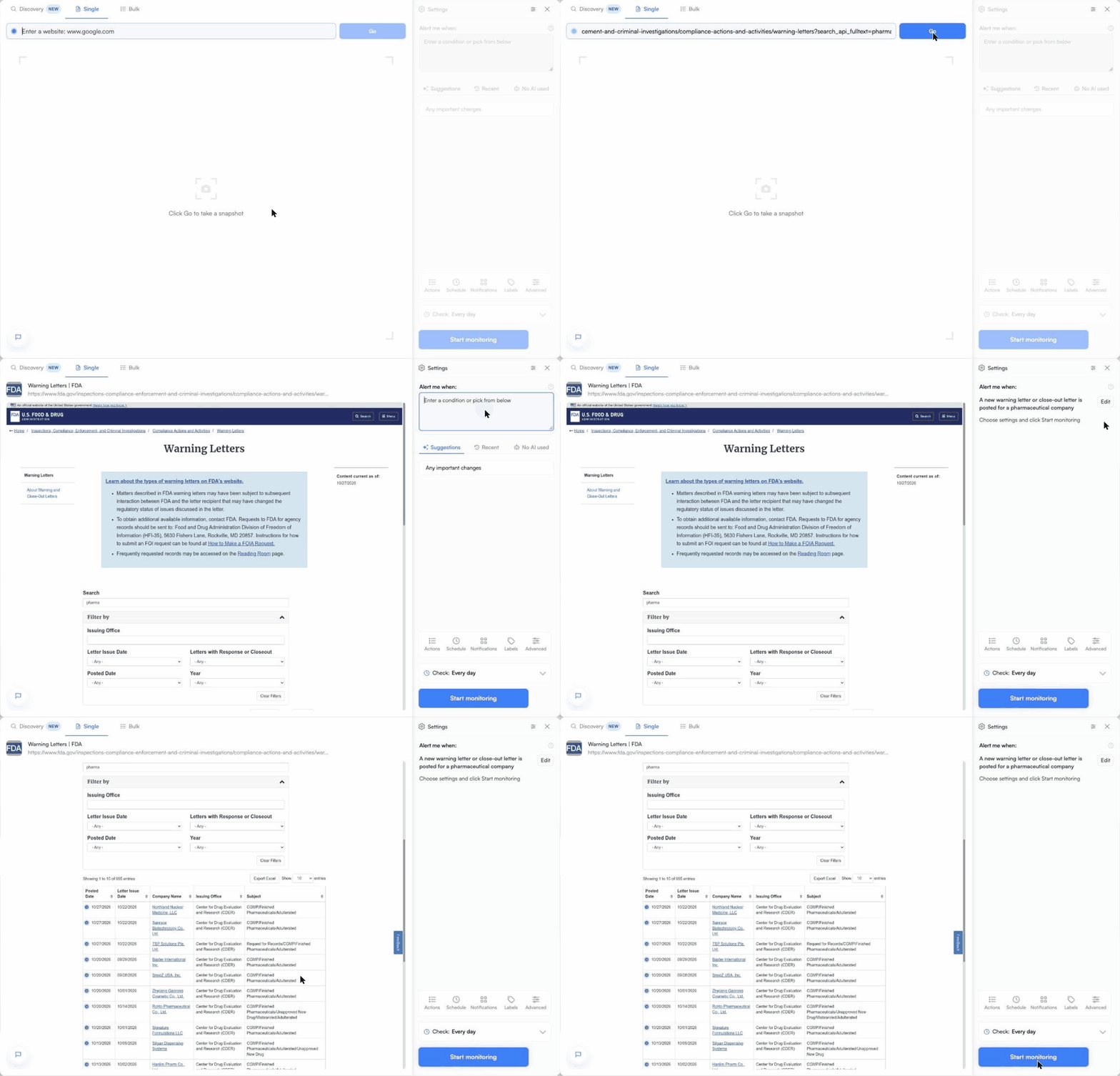 Paste the filtered warning letter URL, let the preview load, describe the letters you care about in "Alert me when," and keep the daily check.
Ready to set up your first FDA monitor? Paste your filtered warning letter URL into Visualping, choose a daily check and enter your email. Four FDA pages checked daily fit inside the Free plan.
How to track Form 483s in the FOIA reading room
The reading room table includes the FEI number for every record, which makes it the most precise place to watch your own sites and your suppliers. Company names vary between records. FEI numbers don't.
- Monitor the OII FOIA Electronic Reading Room in Text mode.
- Add the FEI numbers of your facilities and your CMOs as keywords, plus the company names as a backup. Visualping treats a keyword that looks like a number as a number match, so an FEI number such as
3001234567won't fire inside a longer number. - Set the keyword match to "added," so a record rolling off the page doesn't trigger an alert.
- Check daily. On October 27, 2026, the feed carried 20 records, all published that day between 8:37 a.m. and 1:58 p.m. Eastern.
Each 483 in the reading room links to a PDF. If you monitor PDFs directly, such as a posted 483 or EIR, know that Visualping reads the text of the first 100 pages of a PDF. Text mode warns you when a PDF runs longer than that; Visual and AI mode do not, so use Text mode for long documents. Our guide to monitoring online PDFs covers the setup.
How to watch competitors, CMOs and suppliers
Your own site is one monitor. The bigger value usually sits in the companies around you.
Competitors. A warning letter at a rival's plant can signal supply interruptions, remediation spending or delays to pending applications, though the impact varies widely and FDA treats the letter itself as advisory. One filtered search per competitor keeps each alert attributable. If you follow more than a handful of firms, name each monitor after the company and send the alerts to one Slack or Teams channel, or to a spreadsheet through a webhook.
CMOs and API suppliers. A Form 483 or OAI classification at a contract manufacturer can affect batches you have not released yet. Watch the reading room by FEI number, and watch the Inspection Classification Database, which FDA updates weekly. FDA classifies each inspection as No Action Indicated, Voluntary Action Indicated or Official Action Indicated. OAI means FDA found the facility in "an unacceptable state of compliance." It does not by itself mean a warning letter will follow.
Import alerts. For foreign suppliers, the import alert list sorted by publish date shows which alerts changed most recently. On October 27, 2026, Import Alert 66-40, which covers detention without physical examination of drugs from firms that have not met drug GMPs, carried that day's date. Monitor the alert pages that apply to your product categories and add supplier names as keywords.
Close-out letters. When FDA closes out a warning letter, the existing row on the warning letter page gains a close-out date. A plain "new letter" alert misses that. A filtered search monitored in AI mode, with a condition that mentions close-out letters, catches it.
If you're building a wider program, our guides to pharmaceutical regulatory intelligence, tracking regulatory changes across multiple websites and monitoring government agency guidance cover the rest of the source list. For rival firms beyond FDA records, see our competitor tracking guide.
How many teams already monitor FDA enforcement pages
As of October 27, 2026, 2,138 live Visualping monitors watched pages on fda.gov, set up by 524 separate users and workspaces. Of those, 82 monitors from 63 users and workspaces watched the warning letter page, the FOIA reading room, the inspection observations page or the FDA Data Dashboard. "Live" means the monitor ran at least once in the previous 31 days, and the count excludes Visualping's own internal accounts.
Five setup mistakes that cause missed letters
Watching only the first page of the unfiltered list. The warning letter page shows 10 rows by default. On a busy Tuesday, a letter to your supplier can land on page two before your monitor ever sees it. A filtered search URL avoids this.
Using Visual mode on a busy table. Every new row shifts the table, so a Visual-mode monitor on the full list alerts every posting day. Use Text mode with keywords, or AI mode with a specific condition.
Matching on "any" instead of "added." When an older letter drops off a filtered page, an "any" keyword match fires on the removal. Set keyword alerts to "added."
Searching one version of a company name. FDA lists firms under legal entity names, "aka" and "dba" names, and former owners. Add each variant as a keyword, and use FEI numbers in the reading room.
Assuming no letter means no problem. Letters can post weeks after issue, and 483s may never be posted at all unless FDA posts them proactively or three people request them. An alert tells you what FDA has published. It doesn't replace asking a supplier directly.
FDA warning letter FAQ
Where can I find FDA 483 reports?
In the OII FOIA Electronic Reading Room. Only 483s that FDA posts proactively, or that three or more people have requested under FOIA, appear there. Anything else requires a FOIA request. FDA also publishes yearly spreadsheets of the regulations most often cited on 483s on its inspection observations page.
Is there an FDA warning letter database?
Yes. The warning letter page is searchable and filterable, and it exports to XLSX. The FDA Data Dashboard also counts warning letters under Compliance Actions.
Does OAI mean a warning letter?
Not necessarily. OAI (Official Action Indicated) means FDA found the facility in an unacceptable state of compliance. A warning letter is one possible outcome, but FDA can also pursue other actions, and some inspection data isn't posted until a final enforcement action is taken.
What happens after an FDA warning letter?
The company responds, usually within 15 working days, with its corrections or its reasons for disagreeing. FDA then checks whether the corrections are adequate. If a follow-up inspection confirms them, FDA may issue a close-out letter. If FDA finds violations again, its close-out letter page says enforcement action "may be taken without further notice."
How long does a company have to respond to an FDA warning letter?
FDA's Regulatory Procedures Manual says a warning letter usually requests a written response within 15 working days of receipt. The letter itself states the deadline.
Does FDA remove old warning letters?
According to the Regulatory Procedures Manual, FDA does not remove warning letters from its site unless it rescinds or amends them. A recipient can ask FDA to post its response, and the page then shows a response letter link.
Can I get FDA warning letters by RSS?
FDA's RSS feed list (checked October 27, 2026) has a feed for the FOIA reading room but none for warning letters. The warning letter page offers an email sign-up for the whole topic. To filter by company, monitor a filtered search URL instead.
About this guide
The Visualping team wrote this guide for regulatory affairs, quality and competitive intelligence teams. We checked every FDA page linked here on October 27, 2026, and the monitor counts come from Visualping's own platform data pulled the same day. This guide explains where FDA publishes enforcement records. It is not legal or regulatory advice, and your regulatory counsel should guide any response to a Form 483 or a warning letter.
Want to monitor web changes that impact your business?
Sign up with Visualping to get alerted of important updates from anywhere online.
Eric Do Couto
Eric Do Couto is the Head of Marketing at Visualping. He leads content strategy, growth operations, and brand positioning for website change detection.
More articles by Eric Do Couto