Medicaid Provider Bulletins: How to Track All 50 States
Updated September 29, 2026

Medicaid provider bulletins are how each state Medicaid agency tells enrolled providers about new billing rules, rate changes, coverage policy and deadlines. There is no national feed. Fifty states and the District of Columbia each post their own notices on their own sites, under their own names. Plenty of payment changes also live outside the bulletin, in fee schedule files, provider manuals and managed care plan policies.
This guide is for revenue-cycle and reimbursement teams that bill Medicaid in more than one state. It starts with a verified directory of every state's bulletin page, then covers the other state pages that carry payment changes and a monitoring system that routes each change to the person who owns it. For the federal layer (CMS rules, the Federal Register and CMS guidance), see our companion guide to Medicare and Medicaid policy monitoring. If you also bill Medicare, our guide to Medicare administrative contractor updates covers the MAC side.
This article describes monitoring workflows. It is not billing, coding or legal advice. Always confirm payment and coverage requirements against the current notice on your state Medicaid agency's website.
Where to start in this guide:
- Looking for one state's bulletin page: go to the 50-state and DC directory.
- Building a multi-state watch list from scratch: go to what to monitor in each state, then the 5-step system.
- Fighting fee schedule files that change names every year: go to fee schedules.
- Watching federal changes (CMCS bulletins, SPA approvals, waivers): go to federal Medicaid listings.
- Sizing the workload: go to how often state Medicaid pages change.
 Every state posts its Medicaid notices its own way
What Medicaid provider bulletins are
A Medicaid provider bulletin is an official notice from a state Medicaid agency, or from the fiscal agent that runs its claims system, to the providers enrolled in its program. Bulletins announce policy changes, billing instructions, new or changed codes, rate updates, system changes and deadlines. Some states publish a numbered monthly bulletin. Others post individual notices as they're ready. Notices also get revised: Wisconsin's ForwardHealth says its provider Updates "reflect current policy at the time of publication; this information may change over time and be revised by a subsequent Update."
The names vary as much as the formats. A sample of what states call the same kind of notice:
| What the state calls it | Example |
|---|---|
| Provider bulletins | Colorado, Delaware, Nebraska |
| Policy bulletins | Michigan (numbered in the form MMP 26-40) |
| Memos and bulletins | Virginia |
| Transmittals | District of Columbia, Maryland |
| Advisory letters | Ohio (Medicaid Advisory Letters, or MALs) |
| Informational letters | Iowa (ILs) |
| Global messages | Oklahoma |
| Provider memos | Hawaii |
| Banners | Vermont |
| Newsletters | Arizona (Claims Clues), North Dakota |
| Alerts | Alabama, Florida (Health Care Alerts) |
| Remittance advice messages | Alaska |
| Supplements | New Mexico |
A bulletin is only one of the state pages that can change what you get paid. A multi-state regulatory watch list should cover six kinds of source:
- Provider bulletins and notices, where the state announces a change. Sometimes the bulletin is the only announcement.
- Provider manuals, the standing rulebook. Manuals get revised on their own schedule, and some states use each revision to fold in the bulletins issued since the last one.
- Fee schedules and rate files, usually spreadsheets or PDFs, reissued when rates change and often renamed each time.
- Managed care plan policies. In states that contract with managed care organizations (MCOs), each plan publishes its own provider manual, payment policies, prior authorization lists and provider news.
- State plan amendments (SPAs) and public notices, the formal record of changes to how the state runs its program and sets payment rates.
- Fiscal agent portal messages: banners and alerts on the claims portal about system issues, claim holds and reprocessing.
Why state Medicaid changes are hard to track
Each state's information is public, but it's spread across dozens of sites in formats that resist a quick weekly check.
The same state often runs two or three websites
Many states split provider information between the agency's own site and a claims portal or fiscal-agent site. Texas posts its provider news on the TMHP news page; TMHP is the Texas Medicaid & Healthcare Partnership. Kansas uses the KMAP portal. Wisconsin publishes through its ForwardHealth Portal.
Georgia posts provider notices in GAMMIS, its Medicaid claims portal, and New Hampshire posts messages and announcements in its NH MMIS portal. Alaska posts remittance advice messages on a separate provider site. A team that bookmarks only the agency's home page will miss the portal notices. Some portal pages also expire sessions or load their content with scripts, which makes them harder to bookmark or link to.
Pages and files are organized by year
Several states organize provider notices by year. Oklahoma posts provider notices on a page named 2026 Global Messages, with a separate page for each earlier year. Michigan lists this year's policy bulletins on a 2026 Medicaid Policy Bulletins page, Massachusetts keeps a 2026 MassHealth provider bulletins list, and Utah files its bulletins in a 2026 folder. A bookmark or monitor on one of these pages stops showing new notices once the next year's page starts.
The District of Columbia keeps current transmittals on its DHCF Medicaid Updates page and moves earlier years to archive pages such as "DHCF Medicaid Updates - 2025." A notice from last year may no longer be on the current page.
Archives work the same way: Virginia lists memos and bulletins by year, and North Carolina keeps its older monthly bulletins, going back to 1997, in a separate Medicaid Bulletin archive. If you need a bulletin that's no longer listed, Nebraska's bulletin page and Virginia's library both explain how to request older copies by email.
Fee schedule files change names
Rate files are the worst offenders. Colorado's fee schedule page links each release as a spreadsheet whose file name carries the effective date and a version number. When we checked in late September 2026, the January 2026 schedule was on version 1.8, and the page noted that only reduced codes would appear on the April 2026 schedule.
Florida's current practitioner file is named "2026 Practitioner Fee Schedule," while an earlier release was named "Practitioner Fee Schedule January 1, 2025." Florida's historical schedules are posted as ZIP archives. A monitor or bookmark pointed at last year's file keeps showing last year's rates.
Even a current schedule can change after it's posted. Oklahoma's provider letter 2026-17, dated September 23, 2026, says the state found an issue with its July 1, 2026 fee schedule update. The state corrected the posted schedule and set claim adjustments to begin on September 30, 2026.
Effective dates can land before the notice
A Medicaid rate change can take effect before anyone announces it. Four examples from 2026:
- Maine: On September 2, 2026, MaineCare posted a retroactive physician rate update, effective January 1, 2026 and implemented for billing on August 26, 2026. Some rates went up and some went down.
- Texas: In March 2026, TMHP posted reimbursement rate updates for certain HCPCS codes "effective for dates of service on or after January 1, 2026." The notice said TMHP would reprocess affected claims and show any adjustments on future remittance reports. TMHP posted a correction to the same update on June 8, 2026.
- North Carolina: A September 25, 2026 Medicaid Bulletin article announced managed care rate increases for NC Innovations Waiver direct care workers, effective October 1, 2026 and retroactive to July 1, 2026.
- Virginia: A DMAS bulletin titled "Outpatient Rehabilitation Rates Effective July 1, 2026" was posted on August 18, 2026.
Some of these notices also start a clock. MaineCare's notice says it will adjust paid claims billed at or above the new rates. Providers must adjust claims billed below the new rates themselves, within 120 days of the most recent claim payment date, to avoid timely filing denials. Indiana's bulletin BT2026148, published September 3, 2026, gives providers 180 days from publication to submit or resubmit claims affected by a pricing-method error. A notice that sits unread for a month uses up a month of that window.
Federal rules allow for retroactive rates. Under 42 CFR 447.256, an approved state plan amendment that changes payment methods can take effect as early as the first day of the calendar quarter in which the state submitted it. CMS has 90 days to act on the state's payment assurances, so approval can arrive well after the new rates apply. Maryland's SPA MD-26-0005, which changes the rates for targeted case management services, was approved by CMS on September 23, 2026 with an effective date of July 1, 2026. When a change is retroactive, your team needs to know quickly: it affects expected reimbursement, underpayment follow-up and any claims the state reprocesses.
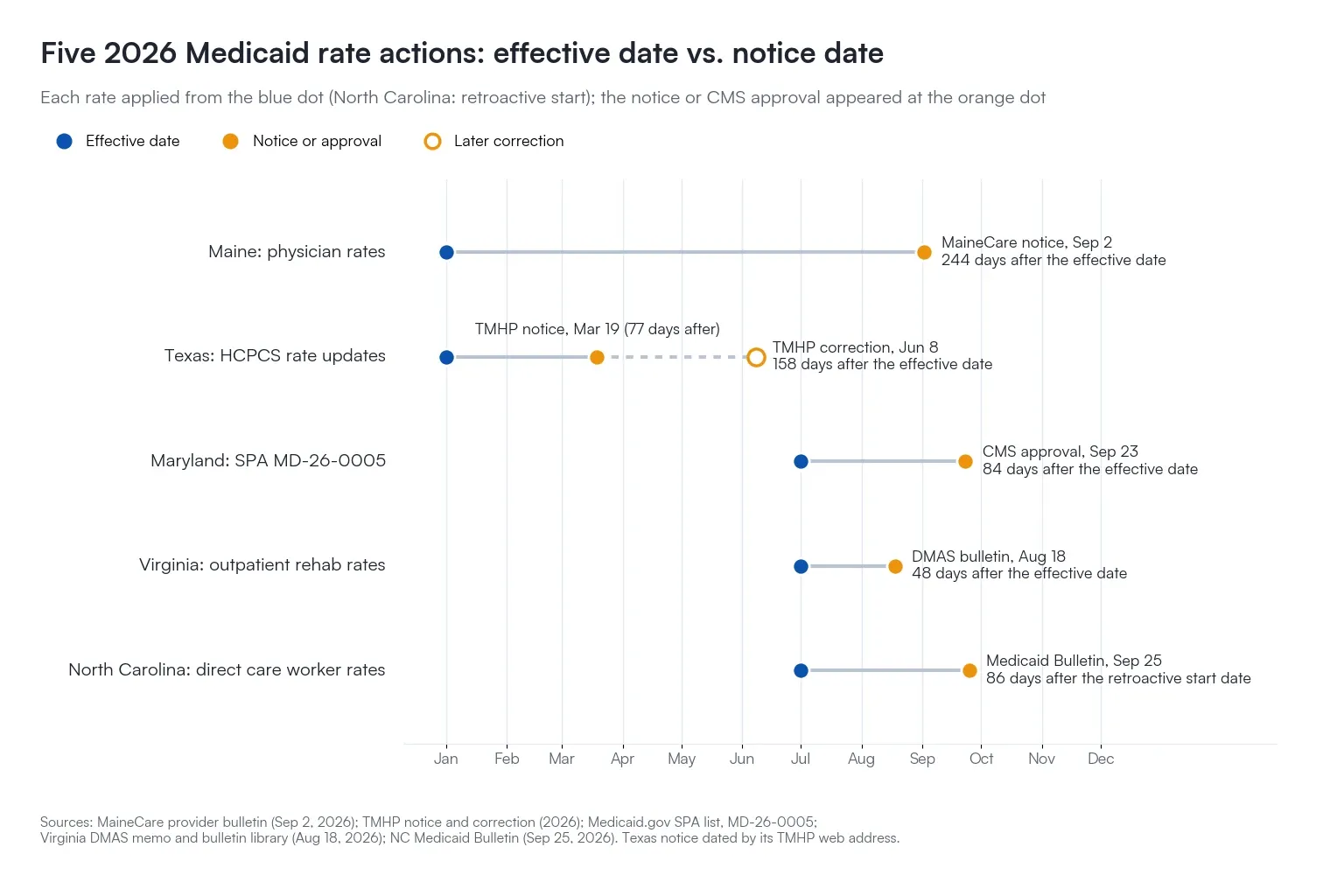 Five 2026 rate actions, dated from each official notice
Volume adds up fast
A single state can publish a lot. Virginia's memo and bulletin library showed 10 new memos and bulletins between September 2 and September 25, 2026, covering maternity care billing and coding, service authorization, transportation, behavioral health enrollment and federal eligibility changes. Multiply that by every state you bill in, then add each state's managed care plans.
Long manuals and PDFs
Provider manuals are often published as large PDF files. Michigan's Medicaid Provider Manual is a single PDF of 2,678 pages (the July 1, 2026 version), and the state updates the online manual quarterly to incorporate policies issued through bulletins. Nobody rereads a 2,678-page file every quarter, so teams lean on the bulletins to see what moved.
How often state Medicaid pages change
To size the workload, we looked at a sample of Visualping monitors on state Medicaid agency and Medicaid claims-portal websites. The sample leaves out Visualping's own internal accounts and a few accounts we exclude for privacy reasons. It counts only web pages (not PDF or spreadsheet files) that were set up before June 28, 2026 and checked successfully at least once between June 28 and September 28, 2026. That 93-day window is as far back as our check-level data goes.
We also left out one account whose pages changed far more often than everyone else's, partly because it checks them more often. That leaves more than 600 pages from 46 of the 51 Medicaid programs, monitored by more than 110 accounts.
- About two-thirds of the pages had at least one detected change in the 93 days.
- Nearly half changed at least once in the last 30 days, and about 1 in 5 changed in the last seven days.
- About 65 of the pages are bulletin, notice or news pages (judging by their web addresses), held by about 35 accounts. About 8 in 10 of them changed at least once in the 93 days, and about 6 in 10 in the last 30 days. Most are checked daily.
- Multi-state watch lists carry most of the volume. About 1 in 4 accounts in the sample watch Medicaid pages in more than one state, and those accounts hold most of the pages.
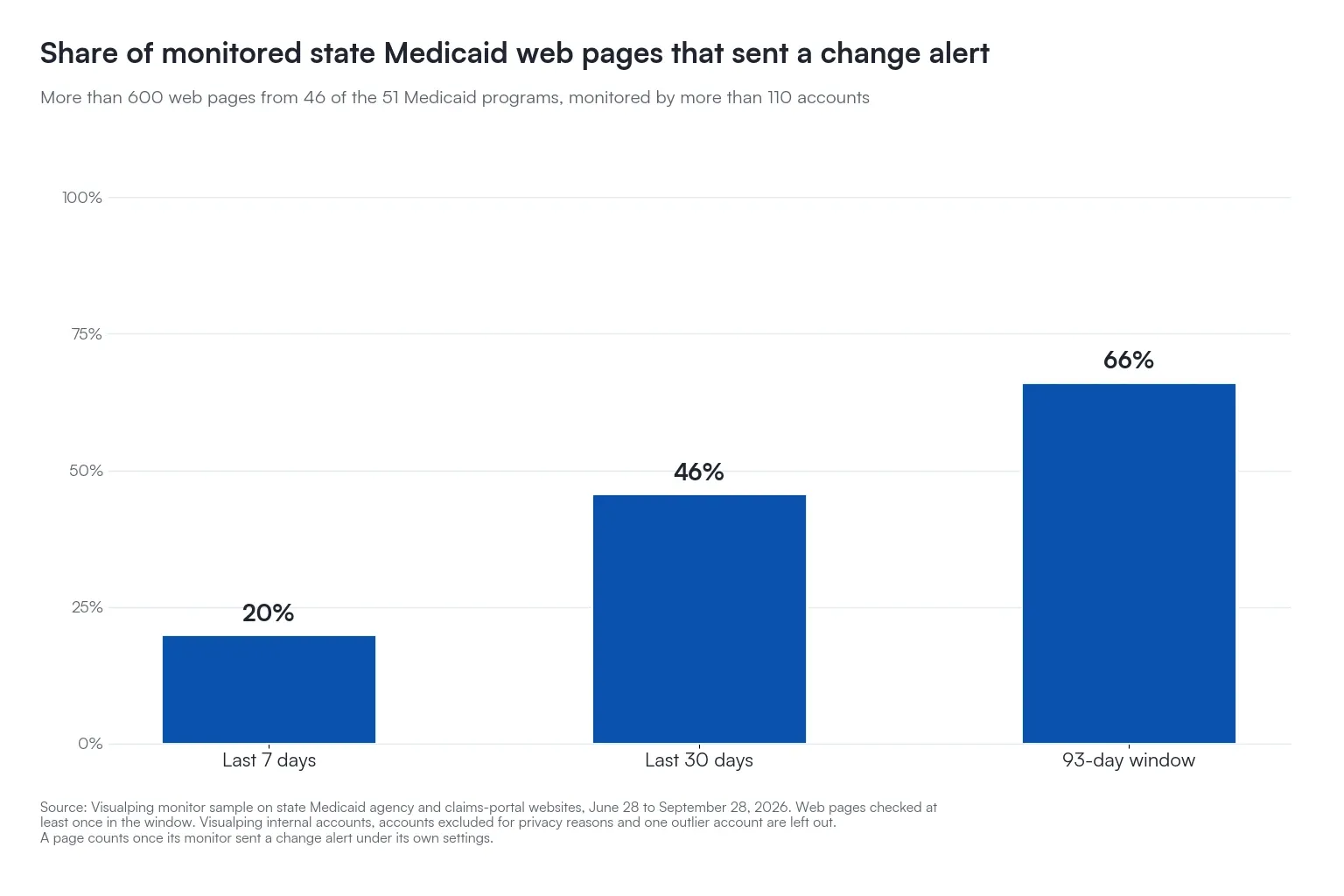 Share of sampled pages that sent a change alert
Read these numbers with the caveats attached. A "detected change" here means the monitor sent a change alert under its own settings, and that includes edits that aren't policy changes. That's why the prompt advice in Step 3 below matters. Three months is a short window, and this is a sample of pages Visualping users chose to monitor, not a census of every state Medicaid page. Including the account we left out raises the 93-day figure to about 3 in 4.
For planning, use the 30-day rate for bulletin, notice and news pages, most of which are checked daily. At that rate, a watch list of 20 such pages would flag changes on about 12 of them in a month. Some of those will be minor edits. The Important flag from your Step 3 prompts and a named owner for each page (Step 4) let your team separate rate and billing changes from routine edits.
The 50-state and DC Medicaid provider bulletin directory
This table lists the page where each state Medicaid program posts provider bulletins or their equivalent. We checked every row on September 29, 2026. Each linked page lists recent notices on the page itself once it loads in a browser.
Several state sites block automated tools or build their lists with scripts, and we confirmed those pages with a browser-based fetch. The setup notes flag them, plus the pages that need a click. Check the first capture of any monitor you put on one of those pages (see Step 2). If a link fails, start from the agency's provider section, because state agencies move pages.
That on-page check matters, because some obvious candidates don't list anything current. Florida's page titled "Medicaid Provider Bulletins" says the quarterly bulletins "are no longer published"; current notices go out as Florida Medicaid Health Care Alerts. Wisconsin's ForwardHealth Updates page shows no Updates until you click Search. Utah's bulletin page describes the bulletins and links to a folder directory instead of listing them. A monitor on any of those pages would stay quiet while new notices appeared somewhere else.
| State | Medicaid agency or program | Bulletin or notice page | Setup note |
|---|---|---|---|
| Alabama | Alabama Medicaid Agency | Provider alerts | |
| Alaska | Alaska Department of Health | Remittance advice messages | |
| Arizona | AHCCCS | Claims Clues newsletter | Blocks some automated tools; confirm the first capture |
| Arkansas | Department of Human Services, Division of Medical Services | Official notices | Blocks some automated tools and loads its list with scripts; confirm the first capture |
| California | Department of Health Care Services (Medi-Cal) | Medi-Cal provider news | Script-loaded list; confirm the first capture |
| Colorado | Department of Health Care Policy and Financing | Provider bulletins | |
| Connecticut | Department of Social Services (HUSKY Health) | HUSKY Health provider updates | Reposts DSS provider bulletins and Important Messages. The source of record is the DSS CMAP portal, where numbered bulletins need a search |
| Delaware | Division of Medicaid and Medical Assistance | Provider bulletins (document repository) | Script-loaded, alphabetical list; bulletins come out quarterly (the 2026 2Q bulletin was posted July 26, 2026) |
| District of Columbia | Department of Health Care Finance | DHCF Medicaid updates (transmittals) | |
| Florida | Agency for Health Care Administration | Health care alerts (last 90 days) | Blocks some automated tools; confirm the first capture |
| Georgia | Department of Community Health | Provider notices (GAMMIS) | |
| Hawaii | Med-QUEST Division | Provider memos | |
| Idaho | Department of Health and Welfare | Current announcements | |
| Illinois | Department of Healthcare and Family Services | Provider notices | Script-loaded list; confirm the first capture |
| Indiana | Family and Social Services Administration | IHCP bulletins | |
| Iowa | Iowa Department of Health and Human Services | Informational letters (ILs) | Shows the ten latest letters. Manual changes go out separately as general letters |
| Kansas | Kansas Department of Health and Environment | KMAP bulletins | Passes through a sign-in redirect before the list loads; confirm the first capture |
| Kentucky | Department for Medicaid Services | Provider letters | Script-loaded list of this year's letters. If the first capture says "No results were found," monitor the KYMMIS site messages instead |
| Louisiana | Louisiana Department of Health | Informational bulletins | |
| Maine | Office of MaineCare Services | MaineCare bulletins | |
| Maryland | Maryland Department of Health | Provider transmittals | Script-loaded table, newest first, 10 per page; confirm the first capture |
| Massachusetts | MassHealth | 2026 MassHealth provider bulletins | Year-specific. Blocks some automated tools; confirm the first capture |
| Michigan | Department of Health and Human Services | 2026 Medicaid policy bulletins | Year-specific. Blocks some automated tools; confirm the first capture |
| Minnesota | Department of Human Services | MHCP provider news and updates | Some automated requests get a captcha page that loads normally; confirm the first capture |
| Mississippi | Division of Medicaid | Late Breaking News | |
| Missouri | MO HealthNet Division | MO HealthNet news | |
| Montana | Department of Public Health and Human Services | Provider site home page (announcements) | |
| Nebraska | Department of Health and Human Services | Medicaid provider bulletins | |
| Nevada | Nevada Medicaid | News and announcements | |
| New Hampshire | Department of Health and Human Services | Messages and announcements (NH MMIS) | Blocks some automated tools; confirm the first capture |
| New Jersey | Division of Medical Assistance and Health Services | NJMMIS announcements | |
| New Mexico | Health Care Authority | Registers and supplements | Blocks some automated tools; confirm the first capture |
| New York | Department of Health | Medicaid Update | Monthly newsletter |
| North Carolina | NC Medicaid (Department of Health and Human Services) | Medicaid Bulletin | |
| North Dakota | Department of Health and Human Services | Provider newsletters | |
| Ohio | Ohio Department of Medicaid | ODM Press issues (Resources for Providers) | ODM Press, the provider newsletter, comes out about twice a month. The newest issue listed was August 21, 2026 when we checked, so subscribe to the email as well. Medicaid Advisory Letters are listed by number, without dates |
| Oklahoma | Oklahoma Health Care Authority | 2026 global messages | Year-specific. Formal notices go out as 2026 provider letters, also year-specific |
| Oregon | Oregon Health Authority | Oregon Health Plan announcements | Script-loaded list; confirm the first capture |
| Pennsylvania | Department of Human Services | Medical Assistance bulletins | DHS bulletin search, pre-filtered to the Office of Medical Assistance Programs and sorted newest first; script-loaded, so confirm the first capture |
| Rhode Island | Executive Office of Health and Human Services | Provider updates | Blocks some automated tools; confirm the first capture |
| South Carolina | Department of Health and Human Services | Communications | |
| South Dakota | Department of Social Services | Medicaid provider communication | |
| Tennessee | Division of TennCare | TennCare memos to MCOs and providers | |
| Texas | Health and Human Services Commission (TMHP) | TMHP news | |
| Utah | Department of Health and Human Services | 2026 Medicaid Information Bulletins (folder) | Year-specific; bulletins come out in January, March, May, July, September and November |
| Vermont | Department of Vermont Health Access | Vermont Medicaid Portal banners | Script-loaded app; confirm the first capture |
| Virginia | Department of Medical Assistance Services | Medicaid memos and bulletins | |
| Washington | Health Care Authority | Provider alerts | Script-loaded list; confirm the first capture |
| West Virginia | Bureau for Medical Services | WV MMIS announcements | |
| Wisconsin | Department of Health Services (ForwardHealth) | ForwardHealth Portal home (Hot Topics) | Lists recent Updates as undated Hot Topics. The full Updates list needs a Search click, which an Action can do |
| Wyoming | Wyoming Department of Health | Medicaid notices | Blocks some automated tools; confirm the first capture. The state says it publishes provider bulletins quarterly on its manuals and bulletins page, but no 2026 bulletins were posted there when we checked |
A few patterns stand out. The names differ (bulletins, transmittals, advisory letters, global messages, memos, banners). Of the 51 pages, 17 sit on a claims portal or provider website separate from the agency's main site. The Massachusetts, Michigan, Oklahoma and Utah pages are year-specific, and so is Oklahoma's provider letters page, so plan to swap in their 2027 pages in January.
 Fifty-one programs, fifty-one different bulletin pages
What to monitor in each state
If you're starting from nothing, work down this list in each state you bill. It starts with the pages that announce payment changes and ends with early-warning and federal pages. A broader compliance monitoring program can follow the same order.
| Priority | Page type | Why it matters | Suggested check frequency |
|---|---|---|---|
| 1 | Provider bulletin or notice page | First announcement of billing, coding and rate changes | Daily |
| 2 | Fee schedule listing page | New rate files and effective dates; files often renamed | Daily in the weeks around each quarter start and your state's fiscal year start (see the calendar below); weekly otherwise |
| 3 | Fiscal agent portal messages | Claim holds, system fixes and reprocessing notices | Daily |
| 4 | Managed care plan provider news and payment policy pages | Plan-level policy and prior authorization changes | Weekly, for each plan you contract with |
| 5 | Provider manual page and revision log | Manual revisions that fold in earlier bulletins | Weekly |
| 6 | State plan amendment and public notice pages | Proposed and pending changes to payment methods | Weekly |
| 7 | Tribal consultation notice page | Advance notice of SPAs, waivers and demonstrations that affect tribal health programs | Weekly |
| 8 | Proposed policy or comment pages | Changes still open for comment | Weekly |
| 9 | Medicaid.gov guidance list, plus SPA and waiver lists filtered to your states | Federal guidance, SPA approvals and waiver actions | Weekly |
Rows 6 to 8 give you early warning, which compliance teams call regulatory horizon scanning. Michigan, for example, posts notices of proposed policy and states that proposed policy must go through a public comment period before it becomes final. Tennessee lists public notices for state plan changes, with each comment period's status.
Fiscal agent and claims portal notice pages
In some states, the fiscal agent that runs the claims system posts its own notices about claims processing, portal changes and payment schedules. In 17 of the directory's 51 rows, the bulletin page already sits on a claims portal or provider site. In the five states below, the claims portal also posts dated notices on a public page, separate from the state's Medicaid provider bulletins page in the directory:
| State | Claims portal notice page | Newest notice when we checked (September 29, 2026) |
|---|---|---|
| Connecticut | CMAP portal Important Messages | Updated FAQ on primary care increased payments, posted 9/22/26 |
| Kentucky | KYMMIS site messages | Web portal mandate for prior authorization, August 3, 2026 |
| Louisiana | LA Medicaid provider site | Checkwrite schedule for calendar year 2027, 09/10/26 |
| New York | eMedNY notices | Revised prior approval change request process, August 13, 2026 |
| North Carolina | NCTracks provider announcements | Process change for private duty nursing authorizations, Sep 21, 2026 |
Other portals show the public little or nothing. When we checked, the public pages of Florida's Medicaid portal, Pennsylvania's PROMISe, the MassHealth Provider Online Service Center and Ohio's Provider Network Management system showed a sign-in screen or general information instead of a notice list. Confirm that a notice page is still maintained before you rely on it, too: Indiana retired its IHCP banner page on June 13, 2023, and TMHP's banner messages page hasn't listed a new week since February 2023. Connecticut's CMAP portal also shows a live clock, so write your "Alert me when" prompt around the notice list.
Where the provider manuals live
Many states publish provider manuals as PDFs, and some run to thousands of pages. Monitor the page that lists each manual with its revision date, or the state's release notes, instead of the PDF. These pages show a date or version for each manual or change:
| State | Manual page | What shows the change |
|---|---|---|
| California | Medi-Cal provider manual (Part 1 shown) | A revision date for each section; each provider community has its own page |
| Colorado | Billing manuals | A month and year stamp on each manual, such as "(9/26)" |
| Florida | Service-specific coverage policies | An effective date for each policy |
| Georgia | GAMMIS provider manuals | A date for each manual |
| Indiana | IHCP provider reference modules | A date and version number for each module |
| Texas | TMPPM release notes | Release notes grouped by month, listing each changed handbook section |
| Washington | Billing guides and fee schedules | Dated versions of each guide, and publish dates on fee schedules |
Manual revisions often fold in the Medicaid provider bulletins issued since the last update (Michigan's quarterly updates work this way), so a new revision date is your cue to reread the changed section. If your state isn't listed, look for a manual index with revision dates or a "what's changed" page. For a manual published as one long PDF, remember that Visualping checks only the first 100 pages.
Publication cycles to put on your calendar
Rate and code changes cluster around a few dates. Put them on the same calendar you use to track regulatory changes across other sites:
- State fiscal years: 46 states start their fiscal year on July 1, New York starts on April 1, Texas on September 1, and Alabama and Michigan on October 1, according to NCSL's fiscal 2027 budget tracker. The District of Columbia's fiscal year also starts October 1. Several of the 2026 rate changes in this guide took effect on July 1, including Virginia's outpatient rehabilitation rates, Maryland's case management rates and Oklahoma's fee schedule update.
- Code updates: CMS posts quarterly HCPCS update files for January, April, July and October. It also posts updated Medicaid NCCI edit files at the beginning of each calendar quarter. State notices follow: TMHP posted its fourth-quarter NCCI updates, effective October 1, 2026, on September 25.
- State publishing cycles: Colorado publishes its provider bulletin monthly, and Utah issues bulletins every other month. Wyoming publishes quarterly bulletins and manual updates, and Michigan updates its provider manual quarterly.
- January rollovers: year-specific pages need their replacements each January (Step 5 covers this).
Fee schedules: monitor the listing page instead of the file
A monitor on a fee schedule file breaks when the state posts the next release under a new file name, and Colorado and Florida both do exactly that. Colorado's January 2026 schedule was on version 1.8 when we checked, and each version gets a new file name. Florida's file names changed pattern between 2025 and 2026. A monitor on last year's file stays quiet while the new file sits one link away.
The fix is to monitor the listing page that links to the files:
- Colorado: the rates and fee schedule page lists every schedule by year and release date.
- Florida: the Rule 59G-4.002 reimbursement schedules page lists current schedules with their effective dates.
- California: the Medi-Cal rates page notes that rates are updated and effective as of the 15th of each month and published on the 16th.
When a new file is linked, or an effective date or version number changes on the listing page, you get an alert and can download the file. Compare it with the previous release in your own spreadsheet tools to see which codes and rates changed. A useful AI monitoring prompt for these pages: "Alert me when a new fee schedule file is posted, or when an effective date or version number changes."
A few format rules help:
- Excel files: Visualping can monitor an Excel file directly, but the listing page is still the better target. It shows when a new file is posted, and it keeps working when the file's name or URL changes.
- ZIP files: Visualping doesn't support ZIP files, so monitor the page that links to them.
- PDFs: Visualping can monitor a PDF for text changes, but it checks only the first 100 pages, and the cutoff is silent: in the default AI mode, you get no warning about the pages it skips. For a long fee schedule or manual, monitor the listing page or a chapter-level document.
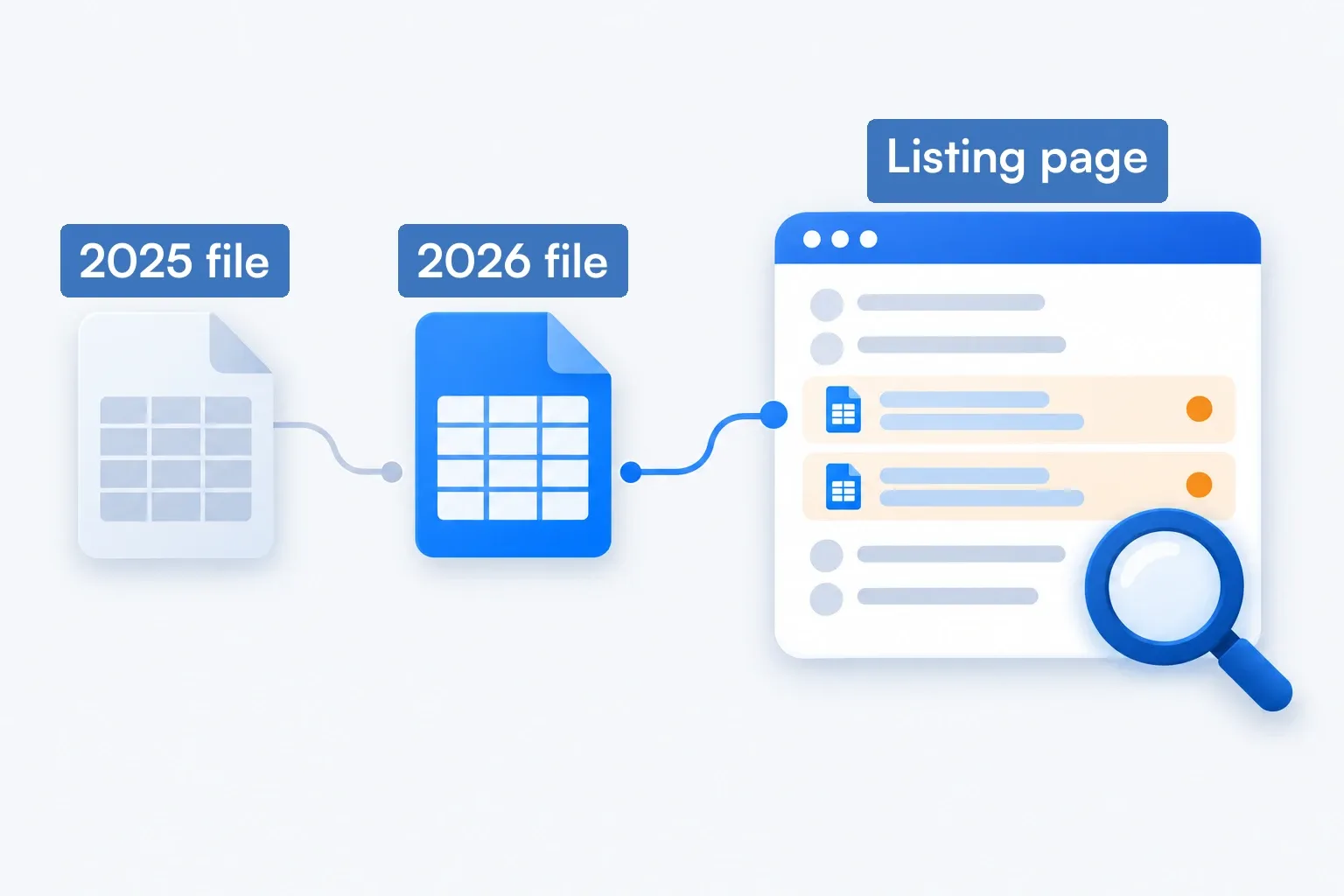 Watch the page that links to the file
Track managed care plan policy changes
In states that deliver Medicaid through managed care, each MCO publishes its own provider manual, payment policies, prior authorization requirements and provider bulletins on its own website. When we searched "medicaid provider bulletins" on September 28, 2026, a Michigan plan's own bulletins page ranked seventh, in between state agency pages.
State bulletins still matter for managed care, and they often set the plans' deadlines. When North Carolina reversed its October 1, 2025 rate reductions, the state's rate reversal notice gave health plans 45 days after the corrected fee schedules were posted to load them, plus 30 more days to reprocess affected claims. Fee-for-service claims followed a separate schedule, starting with the January 13, 2026 check write. A team billing both has two timelines to track from one notice. For each state, monitor the state bulletin page plus, for every plan you contract with:
- The plan's provider news or bulletin page
- Its provider manual page
- Its payment or reimbursement policy page
- Its prior authorization list (see how to track payer prior authorization changes)
Some plans keep payment policies behind a provider login. Visualping can watch some pages behind a sign-in (see how to monitor password-protected pages), but check the portal's terms of use first. Either way, check your provider agreement for how the plan notifies you of changes, and keep the plan's email notices in the same tracker as your monitored pages.
State plan amendments, waivers and federal guidance
A Medicaid state plan is the agreement between a state and the federal government that describes how the state runs its program. According to Medicaid.gov's SPA page, the plan sets out who is covered, which services are provided and the methods used to pay providers. When a state plans to change its program policies or operations, it sends a state plan amendment to CMS for review and approval. Federal rules require the plan to be amended whenever needed to reflect changes in federal law, regulations or court decisions, or material changes in state law, policy or operations (42 CFR 430.12).
For payment changes, federal rules also require advance notice. Under 42 CFR 447.205, a state must give public notice of any significant proposed change in its methods and standards for setting payment rates, with some exceptions. The notice must be published before the proposed effective date. It can appear in a state register, a major newspaper or a state website. A state website used for these notices must be updated for bulletins "on a regular and known basis."
At the state level, four kinds of pages are worth watching for payment changes:
- The state's public notice or SPA page. Indiana, for example, keeps a state plan amendment updates page that lists submitted amendments that CMS hasn't yet approved, with submission dates. When we checked on September 28, 2026, it still listed amendments submitted in September 2025. New Hampshire posts public notices for SPAs, and Wyoming keeps a state plan amendment page.
- The state's tribal consultation page, which can carry advance notice of SPAs, waivers and demonstrations that affect tribal health programs.
- The state register, if your state uses it for rate notices.
- The provider bulletin page, where many states announce the change once it's final.
Two federal rules require tribal consultation before a state files. Section 1902(a)(73) of the Social Security Act covers states where Indian health programs or urban Indian organizations provide care. Those states must seek the programs' advice before submitting state plan amendments, waiver requests and demonstration proposals likely to have a direct effect on them. For section 1115 demonstrations, 42 CFR 431.408 also requires at least a 30-day public notice and comment period, plus consultation with tribes on demonstrations that affect them, before the state applies. Oklahoma's tribal consultation page lists each meeting with its agenda and the proposed rule amendments up for discussion, most recently for September 1, 2026. Washington's HCA lists consultations and meetings with a Dear Tribal Leader letter for each, including a March 30, 2026 roundtable on a draft traditional health care practices waiver application.
Some rate changes start even earlier, in the legislature. Florida's FL-24-0008-A (below) cites the state's General Appropriations Act and two Senate bills, and our guide to monitoring state and federal legislation covers that step.
Federal Medicaid listings to watch
CMS's Center for Medicaid and CHIP Services (CMCS) issues Informational Bulletins and State Medicaid Director letters and approves SPAs. It also approves section 1115 demonstrations and section 1915 waivers, including the 1915(b) waivers states use for managed care and the 1915(c) home and community-based services waivers. Our Medicare and Medicaid policy guide covers these federal channels. For a multi-state team, the useful step is to filter each Medicaid.gov list to the states you bill in and monitor the filtered view:
| What changes | Filtered view to monitor | What the page shows |
|---|---|---|
| Informational Bulletins and State Medicaid Director letters | Federal Policy Guidance, filtered to those two types | Newest items first, with date and type |
| Managed care guidance and rules | Federal Policy Guidance, filtered to the Managed Care topic | Managed care bulletins, guidance and rulemaking notices |
| Approved state plan amendments | SPA list, filtered to one state (Florida shown) | Transmittal number, approval date and effective date |
| Section 1115 demonstrations and 1915(b) and 1915(c) waivers | State Waivers List, filtered to one state (Florida shown) | Approval date, effective date, status and authority |
Three setup details matter here:
- These are search pages, and the default view may not show what you need. The default waiver list sorts by state, so its first page shows Alabama programs; a new approval for Texas won't appear there. Pick your state in the filter, sort by newest, and copy the resulting URL into the monitor (the Florida links above show the pattern).
- Medicaid.gov blocked some of our automated requests while we tested these pages, so check each monitor's first capture for the list, as described in Step 2 below.
- The SPA list shows how far approval can trail the effective date. When we checked on September 28, 2026, Florida's amendment FL-24-0008-A, covering inpatient services and graduate medical education for state fiscal year 2024-2025, had an approval date of September 14, 2026 and an effective date of July 1, 2024.
Federal rules also come through the Federal Register. CMS is implementing the Medicaid provisions of the federal budget law signed on July 4, 2025 (Public Law 119-21, often called H.R. 1; CMS calls it the Working Families Tax Cut legislation), and it uses these same channels. It issued State Medicaid Director Letter 26-001 on eligibility redeterminations on March 6, 2026, and published an interim final rule on the community engagement requirement on June 3, 2026 (91 FR 33348). That rule took effect July 31, 2026, the same day its comment period closed. It requires states to implement community engagement no later than January 1, 2027, and allows good-faith exemptions that can run no later than December 31, 2028.
States then pass these changes to providers. The District of Columbia's federal changes page lists work requirements, six-month renewals for many adults and shorter retroactive coverage starting January 1, 2027. Under the new rules, DC Medicaid can pay bills from only 1 month before an application for adults without children, and up to 2 months for everyone else. Retroactive coverage limits matter to revenue cycle because they change which past dates of service Medicaid can pay.
Virginia posted a provider bulletin on the work requirement and six-month renewals on September 4, 2026. Watch how each of your states implements these provisions, because dates and details can differ by state.
Go deeper: What is regulatory intelligence? | Monitoring government agency guidance
 Proposed, approved, then announced to providers
A 5-step system for tracking Medicaid changes across states
This system works for a team covering three states or all 51 programs. The steps are the same; only the size of the inventory changes.
Step 1: Build a state-by-source inventory
Start a sheet with one row per page. Columns that pay off later:
- State and program (fee-for-service or a named managed care plan)
- Source type (bulletin, fee schedule listing, manual, portal messages, SPA or public notice, MCO policy)
- URL, and the date you last confirmed it works
- Owner (the person who reads the alert and decides what to do)
- What triggers action (for example, "new rate file" or "anything about claim reprocessing or prior authorization")
- Check frequency and the "Alert me when" prompt you'll use (Steps 2 and 3)
Use the directory above to fill in each state's Medicaid provider bulletins page, then add each state's fee schedule listing page and manual page. For a large footprint, add states in order of Medicaid revenue. If your organization also staffs nurse practitioners in those states, a similar per-state watch list covers board of nursing and NP practice rule changes.
Step 2: Put a monitor on each listing page
Create one monitor per page in Visualping and point it at the listing page (our guide to monitoring website changes covers the basic setup). When a state renames a PDF or rate file, the new link shows up in your alert. Check the pages that carry claim holds and rate changes daily, and the rest weekly. Each check counts toward your plan's monthly checks, so a daily-and-weekly mix covers more pages on the same plan than checking everything daily.
Some state pages need a click before the content appears, such as a search button, a filter, a tab or an agreement screen. The setup notes in the directory flag the ones we found. Visualping Actions run before each check and handle those steps, so the monitor captures what your analyst would see after those clicks. Actions are available on every plan, including Free.
Then open each monitor's first capture and confirm that it shows the list of Medicaid provider bulletins or notices. Some state sites block automated visitors or build their lists with scripts. When we tested the pages in this guide with automated tools, Minnesota's DHS site sent some of our requests to a captcha page that still loaded normally, and Florida's AHCA site returned a block page instead of its alerts list.
A capture that shows a captcha, an "access denied" message, a "page not found" screen or an empty search form looks like a working monitor that never changes. If you see one, fix the URL or the Action, or contact Visualping support. Until the capture shows real notices, treat that state as uncovered and rely on its email notices.
Ready to try this on your own states? Start with five pages free, such as the bulletin page and fee schedule listing page for your largest Medicaid state.
Step 3: Write "Alert me when" prompts for each page type
A bulletin page changes every time a notice is posted, and many notices won't apply to you. Write an "Alert me when" prompt in plain language that describes the changes you care about. Every detected change comes with an AI summary of what changed and a binary Important flag based on your prompt, so your team triages from the email and opens only the pages that need a closer look.
Example prompts:
- Bulletin page: "Alert me when a new bulletin announces a rate change, a new billing requirement, or claim reprocessing."
- Fee schedule listing: "Alert me when a new fee schedule file is posted, or when an effective date or version number changes."
- Portal messages: "Alert me when a message mentions a claim hold, reprocessing, recoupment or a system outage."
- SPA or public notice page: "Alert me when a new state plan amendment or public notice about provider payment rates is posted."
For more examples, see our guide to writing Important-alert prompts.
Step 4: Route each alert to its owner
Send each monitor's alerts to the person or queue that owns it. Email alerts and webhooks work on every plan, and the Visualping API, also on all plans, lets you pull changes into a tracker or ticketing system.
Alerts in Slack, Microsoft Teams, Discord, Google Chat or Google Sheets need a Business plan.
One way to split the work: billing and coding leads own bulletin, manual and portal-message alerts for their states, a reimbursement analyst owns fee schedule and SPA alerts, and the managed care contracting lead owns plan policy alerts.
 Give every monitored page an owner
Step 5: Keep a dated record and review failed checks
Every alert leaves a dated record of what changed and when, which helps when you need to show when a notice appeared. Visualping keeps change history for 3 months by default. Business accounts can extend a monitor to 12 months, starting from the day the setting changes, so save a copy of any alert you may need longer. Once a week, review failed checks. Failure emails are on by default on every plan, with timing that depends on how often the page is checked, and a monitor pointed at a page that now returns an error needs a new URL.
Put the known rollover dates on a calendar. In January, replace year-specific pages (Massachusetts, Michigan, Oklahoma's messages and letters, and Utah in our directory) with the new year's page, and recheck each state's fee schedule listing around its usual release dates.
Where Medicaid monitoring breaks down
Plan for these gaps in any page-monitoring setup:
- Login-only content: Some plan payment policies and portal messages sit behind a provider login. Visualping can monitor some login-protected pages, but portal terms of use and sign-in requirements limit what's practical, so rely on provider agreements and email notices for the rest.
- Very long PDFs: Visualping checks the first 100 pages of each PDF. Michigan's manual runs to 2,678 pages, so watch the manual page and the bulletins instead of the whole file.
- ZIP archives: Monitor the page that links to them.
- Email-only notices: Some states and plans send announcements by email list. Subscribe as well; Nebraska, for example, offers a subscription link on its bulletin page.
- Moving pages: When a state redesigns its site, a monitor usually reports a failed check or one very large change, and the weekly failed-check review catches the failures. Year-specific pages are different: last year's page still loads but goes quiet, so only the January calendar check in Step 5 catches a rollover.
No monitoring setup catches everything. Treat page monitoring as one layer of your regulatory compliance monitoring, next to state and plan email subscriptions, your clearinghouse's payer notices and your own denial and underpayment reporting.
 Long PDFs are checked on their first 100 pages
Frequently asked questions
What is a Medicaid provider bulletin?
A Medicaid provider bulletin is an official notice from a state Medicaid agency to enrolled providers. It announces changes to policy, billing, coverage, rates or systems. States use different names for the same thing, including bulletins, memos, transmittals, advisory letters and global messages. Bulletins are posted on the agency's website or its fiscal agent's portal; see the directory above for each state's page.
How often do state Medicaid agencies publish bulletins?
It depends on the state. Colorado publishes a monthly Provider Bulletin. North Carolina posts individual Medicaid Bulletin articles as they're ready, and Utah issues its bulletins every other month. Virginia posted 10 memos and bulletins between September 2 and September 25, 2026. Provider manuals follow their own cycle; Michigan updates its online manual quarterly.
What is a Medicaid state plan amendment?
A state plan amendment (SPA) is a change a state submits to CMS to update its Medicaid state plan, the agreement that describes who is covered, which services are provided and how providers are paid. CMS reviews and approves SPAs. For payment changes, an approved SPA can take effect as early as the first day of the calendar quarter in which the state submitted it (42 CFR 447.256), which is one reason rate changes can be retroactive.
Where can I find my state's Medicaid fee schedule?
Most states post fee schedules on a rates or fee schedule page in the provider section of the Medicaid agency's site or fiscal agent portal. Examples include Colorado's rates and fee schedule page and Florida's Rule 59G-4.002 page. Because file names often change with each release, bookmark and monitor the listing page rather than the file.
What are the new Medicaid changes for 2026?
Many of the Medicaid changes in the 2025 federal budget law (Public Law 119-21, often called H.R. 1) reach providers through federal guidance and state notices in 2026 and take effect later. CMS published an interim final rule on community engagement on June 3, 2026, which requires states to implement the requirement no later than January 1, 2027. The District of Columbia, for example, lists work requirements, six-month renewals for many adults and shorter retroactive coverage starting January 1, 2027. New Jersey lists some eligibility changes for non-citizens starting October 1, 2026. Timing and details vary by state, so watch each state's bulletin and federal-changes pages, along with CMS's federal policy guidance list.
Do state email subscriptions replace page monitoring?
They complement it. Email lists are good for announcements an agency chooses to send. Page monitoring covers the pages that change without an email, such as fee schedule listings, manual revisions, SPA pages and portal messages, and it shows you when a page moves or breaks. The same approach works for other government agency news pages.
What's the difference between a provider bulletin and a provider manual update?
A bulletin announces a change, often with an effective date. The manual is the standing rulebook. Many states issue bulletins first and fold them into the manual at the next revision. Michigan, for example, updates its provider manual quarterly to incorporate policies issued through bulletins since the last update. Track both: the bulletin tells you what changed, and the manual shows the current rule.
Start monitoring your three largest Medicaid states
You don't need all 51 programs on day one. Pick your three largest Medicaid states, put monitors on each one's Medicaid provider bulletins page, fee schedule listing page and portal messages page, and give every monitor an owner. Once that routine works, add the managed care plans and the next states on your list.
Then add the filtered Medicaid.gov lists for the same states, or see how Visualping supports broader regulatory intelligence programs.
Create a free Visualping account and monitor your first five pages free.
Want to monitor web changes that impact your business?
Sign up with Visualping to get alerted of important updates from anywhere online.
Eric Do Couto
Eric Do Couto is the Head of Marketing at Visualping. He leads content strategy, growth operations, and brand positioning for website change detection.
More articles by Eric Do Couto