Medical Records Fees by State: 2026 Law Tracker
Updated September 29, 2026
Medical records fees by state are set jurisdiction by jurisdiction: 47 of the 50 states and DC have a fee rule in a statute, regulation or board rule. In 11, an agency publishes new dollar amounts every year: DC, Georgia, Illinois, Michigan, Missouri, Ohio, Pennsylvania, South Carolina, Texas (for hospitals), Utah and Wisconsin. The federal HIPAA fee limit sits on top of every state rule when patients ask for their own records.
We checked all 50 states and DC against their official statute or agency pages on September 28 and 29, 2026. This guide is for health information management (HIM) and release-of-information (ROI) teams who keep an invoice template current. It covers HIPAA's fee rules and deadlines, how state laws treat patients and third parties, electronic versus paper fees and free-copy rules. It also names who publishes each year's update and ends with a 50-state + DC table of fee limits and official sources, with a "last verified" date on every row.
Not legal advice. This article describes where agencies publish copy-fee rules and how to keep track of them. It is not legal, billing or compliance advice, and fee rules change. Confirm the current amount on the official source linked for your state, and ask your counsel or privacy officer how the rules apply to a specific request.
Where to start:
- Need your state's fee limits and statute: go to the 50-state + DC reference table.
- Setting this year's fee schedule: go to which states adjust medical record fees every year.
- Handling a patient's own request or its 30-day deadline: go to the HIPAA right of access fee limit.
- Pricing an electronic copy: go to electronic vs paper medical record copy fees.
- Checking a waiver for a benefit claim: go to free and reduced-fee copies.
- Building an update routine: go to an annual fee-tracking workflow for HIM and ROI teams.
Key takeaways
- The HIPAA fee limit at 45 CFR 164.524(c)(4) covers an individual's request for their own records. Since the Ciox Health v. Azar decision in January 2020, HHS says it does not apply to requests to send records to a third party.
- HIPAA gives a provider 30 days to act on a patient's request, plus one extension of up to 30 days, and several states set shorter deadlines.
- State statutes set the caps for most third-party requests, such as those from attorneys and insurers, and several also limit what patients pay. California, for example, sets one per-page rate for patients and another for attorneys.
- Eleven jurisdictions publish a new schedule every year, and the new amounts take effect on different dates, from January 1 in Pennsylvania to September 1 for Texas hospitals.
- Washington's statute calls for an update every two years, but its rule was last amended in 2021. Massachusetts, Maryland and West Virginia tie fees to a price index in statute but name no agency to publish the new number, and we found no official schedule for any of the three.
- The statutes change too. At least 10 jurisdictions changed their copy-fee laws between 2022 and 2026.
- More than 20 states waive or cut fees for specific requests, most often records that support a Social Security or other benefit claim.
- Several agencies post the new amounts in a PDF behind a link, so monitor the PDF file as well as the page that links to it.
Why medical records fees vary by state
What a provider may charge for a copy depends on who is asking, what format they want, and which state's law applies. A patient requesting their own records falls under HIPAA's right of access. An attorney or insurer requesting records with the patient's signed authorization usually falls under state law. Several states set different caps for paper copies, electronic copies, microfilm and imaging. Each state writes its caps into a statute, a regulation or a licensing-board rule, and some adjust those caps for inflation every year.
So medical records fees by state come in two layers, and an ROI team needs a calendar for the state layer. The federal layer changes rarely. The state layer is where the dollar amounts move. Copy fees are also one of several rule sets that providers billing in many states track, and our guide to Medicare and Medicaid policy changes covers the payer side.
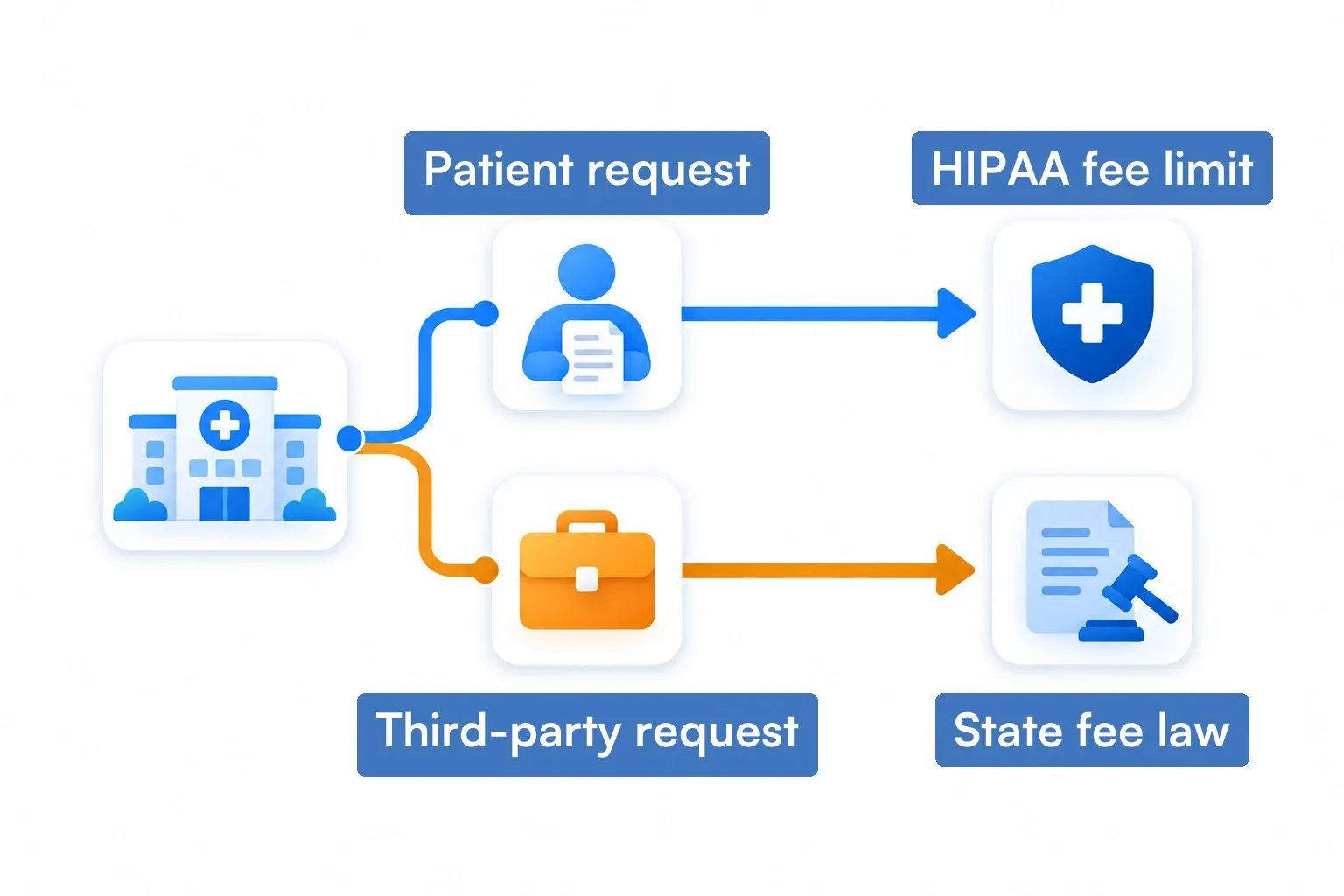 Who asks for the records decides which fee rule applies
The HIPAA right of access fee limit
Under the HIPAA Privacy Rule, a covered entity may charge an individual a "reasonable, cost-based fee" for a copy of their protected health information. The regulation, 45 CFR 164.524(c)(4), limits that fee to four costs:
- Labor for copying the records, on paper or electronically
- Supplies for a paper copy, or portable media if the patient asks for one
- Postage, when the patient asks for the copy to be mailed
- Preparing an explanation or summary, if the patient agrees to one in advance
Search and retrieval time is not on that list. HHS's FAQ on labor costs spells out what stays off the invoice: labor for reviewing the request, and for searching for, retrieving and otherwise preparing the records for copying. HHS's FAQ on state fee schedules adds that this labor, and any other cost the Privacy Rule doesn't permit, "may not be charged to individuals even if authorized by State law." Pennsylvania's Department of Health makes the same point in its 2026 fee notice: labor costs under the HIPAA rule "shall not include the cost attributable to search and retrieval of the records."
Is $6.50 the maximum HIPAA fee?
No. HHS guidance gives covered entities three ways to set the fee for an individual's request, listed in its FAQ on the $6.50 flat fee. A covered entity may calculate "actual allowable costs to fulfill each request." It may use "a schedule of costs based on average allowable labor costs to fulfill standard requests." Or, for electronic copies of records kept electronically, it may "charge a flat fee not to exceed $6.50 (inclusive of all labor, supplies, and postage)."
HHS describes the flat fee as an option for entities that don't want to calculate actual or average costs. A team that charges more than $6.50 for an electronic copy of electronically kept records should be ready to show the actual-cost or average-cost calculation behind the number.
How fast does a provider have to respond?
HIPAA requires a covered entity to act on an access request "no later than 30 days after receipt of the request." It may extend that once, by no more than 30 days. To use the extension, it must give the individual a written statement of the reasons for the delay and the date it will finish, within the first 30 days (45 CFR 164.524(b)(2)).
OCR enforces the deadline. Its 55th right of access enforcement action, announced August 27, 2026, was a $50,000 settlement with Azul Vision, a California optometry and ophthalmology provider. The patient had asked for her records in January 2023 and didn't receive them until January 2025.
State deadlines can be shorter. HIPAA leaves in place state laws that give individuals "greater rights of access" (45 CFR 160.202 and 160.203(b)), so a shorter state clock generally still applies to a patient's request. These states set shorter or stricter deadlines in statute for the requesters shown:
| State | Deadline | Applies to | Source |
|---|---|---|---|
| California | 15 days (30 days for free benefit-claim copies); records available to an attorney within 5 days | Patients and personal representatives; attorneys with a written authorization | H&S § 123110; Evid. Code § 1158 |
| Hawaii | 10 working days | Attorneys with the patient's authorization | HRS § 622-57 |
| Louisiana | 15 days | Requests with the patient's written authorization | R.S. 40:1165.1 |
| New Hampshire | 30 days, or the copies are free; 14 days, at no cost, when the requester is the patient's provider | Personal representatives, attorneys, power-of-attorney holders and providers | RSA 332-I:1 |
| Texas | 15 days after the request and payment | Hospitals | H&S § 241.154 |
What Ciox Health v. Azar changed for third-party requests
In 2016, HHS guidance said the patient-rate fee limit also applied when a patient directed records to a third party, such as a law firm. Ciox Health, a medical records company, challenged that guidance in federal court, along with the 2013 rule that let patients direct their records to a third party regardless of format. On January 23, 2020, the US District Court for the District of Columbia vacated parts of both (Ciox Health, LLC v. Azar, No. 18-cv-0040). It limited the patient's third-party directive to "requests for a copy of 'an [EHR] with respect to [PHI] of an individual . . . in an electronic format.'" It also vacated the 2016 guidance "insofar as it, without going through notice and comment, extends the Patient Rate to reach third-party directives."
HHS then posted a notice on the court order. Under that notice, the fee limitation in 164.524(c)(4) "will apply only to an individual's request for access to their own records." It "does not apply to an individual's request to transmit records to a third party." The same notice says the right of access and its fee limits "are undisturbed and remain in effect," and that OCR will keep enforcing the parts of 164.524 the court order didn't restrict.
In practice, that gives an ROI team three kinds of requests and two fee tracks:
- Patient's own request, or their personal representative's: the HIPAA cost-based fee and the HIPAA deadline. Several states also cap or waive fees for patients. When a state fee schedule allows more, HHS's FAQ on state fee schedules says those costs can't be charged. The one exception is "where the State authorized costs are the same types of costs permitted under 45 CFR 164.524(c)(4) of the HIPAA Privacy Rule, and are reasonable."
- Patient-directed electronic copy: the patient's written, signed request to send an electronic copy of records held in an EHR to a person they name, such as a lawyer or another provider (45 CFR 164.524(c)(3)(ii)). It's still a HIPAA access request, so the HIPAA deadline applies, but the patient-rate fee limit doesn't. State law and the information-blocking rules below govern the fee.
- Third-party request with an authorization, or a subpoena: the state statute, including any annual inflation adjustment. A patient's request to send paper records to someone else belongs on this fee track too, because the court limited the patient-directed track to electronic copies.
Some state agencies print this split on their own schedules. Georgia's Department of Community Health, for example, says on its retrieval-rates page that "state rates for medical records should not be applied when individuals request records for themselves from a covered entity."
Where information-blocking rules come in
Health care providers are "actors" under the information-blocking rules that carry out the 21st Century Cures Act (45 CFR 171.102). The fees exception, 45 CFR 171.302, sets out when charging for access to electronic health information won't count as information blocking. It doesn't cover "a fee prohibited by 45 CFR 164.524(c)(4)," or "a fee based in any part on the electronic access of an individual's EHI by the individual, their personal representative, or another person or entity designated by the individual." The rule defines electronic access as "an internet-based method that makes electronic health information available at the time the electronic health information is requested and where no manual effort is required to fulfill the request."
A state fee schedule doesn't change either exclusion, so a charge for that kind of automated access falls outside the exception even where state law allows a fee. The rules have other exceptions, including one for the manner in which a request is fulfilled (45 CFR 171.301). Ask counsel how your fees for electronic requests fit.
Is a federal change coming?
HHS proposed changes to the right of access in a January 21, 2021 notice of proposed rulemaking. Among other things, it would adjust the permitted access fees and require covered entities to post estimated fee schedules on their websites.
Two federal items are pending. HHS's 2026 regulatory agenda lists the final rule from that proposal (RIN 0945-AA00) with a target date of August 2026, and the Office of Management and Budget's review list shows that final rule under review since April 2, 2026. The same agenda adds a new rulemaking, RIN 0945-AA28, for a proposed rule on "the amount of time that covered entities have to respond to requests" under the right of access, with a target date of November 2026. As of September 29, 2026, neither had been published in the Federal Register.
Put both reginfo.gov entries in your regulatory horizon scanning. Most changes to medical records fees by state will still come from state agencies and legislatures.
How state copy-fee laws work and what to monitor
Medical records fees by state follow four patterns. In our review, 30 of the 51 jurisdictions write fixed caps into a statute or rule: a per-page amount, and sometimes a search or handling fee, that stays put until the legislature or a board amends it. Fifteen tie their caps to a price index. Eleven of those publish a new schedule every year, and four have indexing language with no current official schedule we could find. Arizona and Hawaii allow a "reasonable fee" or "reasonable costs" without setting a number.
That leaves Alaska, Idaho, Kansas and Wyoming, where we found no statute or rule setting a dollar cap outside workers' compensation. Alaska's statute grants a right to inspect and copy records without any fee language. The Kansas medical board points licensees to the HIPAA fee. Wyoming repealed its hospital-records statutes in 2019.
The type tells you what to monitor. For a fixed cap, watch the statute or rule page, plus your legislature's bill pages during session, because an amendment is the only way the number changes. For an indexed cap, watch the agency page that publishes the yearly schedule. For "reasonable fee" states and states with no cap, watch your legislature's bill pages for a new proposal, along with the federal rulemaking entries above.
Several states also split rules by provider type. Florida has one statute for hospitals and a Board of Medicine rule for physicians. Texas indexes its hospital fees every year, while the Texas Medical Board's rule for physicians sets fixed amounts, summarized in the board's fee guidance. Check which provision covers your facility type.
Medical records fees by state also split by requester. California charges patients under Health and Safety Code § 123110, up to $0.25 a page, and attorneys under Evidence Code § 1158, at $0.10 a page plus clerical time. Ohio, Utah, Virginia and West Virginia send patients' own requests to a cost-based fee and set a separate schedule for everyone else. DC, Colorado and New Hampshire apply their schedules only to requesters other than the patient. The Georgia and Pennsylvania health departments say the same of their rates. The reference table below shows both tracks wherever state law splits them.
Statutes change too
The laws themselves get rewritten more often than a "fixed cap" label suggests, which is why fixed-cap states still belong in your legislative tracking. Between 2022 and 2026, at least 10 jurisdictions in our review changed their copy-fee laws:
| Jurisdiction | Change | Source |
|---|---|---|
| District of Columbia | Personal Medical Record Fee Amendment Act of 2022 set fee maximums that DC Health adjusts each year | D.C. Law 24-290 |
| New Jersey | P.L. 2022, c.114 (approved September 22, 2022) amended hospital and physician fee caps | NJ Legislature |
| Arkansas | Act 765 of 2023 amended Ark. Code § 16-46-106 | Arkansas Legislature |
| South Dakota | 2023 law created SDCL §§ 36-2-16.1 to 36-2-16.7; former § 36-2-16 no longer applies | SD Legislature |
| Ohio | House Bill 33 (135th General Assembly) amended Ohio Rev. Code § 3701.741, effective October 3, 2023 | Ohio Laws |
| Minnesota | Laws 2024, chapter 127, amended § 144.292 | Minnesota Revisor |
| Colorado | HB 26-1414 capped fees at $400 for requests from the patient's attorney over 664 pages, with inflation adjustments every other year from 2028 (effective August 12, 2026); SB 25-275 moved the fee definitions into new § 25-1-800.3 (effective August 6, 2025) | Colorado Revised Statutes 2026, Title 25 |
| Utah | H.B. 312 (2023 General Session) changed the fees Utah Code § 78B-5-618 allows when records arrive late, effective May 3, 2023; a 2025 technical-corrections bill (Chapter 277) amended it again, effective May 7, 2025 | Utah Legislature |
| Tennessee | 2025 Public Chapter 339 rewrote § 68-11-304 fees, effective July 1, 2025 | TN Secretary of State |
| New Hampshire | RSA 332-I:1 amended in 2024 (effective July 26, 2024) and twice in 2025 (effective June 17 and September 13, 2025) | NH General Court |
Two of these show how fast secondary sources go stale. South Dakota repealed its former § 36-2-16, which some fee lists still link to. New Hampshire's current text caps electronic copies for requestors at $50, so check when a summary was last updated and compare anything written before the 2024 and 2025 amendments against the current statute.
Which states adjust medical record fees every year
Most of the yearly movement in medical records fees by state comes from 11 jurisdictions that publish a new maximum-fee schedule on a fixed annual cycle. Each row links to the official schedule we checked on September 28, 2026.
| Jurisdiction | Who publishes | New amounts take effect | Index named in the law | Current schedule |
|---|---|---|---|---|
| District of Columbia | DC Health | Adjusted each year since January 1, 2024; published by February 1 | Washington, DC-area CPI | DC Health fee notice |
| Georgia | Department of Community Health | July 1 | Medical care component of the CPI | DCH retrieval rates |
| Illinois | Comptroller | January 20, posted by January 31 | CPI-U | Copying fees adjustments |
| Michigan | Department of Health and Human Services, on the State Treasurer's certification | Calendar year (2026 notice signed February 18) | Detroit CPI | Medical Records Access Act fees |
| Missouri | Department of Health and Senior Services | February 1 | Medical care component of the CPI-U | DHSS fees for medical records |
| Ohio | Department of Health | Calendar year (2026 file updated February 19) | CPI-U | Medical Records Price Index |
| Pennsylvania | Department of Health, in the Pennsylvania Bulletin | January 1 | CPI | DOH medical record fees |
| South Carolina | Department of Public Health | July 1 | CPI-U, South Region | DPH annual adjustment |
| Texas (hospitals) | Health and Human Services Commission | September 1 | CPI for urban wage earners and clerical workers (CPI-W) | HHSC hospital fee schedule |
| Utah | State Treasurer (adjusts January 1, certifies by January 30), posted by Utah State Courts | January 1 | CPI for urban wage earners and clerical workers (CPI-W) | Utah Courts medical records fees |
| Wisconsin | Department of Health Services, published in the Wisconsin Administrative Register | July 1 | CPI-U | DHS fee notice |
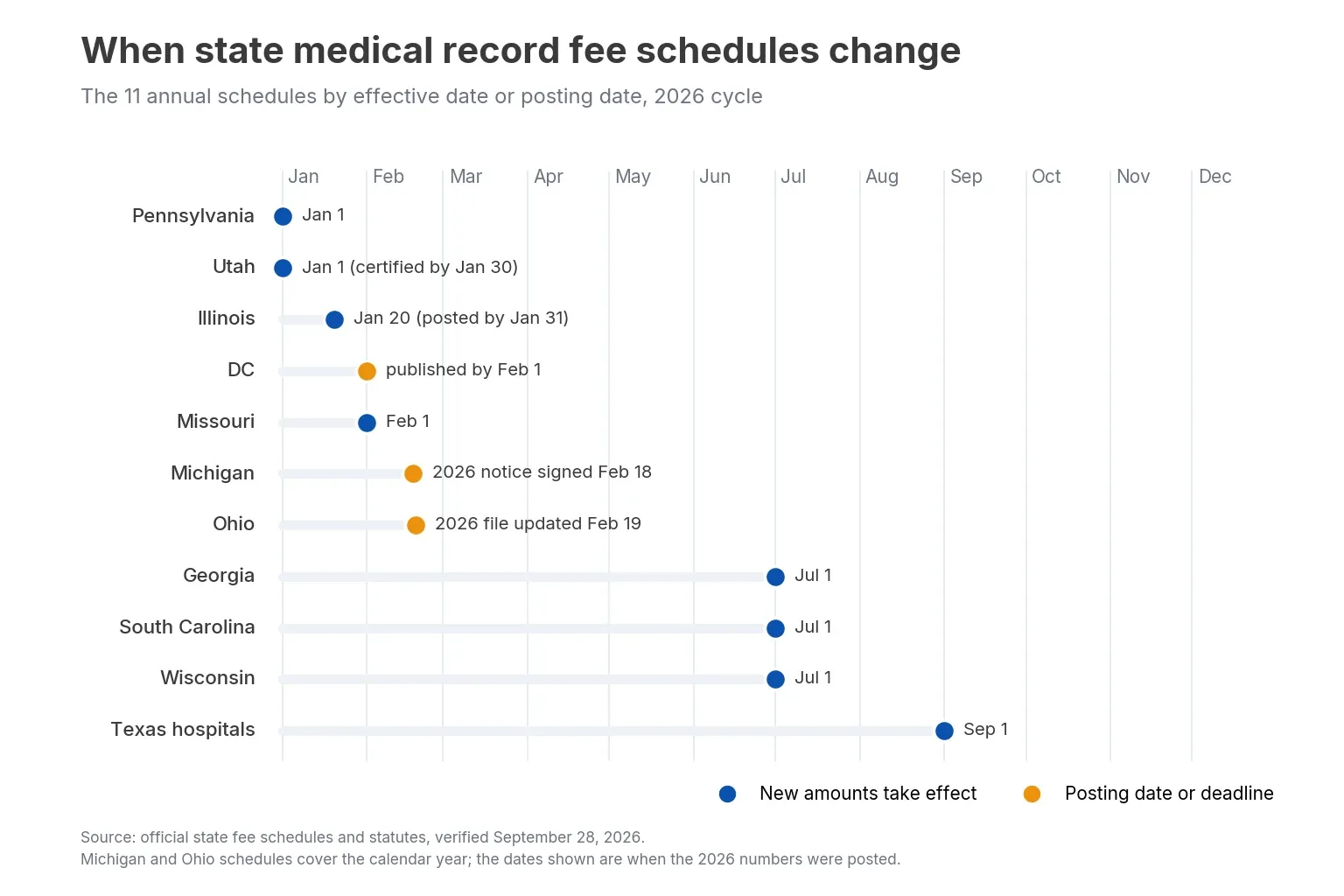 Annual schedules change on different dates across the year
What the 2026 schedules say
These amounts come straight from the official schedules linked above. They're maximums under state law. When patients request their own records, the HIPAA cost-based limit applies too, and several of these schedules say so directly.
| Jurisdiction | Period | Current maximums |
|---|---|---|
| Pennsylvania | From January 1, 2026 | $2.00 per page for pages 1 to 20, $1.48 for pages 21 to 60, $0.52 after that; $2.95 per page from microfilm; $29.61 search and retrieval, which can't be charged when requesters ask for their own record; flat fees of $37.52 for records that support Social Security or needs-based benefit claims and $29.61 for district attorney requests (3.0% CPI change) |
| Illinois | 2026 | $36.68 handling charge; $1.38 per page for pages 1 to 25, $0.92 for pages 26 to 50, $0.46 after that; $2.29 per page for copies from microfiche or microfilm; electronic records at 50% of the paper per-page rate |
| Michigan | Calendar year 2026 | $32.08 initial fee, which a patient may not be charged for their own record; $1.60, $0.80 and $0.32 per page by page band |
| Missouri | From February 1, 2026 | $30.32 plus $0.70 per page for paper; $28.39 more if records are kept off-site; electronic copies at the same fees or $132.89 in total, whichever is less |
| Georgia | From July 1, 2026 | Up to $25.88 for search, retrieval and administrative costs; $9.70 certification; $0.97, $0.83 and $0.66 per page by page band (unchanged from the prior year) |
| Wisconsin | July 1, 2026 to June 30, 2027 | $1.48 per page for the first 25 paper pages, falling to $0.42 after page 100; $2.17 per page from microfiche or microfilm; $29.20 retrieval fee and $11.68 certification when the requester isn't the patient or someone the patient authorized (2.70% CPI change) |
| Texas (hospitals) | From September 1, 2026 | Up to $63.95 for the first 10 pages; $2.16, $1.06 and $0.58 per page by page band; $115.86 retrieval or processing fee for delivery on a digital or electronic medium |
| Utah | Calendar year 2026 | $36.53 to locate a record; $0.65 per page for the first 40 pages and $0.39 after that; electronic delivery capped at $182.63 per request; $20 to certify a copy, not indexed (2.6% CPI change) |
Small annual changes add up
One year's adjustment is often only a few percent, but the increases compound, so an old fee sheet drifts further out of date every year. South Carolina's Department of Public Health publishes its full adjustment history in the same notice. Its maximum for an electronic record rose from $170.26 on July 1, 2021 to $208.63 on July 1, 2026, and its clerical fee rose from $28.37 to $34.76. Both increases come to about 22.5% over five adjustments.
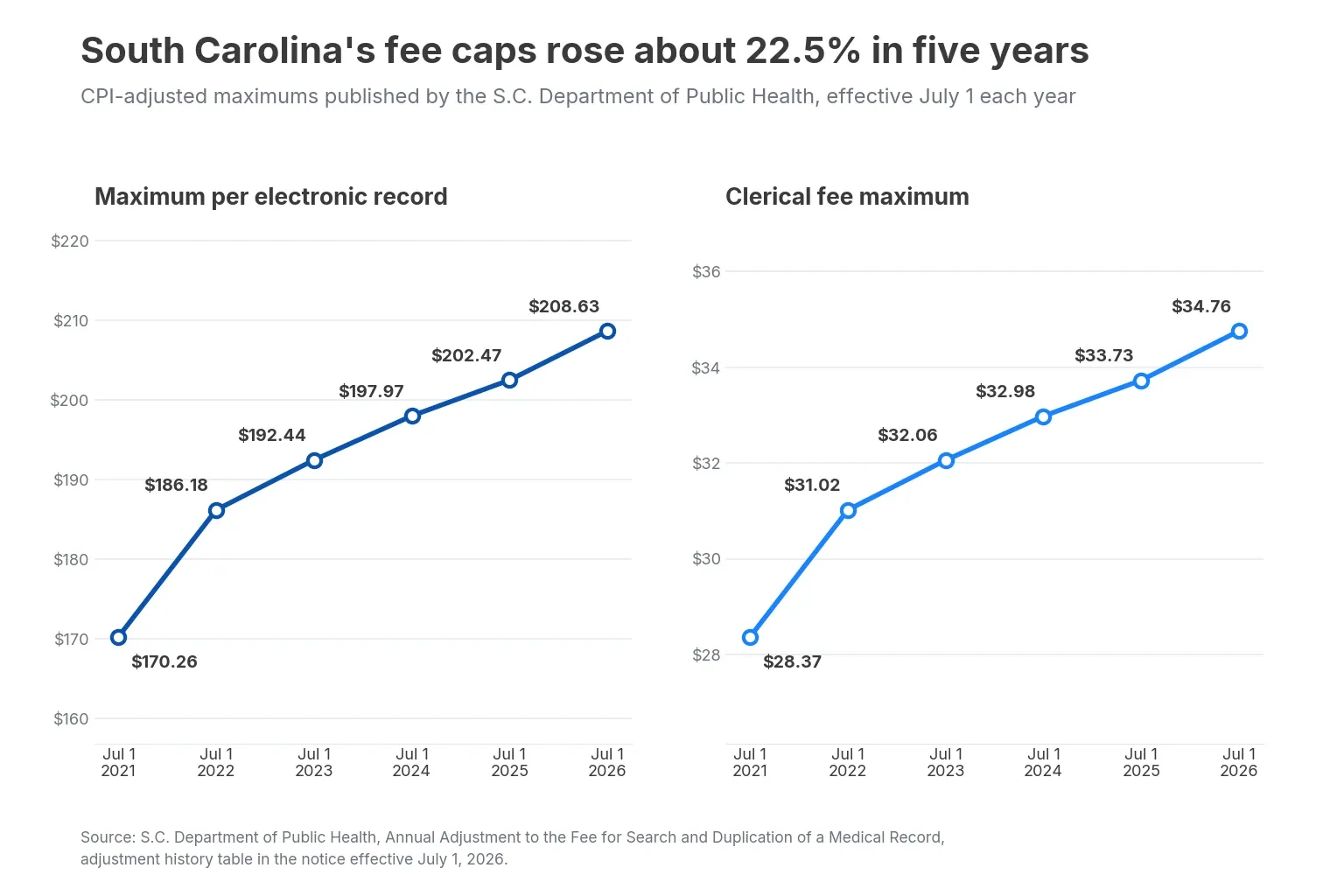 Five CPI adjustments raised South Carolina's caps by about 22.5%
States that index fees but publish no schedule
Four more jurisdictions have indexing language without a current official schedule we could find:
- Washington: RCW 70.02.010 says the amounts "shall be adjusted biennially" using the Seattle-Tacoma consumer price index, "as determined by the secretary of health." The implementing rule, WAC 246-08-400, was last amended effective June 18, 2021. It lists $1.24 per page for the first 30 pages, $0.94 after that and a $28 clerical fee.
- Massachusetts: M.G.L. c. 111, § 70 says the fee "may be adjusted to reflect the consumer price index for medical care services," but names no agency to publish the adjusted amount.
- Maryland: Health-General § 4-304 says copy fees "may be adjusted annually for inflation in accordance with the Consumer Price Index," while the preparation fee may not be. The statute names no agency to publish the adjusted amounts, and we found no current official schedule.
- West Virginia: § 16-29-2 ties the per-page fee to the consumer price index for medical care services "as published every October 1," but names no agency to publish the adjusted fee.
For these four, write down how your organization calculates the current amount, and have counsel sign off on it.
Colorado starts indexing one cap in 2028. HB 26-1414, effective August 12, 2026, limits fees to $400 when a patient's attorney requests a record longer than 664 pages. That cap adjusts for inflation on January 1, 2028 and every even-numbered year after, and the Colorado Secretary of State posts the new amount.
Electronic vs paper medical record copy fees
Electronic copies often carry their own rules. Under HIPAA, a covered entity can price an individual's electronic copy of electronically kept records with the $6.50 flat-fee option, or by actual or average cost. State laws for third-party requests handle electronic copies in several ways:
| Approach | Example (official source) |
|---|---|
| Electronic per-page rate as a share of paper | Illinois: 50% of the paper per-page charge (Comptroller); Maryland: 75% of the paper per-page fee, capped at $80, plus a preparation fee of up to $22.88 (HG § 4-304) |
| Total cap on an electronic request | Missouri: $132.89 from February 1, 2026 (DHSS); Utah: $182.63 for 2026 (Utah Courts); Maine: actual staff cost, up to $150 (22 M.R.S. § 1711-A); Nevada: $40 or the per-page amount, whichever is less (NRS 629.062); Rhode Island: $25 handling plus per-page fees, with page charges capped at $100, for providers with an EHR (§ 23-1-48) |
| Separate electronic and paper caps | South Carolina: $208.63 per electronic request vs $278.16 per admission for paper records from July 1, 2026 (DPH) |
| Lower per-page rate plus a total cap | District of Columbia: $0.72 per page for electronic records with page fees capped at $94.57 in total, vs $0.96 per page for non-electronic records (DC Health) |
| Flat fee for digital delivery | Texas hospitals: $115.86 retrieval or processing fee from September 1, 2026 (HHSC); Tennessee: $90 for requesters other than the patient (2025 Pub. Ch. 339) |
| Same rate for paper and electronic | Pennsylvania: listed fees apply to paper copies or reproductions on electronic media (DOH) |
| No fee under the state schedule | Wisconsin: the state Supreme Court held that § 146.83(3f) doesn't let providers charge its fees for records in electronic format (Banuelos, 2023 WI 25, noted in the statute's annotations) |
Two practical points follow. First, your invoice template needs a format field, because the same request can have a different ceiling on paper and as a portal download. Second, some states require an electronic copy when the records are kept electronically and the requester asks for one. Illinois and Tennessee are two examples: Illinois requires records already kept in an electronic or digital format to be provided electronically on request, and Tennessee's 2025 law requires electronic copies on request unless the records aren't kept electronically.
Free and reduced-fee copies
For specific requests, medical records fees by state can drop to zero or to a flat rate. The most common trigger is a claim or appeal for Social Security disability or another needs-based benefit, and most of these rules require proof of the claim with the request. In our review:
| State | Who qualifies | What the law allows | Source |
|---|---|---|---|
| Arizona | Another provider, for continuing care; a patient or legal representative appealing a Social Security denial (a representative must provide form SSA-1696) | No charge | A.R.S. § 12-2295 |
| California | A patient, personal representative or nonprofit legal-services representative with a written request and proof the records support a claim or appeal for a public benefit program, such as Medi-Cal, SSDI or SSI/SSP | One free copy of the relevant records, within 30 days | H&S § 123110 |
| Colorado | A third party doing work under the Laura Hershey Disability Support Act | One free copy for an application, appeal or reapplication | C.R.S. § 25-1-800.3 |
| Connecticut | A patient, or the patient's attorney or authorized representative, supporting a Social Security Act or veterans' benefits claim or appeal, with documentation | No charge, within 30 days | § 20-7c |
| Florida | A patient whose records are copied for continuing care | No charge (hospitals) | § 395.3025 |
| Illinois | Requests with a valid authorization for veterans' disability, Social Security or SSI, or Aid to the Aged, Blind, or Disabled benefits | One free complete copy | 735 ILCS 5/8-2001 |
| Kentucky | Patients | First copy free | KRS 422.317 |
| Maryland | Patients, personal representatives, legal-aid programs or attorneys filing or appealing a Social Security disability claim; Medicaid enrollees | No charge for the claim; Medicaid enrollees pay no more than $20 per 100 pages (indexed) | HG § 4-304 |
| Massachusetts | Requests that support a Social Security or needs-based benefit claim or appeal, with documentation | No charge, within 30 days | c. 111, § 70 |
| Michigan | A medically indigent individual | All fees waived, one set of copies per provider | MCL 333.26269 |
| Minnesota | Patients appealing a Social Security disability denial | A $10 retrieval fee at most; no fee at all for qualifying patients with proof, such as a public assistance statement | § 144.292, subd. 6 |
| Nevada | Patients or authorized representatives supporting a Social Security or needs-based benefit claim or appeal, with documentation | One free copy, within 30 days | NRS 629.061 |
| New York | Requests that support an application, claim or appeal for any government benefit or program | No charge | PHL § 18 |
| North Carolina | Disability Determination Services requests for Social Security or SSI applicants | The fee section doesn't apply | § 90-411 |
| North Dakota | Copies sent to another provider for continuing care | No charge | § 23-12-14 |
| Ohio | A patient, personal representative or authorized person supporting a Social Security Title II or XVI claim, with documentation that a claim was filed | No charge | § 3701.741 |
| Oklahoma | Requests from the state's Disability Determination Division | Billed at the Social Security Administration's rate | 76 O.S. § 19 |
| Pennsylvania | Records that support a Social Security or needs-based benefit claim | $37.52 flat fee in 2026 | DOH notice |
| South Carolina | Copies sent to another provider for continuing care | No charge | § 44-7-325 |
| South Dakota | Patients using a patient portal | No fee for portal access | SDCL § 36-2-16.3 |
| Tennessee | Social Security disability claims or appeals, with records produced electronically | $20 flat fee | 2025 Pub. Ch. 339 |
| Texas | Patients, or their attorneys or authorized representatives, supporting a disability-benefit application or appeal | No charge | H&S § 161.202 |
| Utah | Requests with documentation of a Social Security or needs-based benefit claim or appeal; indigent individuals (household income at or below 100% of the federal poverty level), who may be asked for an affidavit | First copy free for each date of service the claim needs, each calendar year; for indigent individuals, all fees waived, one copy per date of service per provider each calendar year | § 78B-5-618 |
| Vermont | Records that support a Social Security or needs-based benefit claim or appeal | No charge | 18 V.S.A. § 9419 |
| West Virginia | Indigent people, as the statute defines them, supporting a Social Security claim or appeal | No charge | § 16-29-2 |
| Wisconsin | Patients appealing an SSDI or SSI denial; Medicaid-eligible patients | No more than the Social Security Administration's reimbursement rate for the appeal; 25% of the usual fee for Medicaid-eligible patients | § 146.83 |
Certification and affidavit fees
Many statutes add a flat charge to certify records or sign an affidavit, usually for legal use. Arkansas allows $2, Colorado $10, Georgia $9.70 in 2026, Indiana up to $20 and Iowa up to $10. Oklahoma allows $15, South Dakota up to $10, Tennessee $20, Utah $20 for third parties, West Virginia $10 and Wisconsin $11.68 from July 1, 2026, when the requester isn't the patient or someone the patient authorized. Texas physicians may charge up to $15 for an affidavit under the Medical Board's guidance, and Nevada allows $5 for a custodian's certificate on electronic requests. Louisiana requires a certification page at no extra charge. For a patient's own request, HIPAA's fee can cover only the four costs listed earlier.
Where to track medical record fee updates
The publisher changes from state to state, so each indexed state needs its own bookmark. It's a small version of the problem of tracking multiple regulatory websites. In our review:
- State health departments publish most schedules: DC Health, Georgia DCH, Michigan DHHS, Missouri DHSS, the Ohio Department of Health, the Pennsylvania Department of Health, the South Carolina Department of Public Health, Texas HHSC and Wisconsin DHS. Save the exact URL of each fee page, and expect it to move. Missouri's former fee page address now returns a "not found" error, so recheck saved links when you set up government agency page monitors.
- Finance offices handle two. The Illinois Comptroller publishes the Illinois amounts, and Utah's State Treasurer adjusts and certifies the Utah amounts, which Utah State Courts posts.
- Legislatures publish bills and statutes. An amendment to a fixed cap shows up first as a bill and then as an enacted session law. When the codified statute page catches up depends on each state's code publisher. Connecticut's statutes page, for example, points readers to an annual supplement for the latest session's amendments. Watch the bill pages during session and use the statute page to confirm. Our guide to monitoring state legislation covers bill and statute pages.
- Licensing boards set or explain physician fees in several states, including Alabama, Delaware, Florida, Kansas, New Mexico and Texas.
- Official registers carry some notices. Pennsylvania's Department of Health publishes its adjustment in the Pennsylvania Bulletin (the 2026 notice is 55 Pa.B. 8441), and Wisconsin's Legislative Reference Bureau publishes the adjusted amounts in the Wisconsin Administrative Register.
Attorney general offices weren't the official publisher of a copy-fee schedule in any of the 51 jurisdictions we checked.
Posting dates can also lag the statute. Michigan's health director signed the calendar-year 2026 notice on February 18, 2026, and the file name of Ohio's 2026 calculation says it was updated February 19, 2026. For about seven weeks at the start of the year, a team that checked Michigan only on January 1 would have found no new number.
 Health departments, finance offices, legislatures and boards all publish fee rules
How often state statute pages trigger alerts
Statute pages are quiet most of the time, which makes a real change easy to miss.
In a sample of more than 1,800 Visualping monitors on official state code pages, about 1 in 6 sent at least one change alert between June 27 and September 28, 2026. A few large accounts own most of those monitors, so we also checked each account on its own. The median account with five or more of these monitors saw alerts on 18% of its pages, and in every account with 30 or more of these monitors, fewer than half of the pages sent an alert. Most statute pages stayed silent for the whole quarter.
The sample covers statute pages on any topic. It counts only monitors that ran for the full window, and it excludes Visualping's internal and test accounts.
For an ROI team, that suggests a split. Watch the agency schedule pages for the annual number, and check them more often in the weeks around your states' effective dates. Our guide to monitoring government agency pages covers that setup. Watch the statute section for amendments, and expect alerts there to be rare and worth reading.
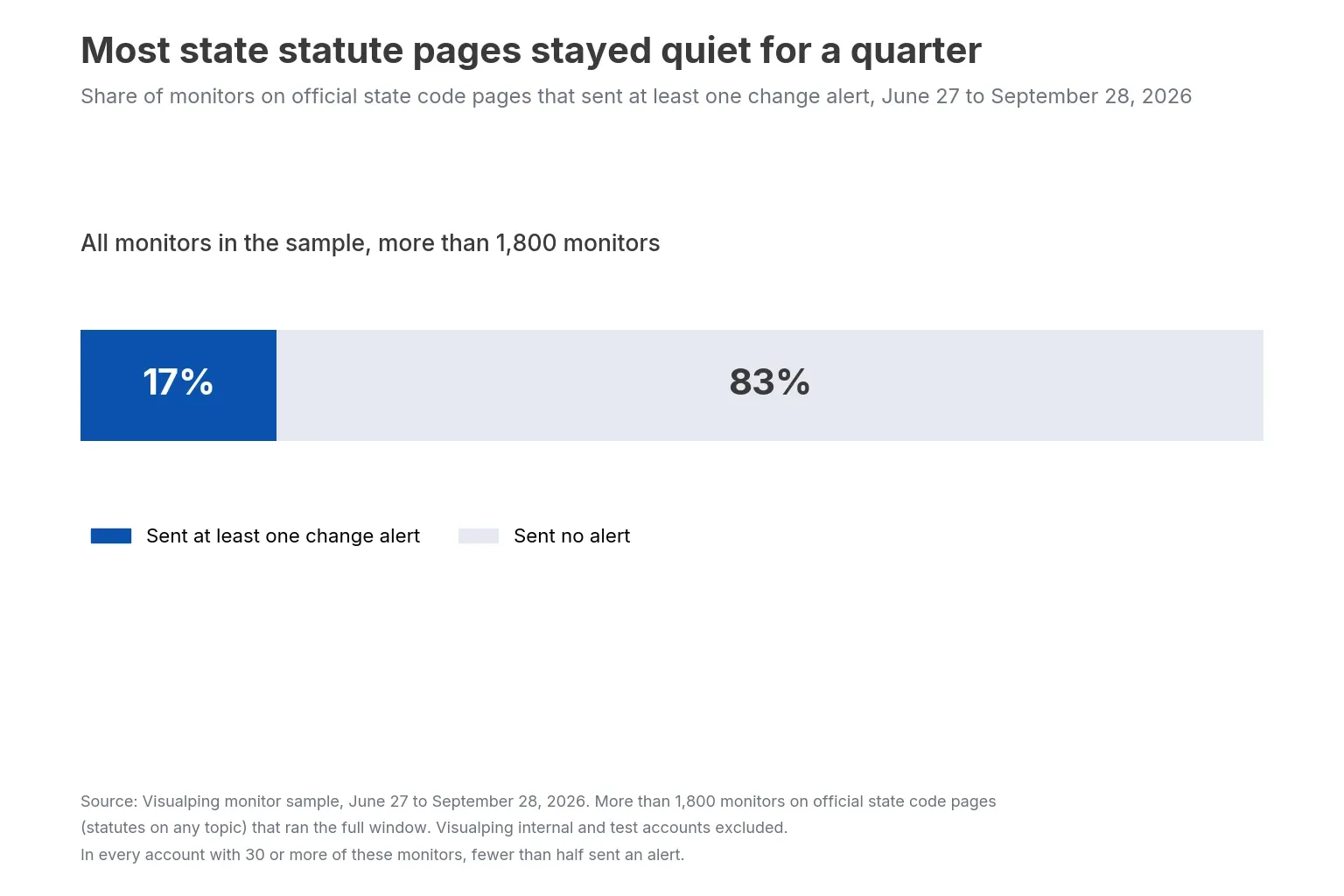 About 1 in 6 statute monitors sent an alert in 93 days
Avoid fee errors that turn into enforcement
HHS's Office for Civil Rights enforces the right of access through its Right of Access Initiative, which reached its 55th enforcement action with the Azul Vision settlement on August 27, 2026. Fees come up in these cases. In one, involving Gums Dental Care, a solo practice in Maryland, OCR's Notice of Proposed Determination says the practice told OCR that the patient had refused to pay a $25.00 flat fee to have records mailed by certified mail. The patient had asked for the records by email. OCR found that a $25.00 fee to mail the records "would not be permissible for providing access under the Privacy Rule" and proposed a $70,000 civil money penalty. An HHS administrative law judge upheld the penalty in September 2023.
The case also turned on delay: as of OCR's March 2022 notice, the practice still hadn't provided the records. The fee finding still shows how a flat fee that seems reasonable at the front desk can fail the HIPAA test when it doesn't match the format the patient asked for.
The obligation stays with the provider when it outsources ROI work. In March 2025, OCR announced a $200,000 penalty against Oregon Health & Science University, its 53rd right of access action. Its acting director said a covered entity's responsibility to provide timely access "continues, even when a covered entity contracts with a business associate to respond to HIPAA right of access requests" (HHS press release). State caps can reach the vendor too. Indiana's rule and Ohio's statute both apply to a "medical records company" that handles requests for a provider, so share each year's schedule with your ROI vendor.
Go deeper: Regulatory compliance monitoring guide | Regulatory change management guide
Tracking fee rules across many states? Start with five pages free, such as your state's fee schedule page and the statute section behind it.
An annual fee-tracking workflow for HIM and ROI teams
A team's list of medical records fees by state stays current when three things are true: someone owns it, it's tied to the effective dates above, and changes to the source pages reach that owner quickly. The routine below covers all three.
Build your watch list
For each state where you release records, list three sources:
- The statute or rule section (from the reference table below)
- The official adjustment schedule, if your state has one
- Any licensing-board page that sets physician fees
For the federal layer, add the two reginfo.gov entries for HHS's pending right of access rules.
Put the effective dates on a calendar
Group your states by date:
- January 1: Pennsylvania and Utah (Utah's certified amounts are due by January 30)
- January 20 to 31: Illinois
- February 1: Missouri, plus DC Health's publication deadline
- February (when the 2026 notices posted): Michigan and Ohio
- July 1: Georgia, South Carolina and Wisconsin
- September 1: Texas hospitals
Add Washington as a two-year check, and October 1 for West Virginia if you calculate its adjustment yourself.
Watch the pages that publish the numbers
Set up a monitor on each page in your watch list. In Visualping, point each monitor at the fee table rather than the whole page, and draw the selected area a little larger than the table, because the area is a fixed box and content above it can shift. Then write an "Alert me when" prompt in plain language, such as: "Alert me when this page posts a new year's medical record fee schedule, or when any dollar amount or effective date changes." On a page that shows last year's and this year's amounts side by side, as Georgia's does, ask about a new effective date, because every number moves when the columns roll over. Each detected change comes with a Visualping AI summary and a binary Important flag based on your prompt, so the owner can tell a new fee table from a footer edit without opening the page. For more examples, see our playbook for writing Important-alert prompts.
Before you add a page, check that the fee amounts are on that page itself. Some agencies put the numbers on the page, as Georgia, Illinois, Missouri, Pennsylvania and Utah do. Others post only a link, and the amounts sit in an attached PDF. South Carolina's fee page, for example, shows a "Fee schedule" link, and the amounts are in a PDF with "2026-07" in its URL path and "2027" in its file name. When only the file behind a link changes, the page can look exactly the same, so a monitor on the page alone may stay silent.
For those states, monitor two things: the agency page, which usually shows a new link title or "Updated" date when the next file goes up, and the current PDF, which holds the amounts. Next year's PDF will usually have a new address, so replace the PDF monitor when the agency page changes. Visualping can monitor online PDFs and checks the first 100 pages of each, which covers every fee notice we reviewed. The "Page to monitor" column in the reference table below names the right target for each state.
Some official code sites load the statute text only after a search or a menu click. Visualping Actions can run those steps before each check, and they're available on every plan. Other sites load the text with scripts after the page opens. Visualping takes its capture after the page loads, and a longer wait time before the capture helps when text appears late. Either way, open the first capture and confirm it shows the fee section. Do the same for long chapter pages, because a full-page capture has a height limit and a section near the end can fall below it.
 When the amounts live in a PDF, monitor the file too
Route alerts to the owner
Email alerts and webhooks are available on every plan, and so is the Visualping API, so you can push changes into a ticketing queue or compliance tracker. Native alerts in Slack, Microsoft Teams, Discord, Google Chat or Google Sheets need a Business plan.
Update, document and date-stamp
When a new schedule posts, update the invoice template, log the source URL and effective date, and have the owner confirm the change, the same way you'd document any rule change in a regulatory change management process.
Keep the old schedule on file, along with a dated capture of the page. Save your own copy even when a monitor covers the page. Visualping keeps the screenshots and page captures behind each change for 3 months by default. Business accounts can set a monitor to keep them for 12 months, which covers only captures made after the switch. A request received before the effective date may fall under the old rate, so ask counsel how your organization handles requests that straddle the change.
No monitoring setup catches everything. Agencies move pages, legislatures post amendments in session-law formats, and some updates go out only by email. Treat page monitoring as one layer of your regulatory compliance monitoring, alongside association newsletters and counsel review.
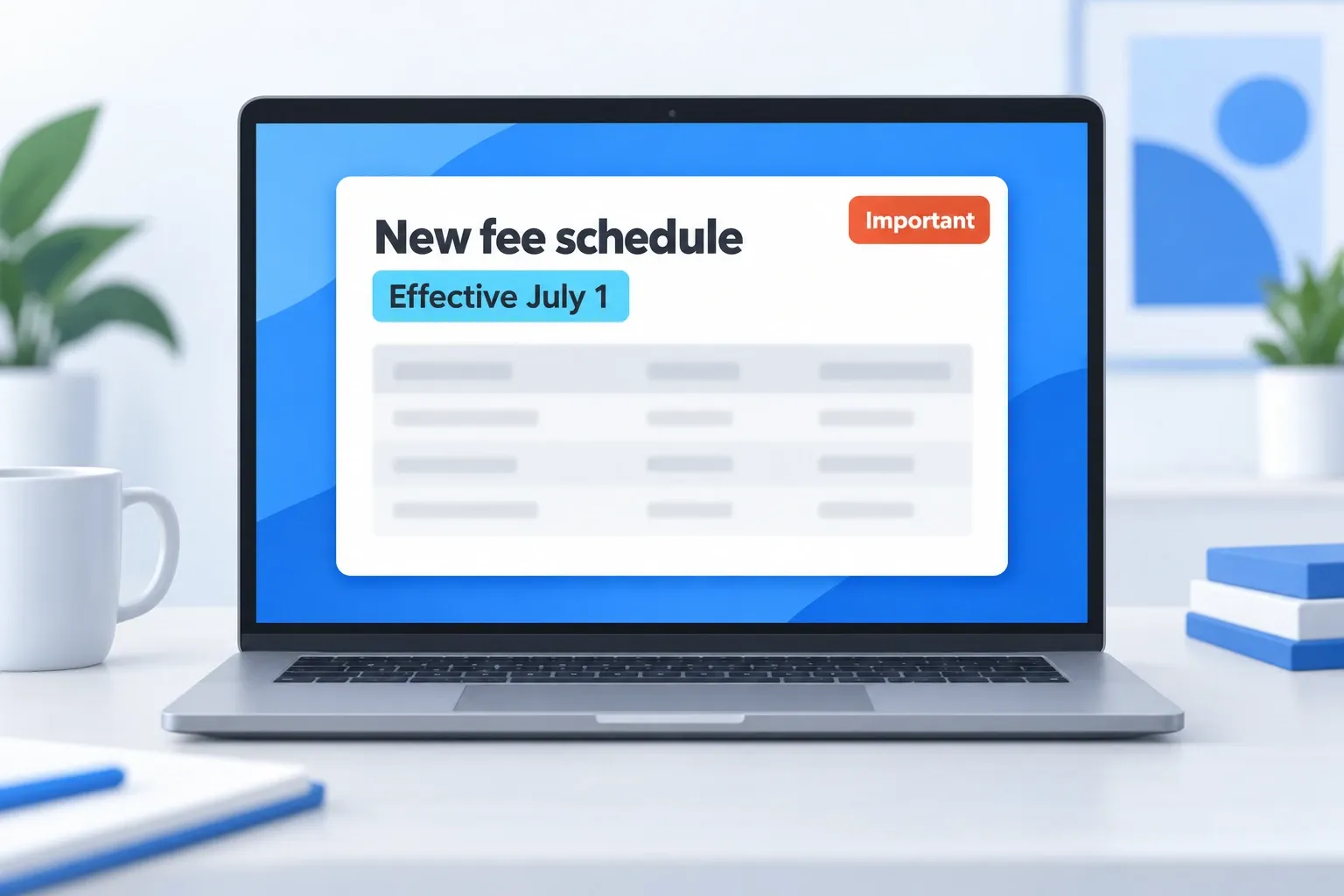 An Important flag separates a new fee table from a footer edit
Medical records fees by state tracker for all 50 states and DC
The table covers medical records fees by state for all 50 states and DC. Each row links the main statute or rule we found for medical record copy fees to the official source we checked, summarizes the main fee limits, and shows whether the amounts are indexed and adjusted. Where state law sets different rules for patients and for third parties, the row shows both. A patient's own request also carries the HIPAA limit, and a lower state limit for patients still applies. The summaries leave out some exceptions, so read the source before you set a fee, and see free and reduced-fee copies for waivers.
For indexed states, the amounts are the current 2026 figures. "Page to monitor" names the page where the text or amounts you'd track actually appear: the statute page itself for fixed caps, and the agency schedule for indexed states. "Last verified" is the date we loaded the official page and confirmed the fee language.
Before you rely on a row, check the page's last-updated date. For fee amounts in indexed states, always pull the current schedule from the agency.
Where a state has more than one provision (for example, separate hospital and physician rules), the table lists the main ones. "None found" means we found no statute or rule with a fee amount on an official source. In those states, HIPAA's cost-based limit still governs patients' own requests.
| State | Statute or rule (official source) | Main fee limits | Indexed and adjusted? | Page to monitor | Last verified |
|---|---|---|---|---|---|
| Alabama | Ala. Code § 12-21-6.1 (board summary); Ala. Admin. Code r. 545-X-4-.08 | $1/page for pages 1 to 25, $0.50/page after, $5 search fee, plus actual mailing; x-rays at actual cost | No | Board page (it quotes the per-page amounts but not the $5 search fee) | Sep 29, 2026 |
| Alaska | Alaska Stat. § 18.23.005 (right to copy; no fee amount) | No fee amount in statute; HIPAA limit applies to patients | No | Same page | Sep 29, 2026 |
| Arizona | A.R.S. § 12-2295 | "Reasonable fee"; no dollar cap; no charge for copies sent to another provider for continuing care, to a patient or their health care decision maker to obtain care, or for a patient's Social Security appeal | No | Same page | Sep 29, 2026 |
| Arkansas | Ark. Code § 16-46-106 (Act 765 of 2023) | Legal, insurance and underwriting requests: $0.50/page for pages 1 to 25, $0.25/page after, up to $25 labor, plus postage; electronic: $75 flat plus postage; $2 to certify or notarize. Patients' own requests: HIPAA access rules | No | No stable current-text page found | Sep 29, 2026 |
| California | Cal. Health & Safety Code § 123110 (patients); Evid. Code § 1158 (attorneys) | Patients: cost-based fee, no more than $0.25/page for paper or $0.50/page from microfilm, copies within 15 days. Attorneys with the patient's written authorization before a lawsuit is filed: $0.10/page, $0.20/page from microfilm, clerical time up to $16/hour, actual postage | No | Same pages | Sep 29, 2026 |
| Colorado | C.R.S. §§ 25-1-800.3, 25-1-801, 25-1-802 (2026 Title 25, PDF) | Third parties with an authorization, subpoena or court order (requests up to 664 pages): $18.53 for the first 10 pages, $0.85/page for the next 30, $0.57/page after ($1.50/page from microfilm), $10 certification, plus postage, electronic media and taxes. Attorneys for the patient or personal representative, requests over 664 pages: $400 total, unless PHI must be withheld or redacted (HB 26-1414, from Aug 12, 2026). Invoice within 30 days; records not provided in 30 days without a written extension notice are free. Patients: HIPAA fee | No (the $400 cap adjusts every two years from Jan 1, 2028) | No stable current-text page found: the legislature posts these sections inside each year's full Title 25 file (2,120 pages as a PDF), at a new URL every year. Monitor the Session Laws page instead and check new laws for changes to §§ 25-1-800.3, 25-1-801 and 25-1-802 | Sep 29, 2026 |
| Connecticut | Conn. Gen. Stat. § 20-7c; § 19a-490b | Patients and their attorneys or authorized representatives: $0.65/page, all-inclusive; free for Social Security or veterans' benefit claims, with documentation; copies within 30 days | No | Same page, plus bill tracking | Sep 29, 2026 |
| Delaware | 24 Del. Admin. Code 1700-16.0 | Physicians, on a patient's own request: $2.00/page for pages 1 to 10, $1.00 for 11 to 20, $0.90 for 21 to 60, $0.50 after, paper or electronic; no prepayment for disability-benefit applications | No | Same page (loads with scripts) | Sep 29, 2026 |
| District of Columbia | D.C. Code § 3-1210.12 (D.C. Law 24-290) | Third parties the patient authorizes, 2026: $25.00 search and handling (even when no records are found); electronic $0.72/page (total cap $94.57); non-electronic $0.96/page. Patients: HIPAA fee | Yes, annual | DC Health fees page plus the 2026 PDF | Sep 29, 2026 |
| Florida | Fla. Stat. § 395.3025 (hospitals); F.A.C. 64B8-10.003 (physicians) | Hospitals: up to $1/page, $2 for non-paper records, up to $1 for each year of records requested, plus sales tax and postage; no charge when the copies are for the patient's continuing care. Physicians: $1/page for pages 1 to 25 and $0.25 after for patients and government agencies, $1/page for other requesters; x-rays at actual cost | No | Same page | Sep 29, 2026 |
| Georgia | O.C.G.A. § 31-33-3 (DCH rates page) | From July 1, 2026 (unchanged from the prior year): up to $25.88 search and retrieval, $9.70 certification, $0.97, $0.83 and $0.66 per page by page band; the Department of Community Health says these rates don't apply to patients' own requests | Yes, annual | Same page | Sep 29, 2026 |
| Hawaii | Haw. Rev. Stat. § 622-57 | "Reasonable costs"; no dollar cap; copies to a patient's attorney within 10 working days | No | Same page | Sep 29, 2026 |
| Idaho | None found (2025 bill S1087 passed the Senate but failed in the House) | None found; HIPAA limit applies to patients | No | No fee law to monitor; check each session's bills | Sep 29, 2026 |
| Illinois | 735 ILCS 5/8-2001; 5/8-2006 | 2026: $36.68 handling; $1.38, $0.92 and $0.46 per page by page band; $2.29/page from microfilm; electronic at 50% of paper; copies within 30 days (60 with written notice) | Yes, annual | Comptroller fee table | Sep 29, 2026 |
| Indiana | Ind. Code § 16-39-9-4; 760 IAC 1-71-3 | $1/page for pages 1 to 10, $0.50 for 11 to 50, $0.25 after; an optional labor fee up to $20, in which case the first 10 pages are free; up to $20 to certify; $10 more for copies within 2 working days | No | Same page (whole rule article; loads with scripts) | Sep 29, 2026 |
| Iowa | Iowa Code § 622.10(6); 876 IAC 8.10 | Actual cost; for requests that release all of the patient's records for the period, capped at the workers' compensation schedule ($20 for 1 to 20 pages, then tiered add-ons, plus postage); affidavit up to $10; copies within 30 days | No | Same page plus the 876 IAC 8.10 rule (PDF), which holds the per-page amounts | Sep 29, 2026 |
| Kansas | None with a dollar cap (Board of Healing Arts guidance); K.S.A. 65-6836 | No dollar cap; board guidance allows a HIPAA cost-based fee; copies within 30 days | No | Same page | Sep 29, 2026 |
| Kentucky | KRS 422.317 | First copy free to the patient; up to $1/page for a second copy (patient, attorney or authorized representative) | No | Same page | Sep 29, 2026 |
| Louisiana | La. R.S. 40:1165.1 | $1/page for pages 1 to 25, $0.50 for 26 to 350, $0.25 after; handling up to $25; digital copies capped at $100 plus postage | No | Same page | Sep 29, 2026 |
| Maine | 22 M.R.S. § 1711; § 1711-A | Patients and their authorized representatives: paper $5 for the first page, $0.45/page after, $250 maximum; electronic at actual staff cost, $150 maximum | No | Same pages | Sep 29, 2026 |
| Maryland | Md. Code, Health-Gen. § 4-304(c) | $0.76/page for copying and mailing; preparation fee up to $22.88; electronic: $22.88 preparation plus a per-page fee of 75% of the paper rate, capped at $80, plus postage; free for Social Security disability claims or appeals; Medicaid enrollees: $20 per 100 pages (indexed) | Per-page fees allowed by statute (not the $22.88 preparation fee); no official schedule found | Same page | Sep 29, 2026 |
| Massachusetts | M.G.L. c. 111, § 70; c. 112, § 12CC | Hospitals and clinics: base charge up to $15, $0.50/page for pages 1 to 100, $0.25 after (practitioners use the same definition); free for Social Security or needs-based benefit claims, with documentation, within 30 days | Allowed by statute; no official schedule found | Same page | Sep 29, 2026 |
| Michigan | MCL 333.26269 | 2026: $32.08 initial fee (not charged to a patient for their own record); $1.60, $0.80 and $0.32 per page by page band; all fees waived for a medically indigent individual, one set per provider | Yes, annual | MDHHS fee notice (PDF) | Sep 29, 2026 |
| Minnesota | Minn. Stat. § 144.292, subd. 6 | Patients and their representatives: paper $1/page plus $10 retrieval, capped at $30 for up to 25 pages, $50 for up to 100 pages, $50 plus $0.20/page above 100, and $500 per request ($10 if no records); x-rays $30 total; electronic $20 total; no fee to review current care | No | Same page | Sep 29, 2026 |
| Mississippi | Miss. Code § 11-1-52 | $20 for pages 1 to 20, $1/page for the next 80, $0.50 after, plus up to 10% for postage and handling; $15 to retrieve records from off-site archives; up to $25 for a records affidavit | No | Board of Medical Licensure rule (PDF), which restates the amounts | Sep 29, 2026 |
| Missouri | RSMo § 191.227 | From Feb 1, 2026: $30.32 plus $0.70/page, plus up to $28.39 when records are stored off-site; electronic capped at $132.89 | Yes, annual | DHSS fee page | Sep 29, 2026 |
| Montana | Mont. Code § 50-16-540 | $0.50/page; administrative fee up to $15 | No | Same page | Sep 29, 2026 |
| Nebraska | Neb. Rev. Stat. § 71-8404 | $20 handling fee plus $0.50/page | No | Same page | Sep 29, 2026 |
| Nevada | NRS 629.061, 629.062 | $0.60/page, with no administrative or service fee; electronic: $40 or the per-page amount, whichever is less ($5 minimum); free copy for Social Security or needs-based benefit claims, within 30 days | No | Same page (whole chapter) | Sep 29, 2026 |
| New Hampshire | RSA 332-I:1 | Patients: HIPAA fee. Personal representatives, attorneys and power-of-attorney holders: $5 for the first page, $0.41 for pages 2 to 50, $0.30 after; electronic up to $50; redactions they request up to $25/hour; free if not provided within 30 days. Transfers to the patient's own provider: free, within 14 days | No | Same page | Sep 29, 2026 |
| New Jersey | N.J.S.A. 26:2H-5n; 45:9-22.27 (P.L. 2022, c.114) | Patients and their legally authorized representatives, including their attorneys: $1/page or $50 per record, whichever is less; other third parties: $1/page; search fee up to $20 (not for patients' own records); $10 certification; no fees for Social Security disability claimants or low-income patients | No | No stable current-text page found | Sep 29, 2026 |
| New Mexico | 16.10.17 NMAC (physicians) | Physicians: $30 for the first 15 pages, $0.25/page after | No | Same page | Sep 29, 2026 |
| New York | N.Y. Pub. Health Law § 18(2)(e) | Up to $0.75/page for paper copies; no charge for copies that support a government benefit application, claim or appeal; access can't be denied for inability to pay | No | Same page | Sep 29, 2026 |
| North Carolina | N.C.G.S. § 90-411 | $0.75/page for pages 1 to 25, $0.50 for 26 to 100, $0.25 after; $10 minimum; doesn't apply to Disability Determination Services requests | No | Same page | Sep 29, 2026 |
| North Dakota | N.D.C.C. § 23-12-14 | Authorized requests: paper $20 for the first 25 pages, then $0.75/page; electronic $30 for the first 25 pages, then $0.25/page (fees include retrieval and postage); free copy to another provider for continuing care | No | Same page | Sep 29, 2026 |
| Ohio | Ohio Rev. Code § 3701.741; § 3701.742 | Patients, personal representatives and power-of-attorney holders: HIPAA cost-based fee, with per-page charges no higher than the third-party per-page rates ($1.62, $0.84 and $0.33 by page band in 2026) and $50 in total for digital records. Third parties, 2026: $24.58 search plus $1.62, $0.84 and $0.33 per page by page band. Free for Social Security claims | Yes, annual | ODH price index page plus the 2026 PDF | Sep 29, 2026 |
| Oklahoma | 76 Okla. Stat. § 19 | Patients and their representatives: $0.50/page. Attorneys, insurers and subpoenas: $20 base fee (charged even when no records are found) plus per-page charges. Digital: $0.30/page, $200 cap; $15 certification | No | Same page, or the Legislature's Title 76 file (PDF) if the court site shows a bot check | Sep 29, 2026 |
| Oregon | ORS 192.563 | Requests with an authorization: up to $30 for 1 to 10 pages, $0.50/page for 11 to 50, $0.25 after, plus a $5 bonus if mailed within 7 business days. Patients' own requests: HIPAA fee | No | Same page (whole chapter) | Sep 29, 2026 |
| Pennsylvania | 42 Pa.C.S. §§ 6152, 6152.1, 6155 | 2026: $2.00/page for pages 1 to 20, $1.48 for 21 to 60, $0.52 after; $2.95 from microfilm; $29.61 search (not for own records); $37.52 flat for Social Security or needs-based benefit claims. Patients and personal representatives: HIPAA fee | Yes, annual | Same page | Sep 29, 2026 |
| Rhode Island | R.I. Gen. Laws § 23-1-48; § 5-37-22 | Statute: $25 handling plus $0.50/page for pages 1 to 100, $0.25 after; electronic copies from an EHR: page charges capped at $100; physician rule differs | No | Same page | Sep 29, 2026 |
| South Carolina | S.C. Code § 44-115-80 (physicians); § 44-7-325 (facilities) | From July 1, 2026: $0.90/page for pages 1 to 30, $0.68 after, $34.76 clerical; caps $208.63 electronic, $278.16 paper; free when sent to a provider for continuing care | Yes, annual | DPH fee page plus the current PDF | Sep 29, 2026 |
| South Dakota | SDCL § 36-2-16.4; § 36-2-16.5; § 36-2-16.6 | Paper: $10 for the first 10 pages plus $0.33/page; electronic: $0.25/page; designees and third parties: plus a search fee up to $18; up to $10 to certify; no fee for patient-portal access (§ 36-2-16.3) | No | Same pages (load with scripts) | Sep 29, 2026 |
| Tennessee | Tenn. Code § 68-11-304 (2025 Pub. Ch. 339) | Paper: $25 for up to 5 pages, $0.50/page after. Electronic: HIPAA fee for a patient's own request, $90 flat for other requesters. $20 to certify or notarize; $20 flat for Social Security disability records produced electronically | No | No stable current-text page found | Sep 29, 2026 |
| Texas | Tex. Health & Safety Code § 241.154 (hospitals); 22 TAC § 163.3 (physicians; see the Medical Board's guidance) | Hospitals from Sept 1, 2026: $63.95 for the first 10 pages, then $2.16, $1.06 and $0.58 per page; copies within 15 days of the request and payment. Physicians: $25 for the first 20 pages plus $0.50/page; electronic $25 (500 pages or fewer) or $50. No fee for disability-benefit claims | Yes, annual (hospitals) | HHSC hospitals page, which links the fee schedule (PDF) | Sep 29, 2026 |
| Utah | Utah Code § 78B-5-618 | Patients: cost-based fee (copying and postage only), on HIPAA's deadlines. Third parties, 2026: $36.53 to locate, $0.65/page for pages 1 to 40, $0.39 after, electronic cap $182.63, $20 certification. Fees waived for indigent individuals | Yes, annual | Utah Courts fee table | Sep 29, 2026 |
| Vermont | 18 V.S.A. § 9419 | $5 flat or $0.50/page, whichever is greater; no charge for Social Security or needs-based benefit claims | No | Same page | Sep 29, 2026 |
| Virginia | Va. Code § 8.01-413; § 32.1-127.1:03(J) | Patients: cost-based fee (§ 32.1-127.1:03(J)). Attorneys, insurers and others (§ 8.01-413): paper $0.50/page for pages 1 to 50, $0.25 after, $20 search; electronic $0.37 and $0.18 per page, $160 cap | No | Same pages | Sep 29, 2026 |
| Washington | RCW 70.02.010; WAC 246-08-400 | $1.24/page for pages 1 to 30, $0.94 after; $28 clerical fee; HIPAA covered entities can't charge fees HIPAA prohibits | Every two years by statute (rule last amended 2021) | Same page (the WAC) | Sep 29, 2026 |
| West Virginia | W. Va. Code § 16-29-2 | Patients: HIPAA fee plus taxes. Others: $20 search, $0.40/page paper; electronic $0.20/page, $150 cap; $10 certification. Free for indigent Social Security claimants | Per-page fee indexed; no official schedule found | Same page | Sep 29, 2026 |
| Wisconsin | Wis. Stat. § 146.83(3f) | July 2026 to June 2027: paper $1.48, $1.10, $0.72 and $0.42 per page by page band; $29.20 retrieval and $11.68 certification only when the requester isn't the patient or someone the patient authorized; no (3f) fee for electronic copies (Banuelos, 2023 WI 25) | Yes, annual | DHS fee notice (PDF) | Sep 29, 2026 |
| Wyoming | None in force (former § 35-2-611 repealed 2019) | None in force; HIPAA limit applies to patients | No | No fee law to monitor; check each session's bills | Sep 29, 2026 |
A few rows need extra care:
- Alabama: the Board of Medical Examiners page quotes the statute's per-page amounts but not its $5 search fee. The Legislature's code site loads sections with scripts, so also track Alabama's bills: a 2024 bill, SB 314, proposed a flat fee for electronic records and dropping the search fee.
- Arkansas, New Jersey and Tennessee: we found no free official page that shows the current statute text and updates when it changes. The linked sources are session laws, which won't change when the law does. For New Jersey, that's the 2022 session law, because we found no official consolidated statute page. Check these with counsel or your state HIM association each year.
- Colorado: a 2025 law, SB 25-275, moved the fee schedule into a new definitions section, § 25-1-800.3, so older citations to § 25-1-801 point to the wrong place. A 2026 law, HB 26-1414 (effective Aug 12, 2026), then amended §§ 25-1-801 and 25-1-802 to cap attorney requests over 664 pages at $400. Each year's statute files get a new address, so monitor the Office of Legislative Legal Services page that links them.
- Connecticut, Nevada and Oregon: the statute pages hold whole chapters. Select the fee section's area and check that the first capture reaches it. Oregon's ORS 192.563 sits about two-thirds of the way down a very long chapter page, so if your capture stops short of it, track Oregon's bills for changes to that section instead. Connecticut's "current" statutes page is revised to January 1 of the previous year, and the page itself points readers to the annual supplement for newer amendments, so pair it with bill tracking.
- District of Columbia: DC Health's 2026 PDF labels its table "2025 Adjusted Fee Maximums," but the file name, the CPI period it uses (January 2025 to January 2026) and DC Health's own link all identify these as the 2026 amounts.
- Ohio: the Department of Health's 2026 file prints two tables, and its patient table ($3.99 a page for the first 10 pages) doesn't match the current statute. Under § 3701.741(B)(1), patients, personal representatives and power-of-attorney holders pay HIPAA's cost-based amount, per-page charges "shall not exceed the sum of the per page charges authorized in division (B)(2)(b) and (c)" (the third-party per-page rates: $1.62, $0.84 and $0.33 in 2026), and digital records cost no more than $50 in total.
- Oklahoma: the state court system's site shows some automated visitors a bot check. If your first capture shows that check in place of § 19, monitor the Legislature's Title 76 file. It runs 77 pages, within Visualping's 100-page PDF limit.
- Oregon: ORS 192.563 applies when a provider receives an authorization to disclose records. A patient's own request falls under the HIPAA fee.
- Rhode Island: the statute and the Department of Health's physician rule set different per-page schedules. Ask counsel which applies to your practice.
- Tennessee: a commercial publisher hosts the official annotated code, so the linked source is the enacted 2025 Public Chapter. It sets a flat $90 fee for electronic records sent to requesters other than the patient.
- Texas: the HHSC fee PDF refuses some automated requests. HHSC's hospitals page links the current schedule, so a new link or date there signals the next one.
- Pages that load with scripts: Delaware's and Indiana's rule pages and South Dakota's, Texas's and Utah's statute pages load their text with scripts. Our browser-based checks found the fee text on the Delaware and Indiana pages. Open your first capture and confirm the fee section appears. Indiana's page holds a whole article of insurance rules, so select the fee rule's area to avoid unrelated alerts.
- Idaho and Wyoming: with no fee statute to watch, a new bill is the first signal, so check each session's bill list.
Frequently asked questions
Is it normal to charge for medical records?
Yes. HIPAA allows a reasonable, cost-based fee for an individual's copy, and most states cap what providers may charge. Some states require free copies in specific cases. Illinois, for example, requires one free complete copy when the records support a claim for federal veterans' disability benefits, Social Security or SSI benefits, or Aid to the Aged, Blind, or Disabled. Kentucky gives patients their first copy free.
Can a provider charge a patient to copy their own medical records?
Yes, within limits. Under 45 CFR 164.524(c)(4), the fee for a patient's own request may cover only copying labor, supplies, postage and an agreed summary. It can't include search and retrieval time. State law may lower that fee further or waive it.
How long does a provider have to send medical records?
Under HIPAA, a covered entity must act on a patient's request within 30 days, and it can extend that once, by up to 30 more days, if it explains the delay in writing. Some states are faster. California requires patient copies within 15 days, Texas hospitals must respond within 15 days of the request and payment, and Louisiana sets 15 days for requests with a written authorization.
How much can a provider charge for electronic medical records?
For a patient's own request, HHS says a covered entity may use actual costs, an average-cost schedule, or a flat fee of up to $6.50 for electronic copies of records kept electronically. For third-party requests, state law controls. Examples include Missouri's $132.89 total cap and Utah's $182.63 cap in 2026.
Does the HIPAA $6.50 fee apply to attorney requests?
Not when the attorney or another third party requests records with the patient's authorization. HHS's 2020 notice after Ciox Health v. Azar says the fee limit applies only to an individual's request for their own records. State copy-fee statutes govern most attorney and insurer requests.
What are the medical record fees in Pennsylvania for 2026?
Pennsylvania's Department of Health lists these fees effective January 1, 2026: $2.00 per page for pages 1 to 20, $1.48 for pages 21 to 60 and $0.52 after that. A $29.61 search and retrieval fee also applies, but it can't be charged for a requester's own record. The notice says HIPAA governs what patients and their personal representatives pay. Check the DOH page for the current notice.
What are the fees for medical records in Michigan in 2026?
MDHHS's calendar-year 2026 schedule lists a $32.08 initial fee and $1.60, $0.80 and $0.32 per page by page band. A patient may not be charged the initial fee for their own record. The MDHHS notice has the details.
Which states adjust medical record copy fees every year?
As of September 28, 2026: DC, Georgia, Illinois, Michigan, Missouri, Ohio, Pennsylvania, South Carolina, Texas (hospitals), Utah and Wisconsin publish annual schedules. Washington's statute calls for an adjustment every two years, but the rule was last updated in 2021. Massachusetts, Maryland and West Virginia tie fees to a price index in statute without a current official schedule we could find.
Are copies free for Social Security disability claims?
In many states, yes. California, Connecticut, Maryland, Massachusetts, Nevada, New York, Ohio, Texas, Utah and Vermont bar a fee for records that support a Social Security or other benefit claim, usually with documentation of the claim. Illinois gives one free complete copy, Arizona waives the fee for Social Security appeals, and West Virginia waives it for indigent claimants. Minnesota limits the charge to a $10 retrieval fee for Social Security disability appeals. Pennsylvania instead sets a flat fee, $37.52 in 2026, and Tennessee sets a $20 flat fee for Social Security disability records produced electronically. The free and reduced-fee copies table lists each rule and its source.
Where can I look up medical records fees by state?
Use the reference table above. Each row lists the statute or rule, the main limits for patients and third parties, whether the amounts are indexed, the page to monitor and the date we last verified it. For the 11 jurisdictions with annual schedules, check the agency's current schedule before you bill.
What is a release of information fee?
It's the charge a provider, or an ROI company working for the provider, bills for producing copies of medical records in response to a request. Depending on the requester and the state, it can include a search or handling fee, per-page or per-request charges, certification and postage.
Methodology and sources
To build this guide to medical records fees by state, we compiled the official statute, administrative code and agency pages that govern copy fees in all 50 states and DC. We used them in place of mirrors, repealed sections and outdated files. For each jurisdiction, we loaded the official page on September 28, 2026, confirmed it contained fee language, and recorded whether the amounts are indexed and who publishes the adjustment.
On September 29, 2026, we re-checked every row that changed in this update against the statute or agency text, including separate patient and third-party rules, electronic caps, free-copy rules and deadlines. We checked federal rules on eCFR, hhs.gov, reginfo.gov, the Federal Register and the court's docket. Where a page blocked automated requests, we confirmed it through a browser-based fetch. Where we couldn't confirm a provision on an official source, the table says so.
This guide will go out of date as states publish new schedules. The "last verified" date on each row tells you how fresh it is.
Catch the next fee schedule update
Start with the states where you release the most records. Add a monitor on each state's schedule page and its statute section, give each one an owner, and put the effective dates on the team calendar. Then pair it with our Medicare and Medicaid policy guide.
Licensure rules follow the same state-by-state pattern. See our guide to NP scope of practice by state for how to track them.
For teams watching rules beyond copy fees, see how Visualping supports regulatory intelligence programs.
Create a free Visualping account and monitor your first five pages free.
Want to monitor web changes that impact your business?
Sign up with Visualping to get alerted of important updates from anywhere online.
Eric Do Couto
Eric Do Couto is the Head of Marketing at Visualping. He leads content strategy, growth operations, and brand positioning for website change detection.
More articles by Eric Do Couto