NP Scope of Practice by State: How to Track Changes
Updated September 29, 2026

NP scope of practice by state is a moving target. Each state legislature and board of nursing sets its own rules for how a nurse practitioner (NP) can diagnose, prescribe and practice without a physician, and legislatures revisit those rules often. In 2025 alone, the American Medical Association counted at least 50 bills affecting NP scope of practice in at least 19 states.
That churn lands on credentialing and compliance teams that staff NPs in more than one state, at health systems, telehealth companies and staffing agencies alike. A practice agreement, a prescribing protocol or a telehealth schedule that was correct in January can be out of date by July. This guide covers the seven rule areas that decide what an NP can do in each state and the official pages that publish changes to them. It then shows how to set up monitoring so the right person hears about a change before it reaches a schedule or a claim.
This article describes monitoring workflows for credentialing and compliance teams. It is not legal advice. Practice authority, prescribing and licensure rules vary by state and change often. Always confirm requirements against the current statute, the state board of nursing, or your counsel before acting.
Where to start in this guide:
- Need the definitions: jump to full, reduced and restricted practice authority.
- Need a state-by-state starting point: go to the verified transition-to-practice hours by state table.
- Building a watch list: go to which pages to monitor in each state and the 5-step tracking system.
- Already monitoring but drowning in alerts: go to setting up monitoring in Visualping.

What NP scope of practice by state covers: 7 rules to track
Scope of practice is the set of activities state law lets a licensed clinician perform. For NPs it's a bundle of separate requirements. Each one can sit in a different statute or board rule and change on a different schedule:
| Rule area | What it decides | Where it usually lives |
|---|---|---|
| Practice authority | Whether an NP needs a physician agreement to practice at all | Nurse practice act, board of nursing rules |
| Prescriptive authority | What an NP can prescribe, including controlled substances | Nurse practice act, pharmacy or controlled substance law |
| DEA and state controlled substance registration | Whether the NP can prescribe Schedule II-V drugs in that state | DEA registration, state controlled substance registration |
| Collaborative or supervision agreements | Who the NP must work with, how often, and what the written agreement contains | Board of nursing and sometimes board of medicine rules |
| Transition-to-practice hours | How many supervised hours an NP needs before practicing independently | Nurse practice act or board rules |
| Telehealth | Whether the NP needs a license, or in some states a telehealth registration, where the patient is located, and any prescribing limits | State telehealth statutes, board rules, DEA rules |
| Licensure, renewal and CE | Licensure prerequisites such as RN experience hours, renewal cycles, continuing education (CE) hours and topic mandates | Board of nursing rules, sometimes statute |
The practical problem is that a credentialing file has to be right on all seven rows, in every state where your NPs see patients. A change in any one row can leave an NP practicing outside the current rules while the license itself stays valid, which is why NP scope belongs in the same regulatory compliance monitoring program as your other state rules.
Full, reduced and restricted practice authority
The American Association of Nurse Practitioners (AANP) sorts states into three practice environments. According to AANP's State Practice Environment definitions (updated May 2026):
- Full practice: state law lets all NPs evaluate patients, diagnose, order and interpret tests, and start and manage treatment, including prescribing medications and controlled substances, "under the exclusive licensure authority of the state board of nursing."
- Reduced practice: state law reduces at least one element of NP practice. It "requires a career-long regulated collaborative agreement with another health provider" or limits the setting of one or more elements of practice.
- Restricted practice: state law restricts at least one element of NP practice and "requires career-long supervision, delegation or team management by another health provider."
AANP's November 2025 research snapshot counted 27 states, Washington, D.C. and two U.S. territories with full practice authority. Wisconsin's 2025 Act 17 and New Jersey's S2996 (signed March 30, 2026) both created paths to practice without a physician agreement, as the table below shows, and neither changed AANP's label. AANP updated its definitions and map in May 2026, after New Jersey's law was signed, and its New Jersey and Wisconsin pages still list both states as reduced practice. Both laws keep limits: New Jersey's exemption covers only primary and behavioral health care, and Wisconsin limits independent practice in pain management. Check AANP's current map and the statute itself rather than any count quoted in an article, including this one.
Two cautions for credentialing teams:
- "Full practice" often comes with conditions. AANP notes that 11 full practice states still impose time-in-practice requirements before an NP can drop a practice agreement. A new graduate in a full practice state may still need a collaborative agreement on file.
- Labels hide scope limits. A state can grant independence for some kinds of care or drug schedules and not others. New Jersey's 2026 law, for example, drops the joint protocol only for APNs with more than 5,000 practice hours in one of five population foci who provide primary or behavioral health care. It also excludes general obstetrics and elective cosmetic services.
New Jersey's law also came with a deadline. It took effect immediately on March 30, 2026. APNs who had been prescribing without a joint protocol under the state's COVID-era waivers could keep doing so if they would reach 5,000 hours within 12 months. The rest could continue without one for only six months, until about September 30, 2026, so confirm that those NPs now have a joint protocol on file. The law also tells the Board of Nursing to adopt rules on how it will verify practice hours, which makes the board's rule notices the next New Jersey page to watch.
Prescriptive authority and DEA registration: a credentialing checklist
Prescriptive authority is where state and federal rules stack. The state decides whether an NP can prescribe, which schedules, and under what agreement. The DEA then registers the NP to handle controlled substances only within that state authority.
Three rules are worth building into your credentialing checklist:
- One DEA registration per state. DEA's registration Q&A states that a practitioner with practice locations in multiple states "has established, for registration purposes, a principal place of business in each of those states." DEA therefore requires a separate registration in each state, and the practitioner must first hold state authority to handle controlled substances there.
- State schedule limits vary. Some states let NPs prescribe Schedule II drugs only under an agreement, or only after a waiting period. Oklahoma's HB 2298, effective November 1, 2025, lets eligible APRNs apply for independent prescriptive authority after 6,240 hours of physician-supervised prescribing, and it limits APRN controlled substance prescribing to Schedules III, IV and V. Nevada allows Schedule II prescribing only after 2 years or 2,000 hours of experience, or under a physician protocol (NRS 632.237).
- Federal telemedicine flexibilities have an end date. DEA and HHS extended the COVID-era rules that let DEA-registered practitioners prescribe Schedule II-V medications by telemedicine without a prior in-person visit through December 31, 2026. It's the fourth temporary extension, so the page announcing what happens on January 1, 2027 is one to watch. Two narrower DEA final rules took effect on December 31, 2025: one expands buprenorphine treatment by telemedicine, and the other covers continuity of care for VA patients. DEA's January 2025 proposal for a special telemedicine registration is still only a proposal.
Collaborative practice agreements: what to audit in each state
In reduced and restricted states, and during transition periods in many full practice states, the NP needs a written agreement with a physician (or sometimes another experienced NP). The rules that tend to change are the details inside the agreement:
- Who can serve as the collaborating or supervising clinician. Minnesota's August 2026 board guidance, for example, lists physicians, or APRNs with at least three years of practice.
- Ratio limits: how many NPs one physician can collaborate with.
- Chart review percentages and meeting frequency.
- Whether the agreement must be filed with the board, and how quickly changes must be reported.
- Whether the agreement must cover controlled substance prescribing separately.
A board rule that changes a chart review percentage rarely makes the news, and it can still put every agreement on file out of date. These rules typically appear first as a proposed rule on the board's rulemaking page or in the state's administrative register, with a public comment period before adoption. Watching those pages is a form of regulatory horizon scanning: you see the change while there's still time to comment or plan. In some states the medical board shares control of the agreement rules. North Carolina's NP rules come from a joint subcommittee of the Board of Nursing and the Medical Board, and in Georgia the delegating physician files the nurse protocol agreement with the Georgia Composite Medical Board. In states like these, watch the medical board's rule and policy pages too.
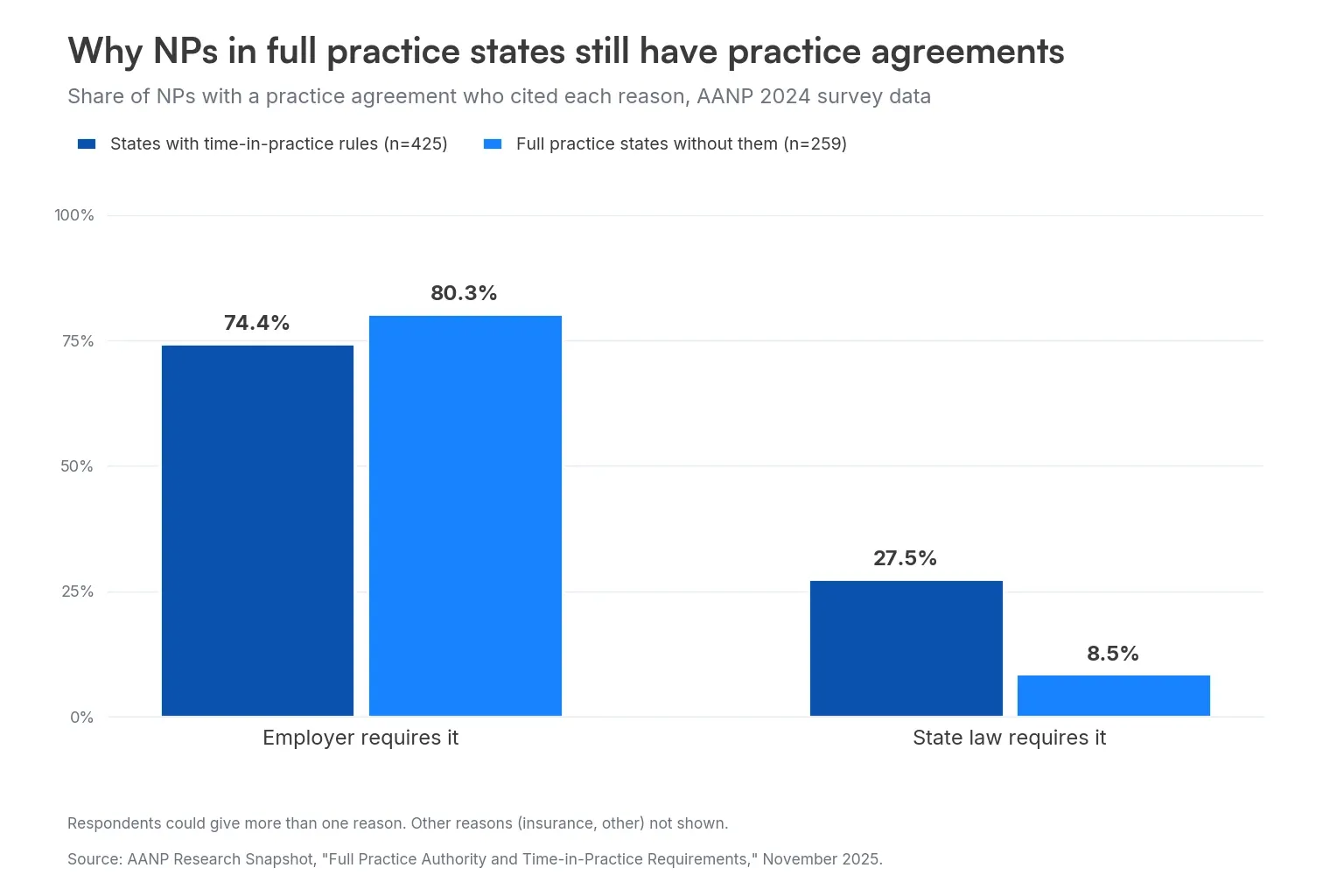
Your own policy can also be stricter than the law. AANP's November 2025 research snapshot looked at NPs in full practice states who still had a practice agreement. In its 2024 survey data, 74.4% of them in states with time-in-practice rules, and 80.3% in states without, said their employer required the agreement. AANP's advice to employers is to "evaluate the institutional value of retaining those requirements beyond the TIP period and consider retiring them." Whatever your organization decides, write the reason down for each state. A policy written for a reduced practice state can outlive the law that required it.
Transition-to-practice hours by state
Transition-to-practice (TTP) or time-in-practice requirements set how long an NP must practice under an agreement before practicing independently. AANP lists 11 full practice states with these requirements: Colorado, Connecticut, Maine, Maryland, Massachusetts, Minnesota, Nebraska, Nevada, New York, South Dakota and Vermont. Several states outside that list have hour thresholds too.
Use the table below as a verified starting point for NP scope of practice by state, then confirm the current text in the statute. Each row links to the official source it was checked against on the date shown.
| State | Requirement before practicing or prescribing without an agreement | Official source | Last verified |
|---|---|---|---|
| California | "103" NPs need a transition to practice in California of at least 3 full-time-equivalent years or 4,600 hours and work in specified settings. An NP with 3 full-time-equivalent years or 4,600 hours of direct patient care as an NP in the last 5 years may be deemed to have met it, and that path doesn't say the hours must be in California. A "104" NP needs at least 3 more years of practice beyond the transition to work outside those settings | Bus. & Prof. Code 2837.103 and 2837.104 | 2026-09-28 |
| Colorado | Practice is independent; full prescriptive authority follows a 750-hour prescribing mentorship, completed within 3 years of provisional prescriptive authority (C.R.S. 12-255-112) | Colorado Board of Nursing prescriptive authority summary | 2026-09-28 |
| Connecticut | At least 3 years and 2,000 hours in collaboration with a licensed physician | CT Department of Public Health | 2026-09-28 |
| Florida | Autonomous practice registration needs 3,000 hours of physician-supervised APRN practice in the prior 5 years (hours from any state count), graduate coursework in differential diagnosis and pharmacology, no discipline in the prior 5 years and proof of financial responsibility, and it's limited to primary care | Fla. Stat. 464.0123 | 2026-09-28 |
| Illinois | No written collaborative agreement after at least 4,000 hours of clinical experience following national certification plus 250 hours of CE or training, confirmed in a notarized attestation filed with the state | 225 ILCS 65/65-43 | 2026-09-28 |
| Maine | At least 24 months under a supervising physician or NP, or employment by a clinic or hospital with a physician medical director | 32 M.R.S. 2102 | 2026-09-28 |
| Maryland | New NPs identify a mentor on the certification application who consults and collaborates with them for 18 months; no collaborative agreement is required | Health Occ. 8-302.1 | 2026-09-28 |
| Massachusetts | Independent prescribing and test ordering after at least 2 years of supervised practice following certification | M.G.L. c. 112, 80E | 2026-09-28 |
| Minnesota | At least 2,080 hours under a collaborative agreement. Since Aug. 1, 2026 the hours no longer have to be in a hospital or integrated clinical setting, except for NPs providing services other than primary care or mental health, who must complete them in a setting where APRNs and physicians work together | Minnesota Board of Nursing guidance | 2026-09-28 |
| Nebraska | First 2,000 hours under a transition-to-practice agreement | Neb. Rev. Stat. 38-2322 (DHHS compilation) | 2026-09-28 |
| Nevada | Independent at licensure; Schedule II prescribing only after 2 years or 2,000 hours, or under a physician protocol | NRS 632.237 | 2026-09-28 |
| New Jersey | No joint protocol for APNs with more than 5,000 hours in a family or individual across the lifespan, adult-gerontology, pediatrics, women's health or behavioral health population focus who provide primary or behavioral health care (excludes general obstetrics and elective cosmetic services) | P.L. 2026, c.6 and governor's signing release | 2026-09-28 |
| New York | NPs with more than 3,600 hours are exempt from the written practice agreement and practice protocols, but they must keep collaborative relationships with a physician or hospital and complete and keep an attestation form describing them; the provision now runs until July 1, 2030 | Education Law 6902 (NYSED) | 2026-09-28 |
| Oklahoma | Independent prescriptive authority after 6,240 hours of physician-supervised prescribing; controlled substances limited to Schedules III-V; effective Nov. 1, 2025 | HB 2298 and Oklahoma Board of Nursing | 2026-09-28 |
| South Dakota | 1,040 licensed practice hours under a collaborative agreement | South Dakota Board of Nursing | 2026-09-28 |
| Vermont | 24 months and 2,400 hours in the initial role and population focus under a formal agreement, or 12 months and 1,600 hours for each additional role and population focus | 26 V.S.A. 1613 | 2026-09-28 |
| Virginia | Practice without a practice agreement after the equivalent of at least 3 years of full-time clinical experience, as determined by the boards, and an attestation from the patient care team physician or an attesting NP | Va. Code 54.1-2957 | 2026-09-28 |
| Wisconsin | Independent practice after 3,840 RN hours (nursing-program clinical hours can count) and 3,840 APRN hours working with a physician or dentist, each over at least 24 months. Invasive pain treatment generally still requires a collaborative relationship with a pain management physician. New APRN licenses from Sept. 1, 2026 | Legislative Council memo, 2025 Act 17 and Act 17 text | 2026-09-28 |
Where a row cites a bill, a chapter law, a memo or a guidance PDF, keep that document as the citation and put the monitor on a page that changes with the law. A fixed file stays frozen when the law changes, so a monitor on it stays silent. Use the board's APRN page or the statute section, and follow the legislature's bill-status page or the board's rulemaking page to see the next change coming.
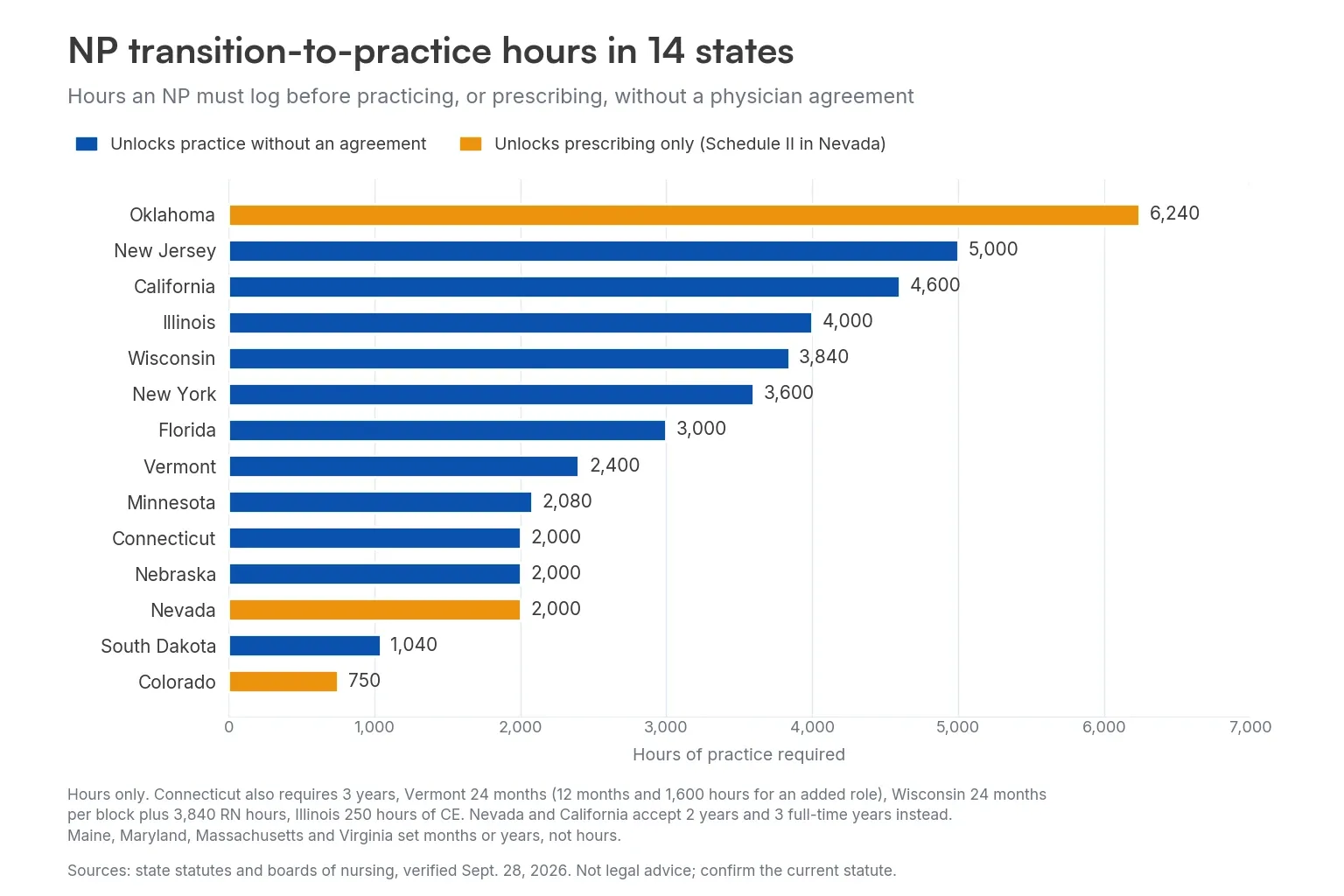
Two patterns from the table matter for staffing:
- Hours transfer differently from state to state. Florida counts clinical hours completed "in any state, jurisdiction, or territory." California defines its transition to practice as practice in California, but an NP with 3 full-time-equivalent years or 4,600 hours of direct patient care in the past 5 years may be deemed to have met it. Vermont counts hours in the NP's initial role and population focus, with a shorter requirement for each one added later. Read the counting rule as closely as the number.
- Thresholds get renegotiated. AANP describes time-in-practice rules as the product of "political compromises," so treat each number as something that can change at the next session.
New York shows what that looks like. Its rule letting NPs with more than 3,600 hours practice without a written agreement was set to expire on July 1, 2026. The Nurse Practitioner Association New York State raised the stakes in February 2026 testimony to the legislature's budget committees. If the law expired, it warned, "all NPs with more than 3,600 hours of practice would be forced to immediately establish collaborative relationships or cease providing care."
The enacted 2026-27 budget bill (A10007-C) extended the provision instead of making it permanent, and the statute text on the NYSED site now reads "Effective until July 1, 2030." For a credentialing team, the change that mattered showed up on the statute page, and the next date for the calendar is 2030. If you'd rather see a change like this while it's still a bill, pair the statute page with legislative tracking on the bills that carry it.
Telehealth across state lines: 3 rules to track
For NP telehealth, the rule of thumb is that the NP must meet the licensure and practice rules of the state where the patient is located. NCSBN's APRN resources describe the same principle for cross-border care. That creates three separate tracking jobs:
- Licensure: does the NP hold an APRN license (and, where required, a prescribing certificate) in the patient's state, or a telehealth registration where that state offers one?
- Practice rules: does the patient's state require an agreement, and does the NP's current agreement cover telehealth in that state?
- Prescribing: does the patient's state allow that drug and schedule by telehealth, and does the NP's DEA registration cover prescribing to a patient there? DEA's telemedicine rules set the federal conditions, and state limits apply on top of them.
Some states let a clinician licensed elsewhere treat their residents by telehealth under a registration instead of a full license. Florida's out-of-state telehealth provider registration and Arizona's interstate telehealth registration are two examples, and each comes with conditions. Florida's registrants, for example, can't open an office in the state or see patients there in person. Track each registration as its own credential.
State telehealth rules live in a mix of statutes, board position statements and Medicaid manuals, so they're among the hardest pages to follow by hand and the best candidates to monitor for regulatory changes automatically.
APRN Compact status: what to track while NCSBN redesigns it
The Nurse Licensure Compact (NLC) lets registered nurses and LPNs practice across member states with one license, but APRNs are not included in that compact. The separate APRN Compact would give APRNs a multistate license. Under its 2020 model text, it takes effect only once seven states have enacted it.
As of September 2026 the compact is not operational. NCSBN has announced four enactments: North Dakota and Delaware in 2021, Utah in 2022, and South Dakota, which NCSBN called "the fourth jurisdiction to enact the APRN Compact" in 2024. Some trackers also count Wyoming, but Wyoming's law (2016 HB 56) adopted an earlier version of the compact that needed 10 states to take effect. NCSBN has posted each enactment so far on its news page.
The bigger change is that NCSBN is rewriting the compact itself. At NCSBN's 2026 APRN Roundtable, its director of government affairs said the NCSBN Board of Directors "has charged NCSBN staff to work with boards of nursing to redesign the APRN compact. That process is underway now." No redesigned text had been announced on NCSBN's news page by late September 2026, so the new version's trigger, and whether the four enacting states would need to pass it again, are still open questions.
For credentialing teams the practical point hasn't changed. Until a compact is operational, every state an NP practices in still requires its own APRN license. Treating patients in a state by telehealth requires that state's license or, where the state offers one, a telehealth registration. That keeps multistate licensure a standing item in your compliance monitoring program. Put NCSBN's news page on your watch list with an "Alert me when" prompt such as "Alert me when NCSBN publishes a redesigned APRN Compact or a state enacts the APRN Compact." When a redesigned compact bill is filed in a state you staff, add that bill's status page on the legislature's site.

Catch board of nursing rule, renewal and CE changes
Many day-to-day scope changes come from boards of nursing: rules that carry out a new law, updated renewal requirements, or new continuing education mandates. The same page-monitoring approach used for government agency news and guidance works here. Common examples:
- A new CE topic mandate (for example, controlled substance prescribing, implicit bias or pain management hours) added at renewal.
- A change to the renewal cycle or deadline.
- A new application form or documentation requirement for prescriptive authority.
- A proposed rule that redefines what a collaborative agreement must contain.
One federal item belongs in the same file. Since June 27, 2023, DEA has required practitioners to confirm once, on their next registration or renewal form, that they've completed the MATE Act's eight hours of training on treating and managing patients with opioid or other substance use disorders. It's a one-time attestation, so check that it's on file for each DEA-registered NP.
Watch for a newer kind of rule too: a minimum amount of RN experience before an NP can be licensed or practice independently. Wisconsin's Act 17 requires 3,840 hours of RN clinical practice, which can include nursing-program clinical hours, before independent practice. At NCSBN's 2026 APRN Roundtable, its government affairs director said Utah and Alabama were also looking at RN experience hour requirements. A rule like that affects new-graduate hiring and initial credentialing as well as renewals.
What one rollout looked like: Wisconsin's new APRN license
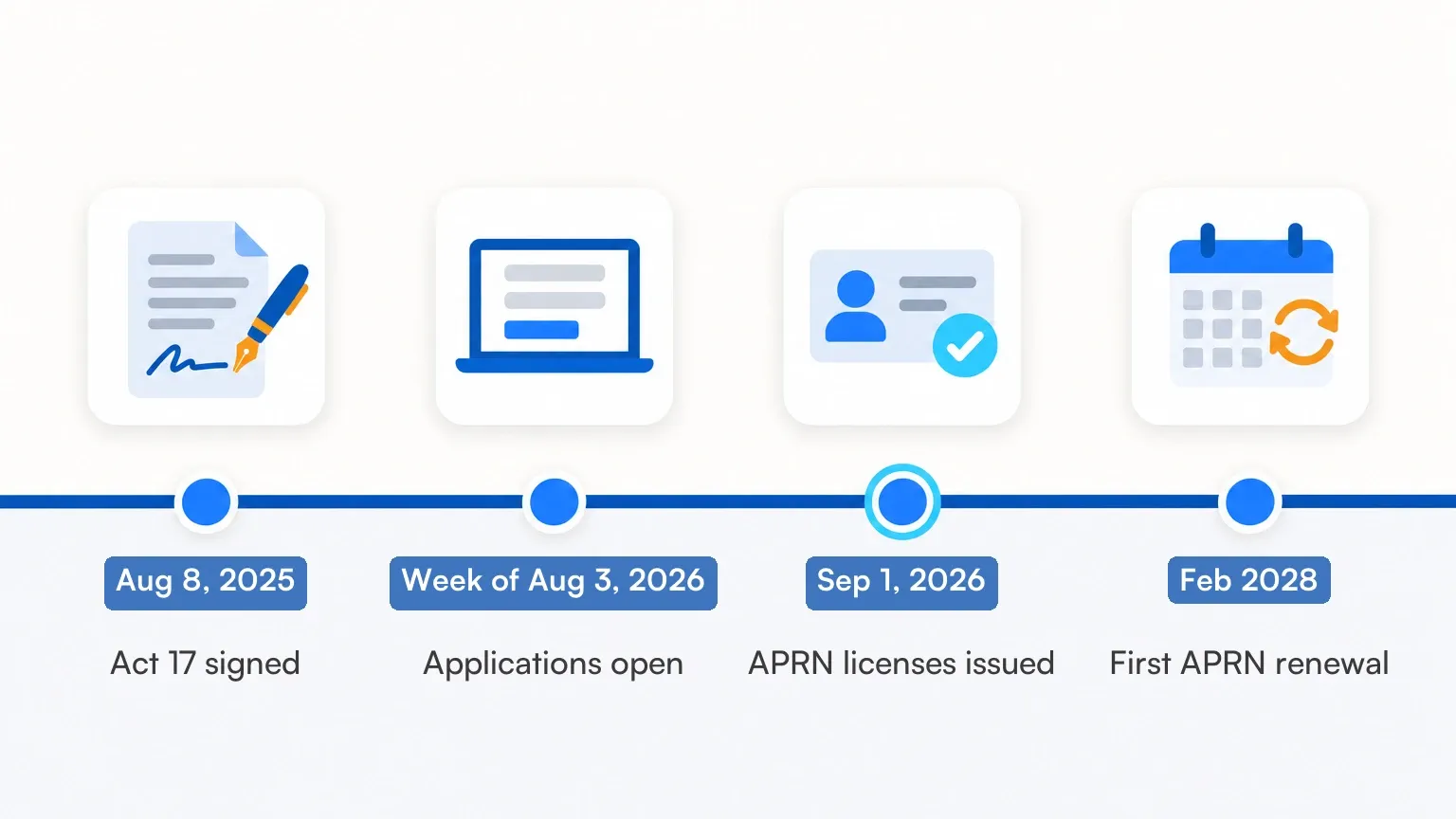
Wisconsin's 2025 Act 17 shows why the board's own pages matter more than the headline. The act was enacted on August 8, 2025. Most of the dates a credentialing team needed arrived over the next year on the Department of Safety and Professional Services (DSPS) website, much of it in the DSPS APRN implementation FAQ:
- The Board of Nursing adopted emergency rules to run the switch from advanced practice nurse prescriber (APNP) certification to APRN licensure.
- Applications for the new APRN license, and for independent practice, opened the week of August 3, 2026, with credentials issued on or after September 1, 2026.
- Existing APNP credentials converted automatically on September 1. DSPS asked holders to confirm the recognized role on file and warned that APRN licenses "may be delayed" for people who didn't respond and had no role on file.
- Independent practice needs a complete application with payment, and it starts only when the Board approves it, so the FAQ answers "No" to whether all APRNs could practice independently on September 1.
- APRN licenses renew every two years with at least 16 contact hours of CE in clinical pharmacology or therapeutics, according to the Legislative Council's Act 17 memo. DSPS says the first APRN renewal will coincide with the next RN renewal, in February 2028.
Even the addresses moved. By late September 2026, the old DSPS page that announced the August changes redirected to a new APRN page on a redesigned site. When a board redesigns its site, recheck that each monitored address still shows the text you care about. That's the kind of change a page monitor surfaces and a once-a-year policy review misses.
How much legislatures change
State legislatures stay busy too. The Federation of State Medical Boards' 2026 first-quarter legislative update listed 344 bills on health professionals' scope of practice (all professions, not only NPs), with 2 signed into law as of that update. Most bills die, so in a typical year tracking the enacted statute and the board's final rules tells you more than following every bill. If you do need bill-level tracking, see how to monitor state legislation pages as bills move.
Why the next two years may bring more NP scope bills
CMS's $50 billion Rural Health Transformation Program gives states a financial reason to change NP scope rules. Its notice of funding opportunity scores each state partly on scope of practice. That factor averages scores for four professions, and for NPs it uses AANP's practice environment ratings: 100 points for full practice, 50 for reduced and 0 for restricted. States could also earn credit by committing to change a policy, and CMS says it will recover the related payments from any state that doesn't finalize the legislative or regulatory action by December 31, 2027.
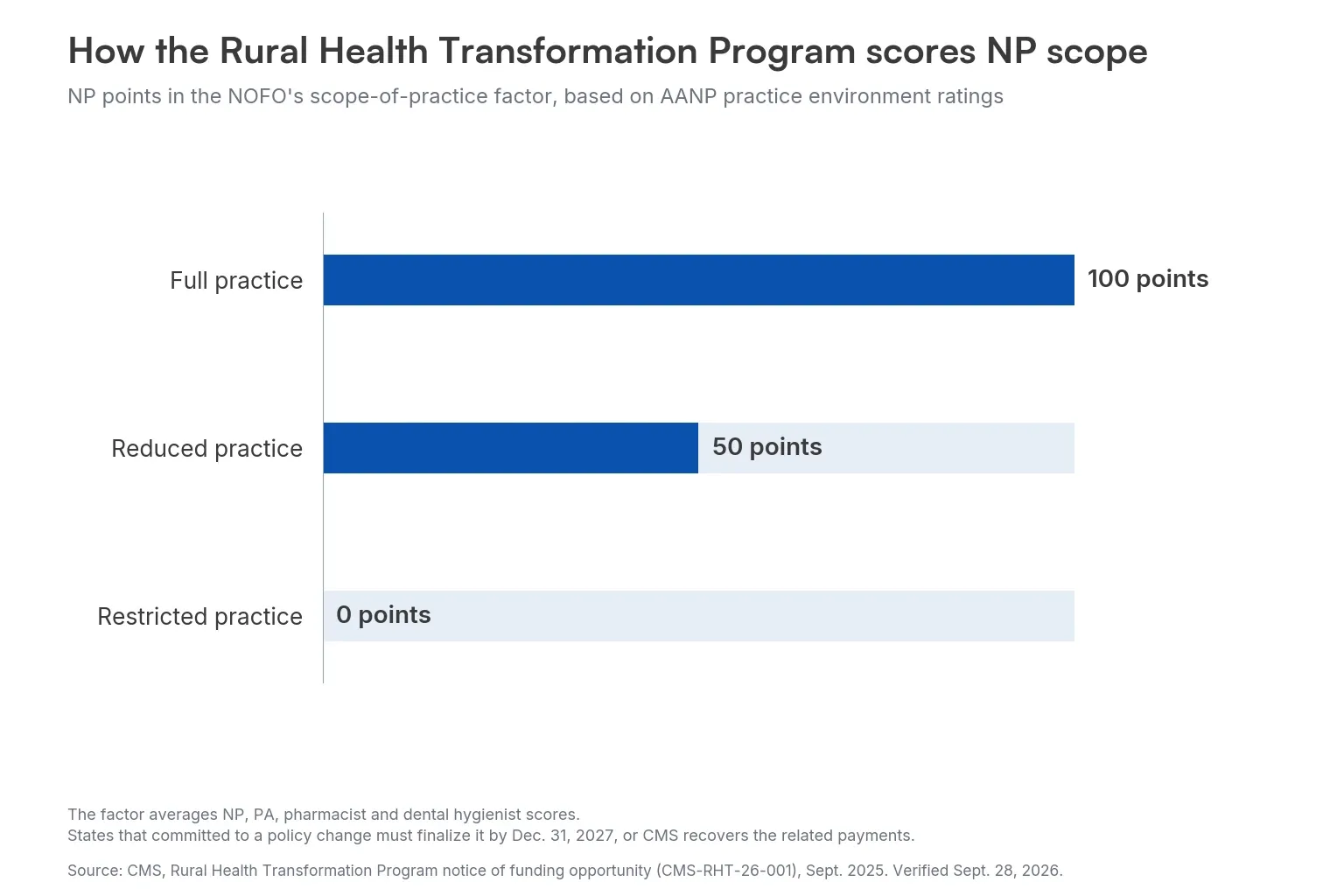
Source: CMS, Rural Health Transformation Program notice of funding opportunity CMS-RHT-26-001, scoring appendix, factor D.3 (scope of practice).
CMS's own summary of the state applications lists "NP Scope of Practice" among New Jersey's policy commitments and "full scope of practice for all professions" among Tennessee's. AANP lists Tennessee as restricted practice. If you staff NPs in a state that made a commitment like this, add the legislature's bill-status page for its scope bill and the state's Rural Health Transformation page to your watch list through 2027.
What a sample of Visualping board-page monitors showed
We looked at active Visualping monitors on U.S. state board of nursing pages that were set up at least 90 days before late September 2026: about 170 monitors across 11 accounts, with Visualping's internal accounts and some customer accounts excluded. Seven of the 11 accounts had at least one of those pages change in the past 90 days.
We count accounts rather than pages because the sample is concentrated. Two accounts that each watch dozens of board pages hold nearly three-quarters of the monitors, so a page-level percentage would mostly describe those two watch lists. Across the other nine accounts, which watch about 45 pages between them, a fifth to a third of the pages changed at least once in those 90 days. How many alerts you get depends on which pages you pick. Pages that collect many notices, such as board news or proposed rules, tend to update more often than a single statute section, so decide up front which pages deserve a daily check and which a weekly one.
Which pages to monitor in each state
Because NP scope of practice by state lives on so many different pages, use this watch list template for one state, then repeat it for each state in your footprint. One check before you add any page: open it and confirm the rule text, the requirement, or the list of notices appears on that page itself. Some board sites use landing pages that only link to the rules or to a PDF. A monitor on a landing page like that stays silent when the linked document changes, so monitor the page or file that carries the text.
| Priority | Page | Why it matters | Suggested check frequency |
|---|---|---|---|
| 1 | Board of nursing APRN practice page that states the requirements (hours, agreements, prescribing) in its own text | Where boards post APRN practice and prescribing updates | Daily |
| 2 | Board rulemaking page that lists proposed and adopted rules on the page | Shows changes before they take effect, with comment deadlines | Daily |
| 3 | Board of medicine or joint committee rule page, in states where agreement or prescribing rules sit there | Agreement rules the medical board writes or shares | Weekly |
| 4 | State administrative register, on its list of notices filtered to your board (confirm the notices appear on that page) | The legal notice of proposed, emergency and adopted rules, with comment deadlines | Weekly |
| 5 | Board meeting agendas and minutes page | Boards usually vote on rules at public meetings, so agendas show what's coming | Weekly |
| 6 | Legislature bill-status page for any live scope bill in your state | Shows a bill moving before it becomes law | Daily during session |
| 7 | Board renewal and CE requirements page (or the renewal PDF itself) | Renewal cycles and CE mandates | Weekly |
| 8 | State controlled substance registration page (often the pharmacy board or health department) | Schedule and registration changes | Weekly |
| 9 | The statute section pages that hold your state's NP rules on the legislature site (not the chapter index, which only lists links) | Confirms the enacted statute text | Weekly |
| 10 | State telehealth statute or board telehealth guidance, plus the telehealth registration page if the state has one | Cross-border rules and registration conditions | Weekly |
Add a few national pages once for the whole program. AANP's State Practice Environment page carries AANP's definitions and an "Updated" date. The state colors live in an interactive map, so for each state you staff, also monitor AANP's state page, such as the one for New Jersey, which gives the practice environment as text. NCSBN's news page lists APRN Compact enactments along with every other NCSBN announcement, so pair it with an "Alert me when" prompt about the APRN Compact. The HHS page on prescribing controlled substances via telehealth states the current DEA telemedicine flexibilities and their end date, and the Federal Register's list of DEA telemedicine documents is where DEA publishes new telemedicine rules and extensions. For CMS and Medicaid rules that affect NP billing, see our guide to Medicare and Medicaid policy changes.
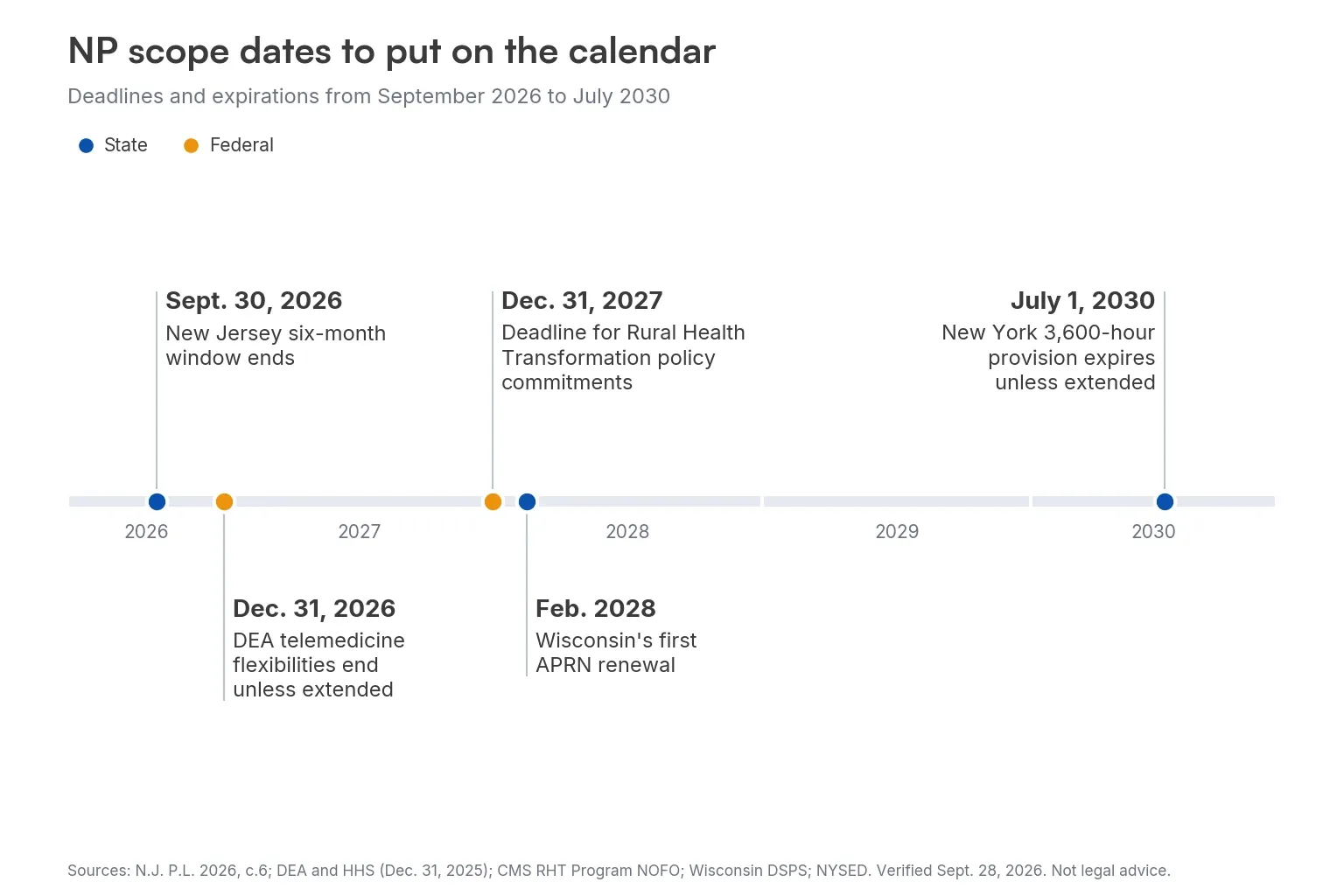
A few dates are worth putting on the calendar now:
- About September 30, 2026: the end of New Jersey's six-month window for APNs who were prescribing without a joint protocol under the COVID-era waivers and won't reach 5,000 hours within 12 months.
- December 31, 2026: DEA's current telemedicine flexibilities end unless they're extended again or replaced by a permanent rule.
- December 31, 2027: the deadline for states to finalize the policy changes they committed to under the Rural Health Transformation Program.
- February 2028: Wisconsin's first APRN license renewal.
- July 1, 2030: New York's 3,600-hour provision expires unless the legislature extends it again.
A 5-step system for tracking NP scope of practice changes
Step 1: Map where your NPs practice and where their patients are
List every state where an NP holds a license, every state with a practice location, and every state where telehealth patients are located. Telehealth states are easy to miss because no NP works there in person.
Step 2: Record the current rule for each of the seven areas
For each state, record the current practice authority, prescriptive authority, DEA and state registration, agreement rules, transition hours, telehealth rules, and renewal and CE requirements. Link each entry to the official page it came from. That link becomes the page you monitor, as long as the requirement appears on the page itself. If the source is a fixed file, such as a bill or memo PDF, monitor the statute, board or bill-status page instead.
Step 3: Monitor the source pages directly
Summaries of NP scope of practice by state from associations and vendors are useful for orientation, but they lag. Monitor the board, legislature and DEA pages directly, and use summaries only to find them. Our guide to tracking regulatory changes across multiple websites covers how to organize a watch list that spans dozens of sites.
Step 4: Give every page an owner and a response rule
Each monitored page needs a named owner and a rule for what happens on a change: who reviews it, within how many days, and which NP files, agreements or schedules get checked. That's the core of any regulatory change management process, applied to one profession.
The response rule should also cover the places a state change doesn't update on its own:
- In a hospital, NP privileges change only when the medical staff acts. Medicare's hospital conditions of participation have the medical staff recommend appointments "in accordance with State law, including scope-of-practice laws, and the medical staff bylaws, rules, and regulations" (42 CFR 482.22). The bylaws and the NP privilege forms may need to change before NPs can use a new authority.
- Update or retire the collaborative agreements, protocols and prescribing agreements the new rule affects.
- Check payer enrollment. Medicare Part B ties an NP's physician collaboration to the law of the state where the services are performed. Where a state has no collaboration law, the NP documents their scope of practice and their relationships with physicians (42 CFR 410.75). Check state Medicaid and commercial enrollment records too, for example any that list a collaborating physician.
- Keep running license, discipline and exclusion checks for each NP, such as Nursys e-Notify, NPDB Continuous Query and OIG and SAM exclusion screening. Page monitoring tracks the rules, and those checks track the person.
Step 5: Log each change against the NP files it affects
When a rule changes, record the date, the source link, the NPs affected and the action taken. That log is what you'll show an auditor or a payer when they ask how you stayed current. Visualping's dated before-and-after captures of each change can back it up, but they're kept for 3 months by default. On a Business plan you can set a monitor to keep them for 12 months, but only captures taken after you switch get the longer retention. Save a copy of each capture into the log when you record the change (see screenshots as evidence).
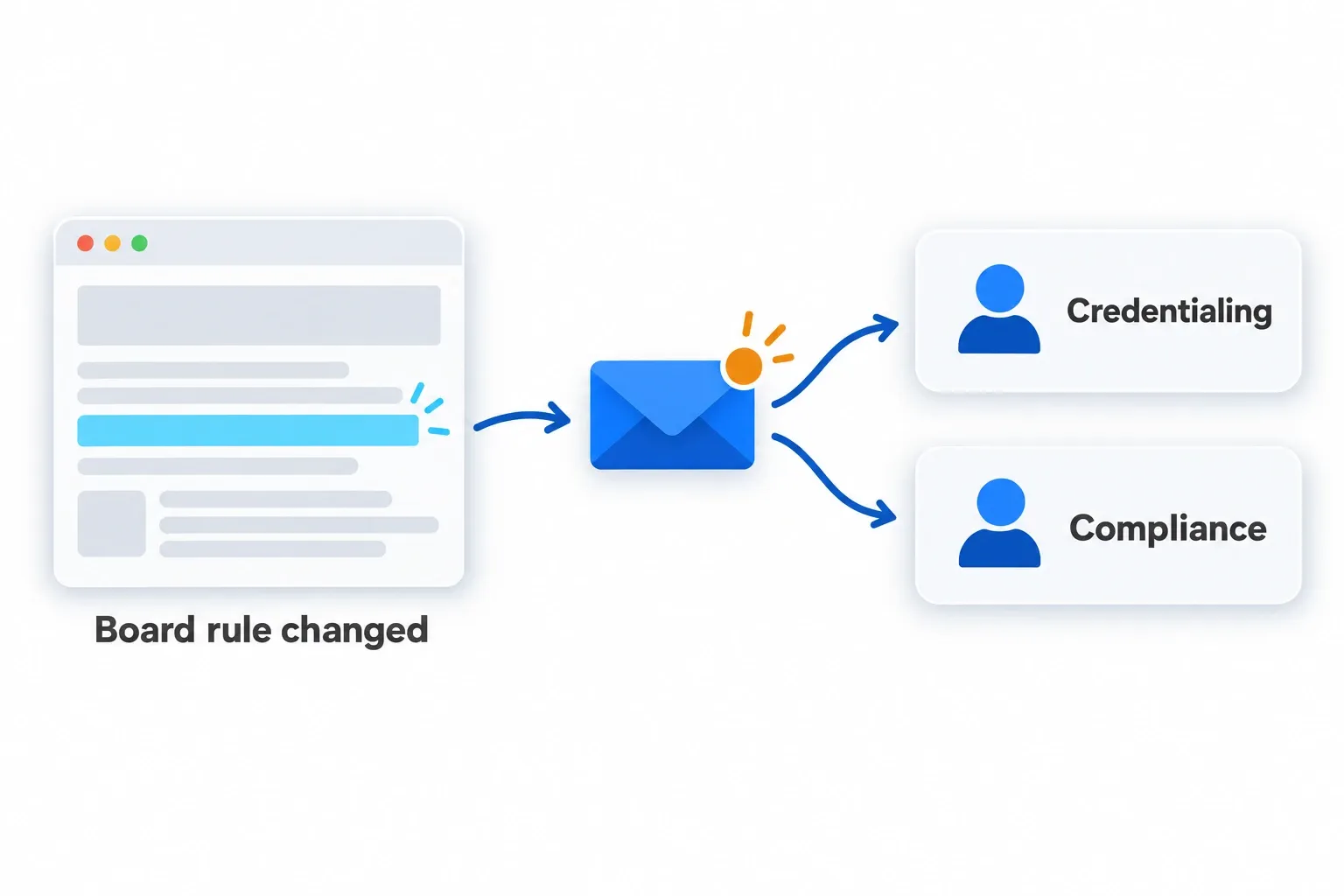
Ready to try this on your own state boards? Start with five pages free, such as the APRN practice page and the rulemaking page for your largest state.
Setting up scope-of-practice monitoring in Visualping
Watch the part of the page that matters
Board pages carry news tickers, event calendars and footers that change constantly. Select only the section that holds the rule or requirement, so the monitor ignores everything else. The setup steps are the same as for monitoring any web page with AI.
Tell Visualping AI what you care about
Use an "Alert me when" prompt instead of a plain change alert. For example: "Alert me when this page changes APRN prescriptive authority, collaborative practice requirements, transition-to-practice hours, or renewal and CE requirements. Ignore meeting dates and staff announcements." Every change still comes with a Visualping AI summary, and changes that match your prompt get flagged Important. (Keyword alerts are also available, but only in Text mode.) For more prompt patterns, see our playbook on prompts for Important alerts.
Use Actions for pages behind menus
Some boards hide rules behind accordions, tabs or "I agree" screens. Visualping Actions, available on every plan, can click through those steps before each check.
Cover PDFs and send alerts where the team works
Many boards publish rules and renewal checklists as PDFs. Visualping can monitor online PDFs, but it checks only the first 100 pages of each PDF, and in the default AI mode it skips the rest without a warning, so check the page count first. For a longer rule document, monitor the individual chapter file if it's under 100 pages. Add the board's rules index page too: it changes when the board posts a new version or revision date, though it won't show edits inside the PDF. A bill or memo PDF stays frozen once it's posted, so monitor the bill-status or rulemaking page instead.
If a board posts a list or roster as an Excel file, Visualping can monitor the file itself (ZIP archives aren't supported). The page that links to the file is usually the better target, and it's the only reliable one when the file's name or URL changes every renewal cycle.
Email alerts and webhooks work on every plan, and the Visualping API, also on all plans, lets you pull changes into a credentialing system or ticket queue. Slack, Microsoft Teams, Discord, Google Chat and Google Sheets alerts need a Business plan.
Frequently asked questions
What are full practice authority states?
Full practice authority states let NPs evaluate, diagnose, treat and prescribe under the board of nursing's licensure authority without a career-long physician agreement. AANP counted 27 states, D.C. and two territories in November 2025. Several have time-in-practice requirements first, so check the statute for the NP's experience level.
What does restricted practice mean for nurse practitioners?
In AANP's framework, restricted practice means state law requires career-long supervision, delegation or team management by another health provider for the NP to provide patient care.
What is a collaborative practice agreement for nurse practitioners?
It's a written agreement between an NP and a physician (or in some states an experienced NP) that sets how they consult, which prescribing the NP can do, and how charts get reviewed. In AANP's framework, reduced practice states require one for the NP's whole career or limit where NPs can practice. Many full practice states require one only during a transition period.
Can an NP prescribe controlled substances in another state?
For a practice location in another state, the NP needs prescriptive authority in that state and a DEA registration there, because DEA requires a separate registration in each state where a practitioner has a practice location. Telehealth prescribing to patients in other states follows DEA's telemedicine rules, currently extended through December 31, 2026, plus each state's limits, so confirm the setup with counsel.
Which states are APRN Compact states?
NCSBN has announced four enactments of the current compact: North Dakota, Delaware, Utah and South Dakota. That version needs seven states to take effect, but NCSBN said in 2026 that it's working with boards of nursing to redesign the compact, so the rules for joining may change. Until a compact is operational, APRNs need a license in each state where they practice, or a telehealth registration where a state offers one for out-of-state clinicians.
Can nurse practitioners do telehealth across state lines?
Generally only if they meet the licensure and practice rules of the state where the patient is located. That usually means an APRN license in that state, though some states, such as Florida and Arizona, register out-of-state clinicians for telehealth instead. Controlled substance prescribing by telehealth also depends on DEA rules, currently extended through December 31, 2026.
How does each state define nurse practitioner scope of practice?
Through its nurse practice act and its board of nursing rules, and sometimes through pharmacy, controlled substance and telehealth laws as well. For a national starting view of NP scope of practice by state, use AANP's State Practice Environment map, then confirm the details in the statute and on the board pages linked in the table above.
How often do NP scope of practice rules change?
Often. The AMA tracked at least 50 NP scope bills in at least 19 states in 2025, and boards of nursing adopt rules between sessions. Monitoring the source pages is more reliable than rechecking a summary once a year.
Start monitoring your largest state first
Tracking NP scope of practice by state doesn't have to start with all 50 states. Pick the state with the most NPs on your roster, set up monitors on its APRN practice page, rulemaking page and renewal page, and give each one an owner. Once that routine works, copy it to the next state. For the payer side of the same program, see our guide to Medicare and Medicaid policy changes.
For the contractor side, see our guide to Medicare administrative contractor updates.
Create a free Visualping account and monitor your first five pages free.
Want to monitor web changes that impact your business?
Sign up with Visualping to get alerted of important updates from anywhere online.
Eric Do Couto
Eric Do Couto is the Head of Marketing at Visualping. He leads content strategy, growth operations, and brand positioning for website change detection.
More articles by Eric Do Couto